

V I I . DESERT FISHES
391
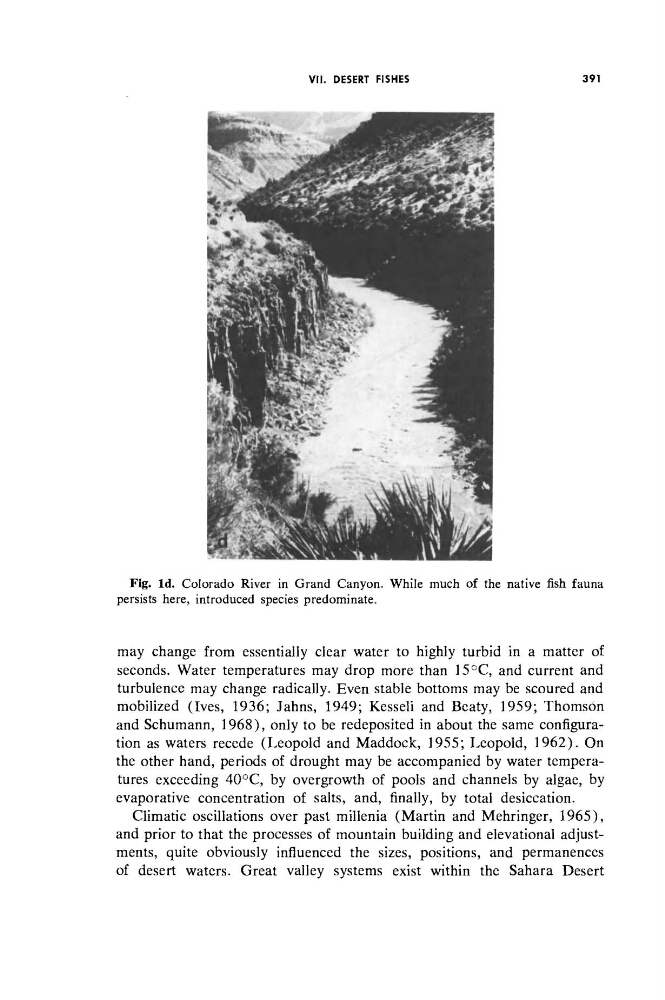
Fig. Id. Colorado River in Grand Canyon. While much of the native fish fauna
persists here, introduced species predominate.
may change from essentially clear water to highly turbid in a matter of
seconds. Water temperatures may drop more than 15°C, and current and
turbulence may change radically. Even stable bottoms may be scoured and
mobilized (Ives, 1936; Jahns, 1949; Kesseli and Beaty, 1959; Thomson
and Schumann, 1968), only to be redeposited in about the same configuration as waters recede (Leopold and Maddock, 1955; Leopold, 1962). On
the other hand, periods of drought may be accompanied by water temperatures exceeding 40°C, by overgrowth of pools and channels by algae, by
evaporative concentration of salts, and, finally, by total desiccation.
Climatic oscillations over past millenia (Martin and Mehringer, 1965),
and prior to that the processes of mountain building and elevational adjustments, quite obviously influenced the sizes, positions, and permanences
of desert waters. Great valley systems exist within the Sahara Desert
391
Fig. Id. Colorado River in Grand Canyon. While much of the native fish fauna
persists here, introduced species predominate.
may change from essentially clear water to highly turbid in a matter of
seconds. Water temperatures may drop more than 15°C, and current and
turbulence may change radically. Even stable bottoms may be scoured and
mobilized (Ives, 1936; Jahns, 1949; Kesseli and Beaty, 1959; Thomson
and Schumann, 1968), only to be redeposited in about the same configuration as waters recede (Leopold and Maddock, 1955; Leopold, 1962). On
the other hand, periods of drought may be accompanied by water temperatures exceeding 40°C, by overgrowth of pools and channels by algae, by
evaporative concentration of salts, and, finally, by total desiccation.
Climatic oscillations over past millenia (Martin and Mehringer, 1965),
and prior to that the processes of mountain building and elevational adjustments, quite obviously influenced the sizes, positions, and permanences
of desert waters. Great valley systems exist within the Sahara Desert