

362
E. B. EDNEY
Beetles alive
Beetles dead
Beetles alive, carbon coated
Incident angle of sun (deg)
Incident angle of sun (deg) V
Incident angle of sun (deg)
0
45
90
135
180
0
45
90
135
180
0
45
90
135
180
Time
Time
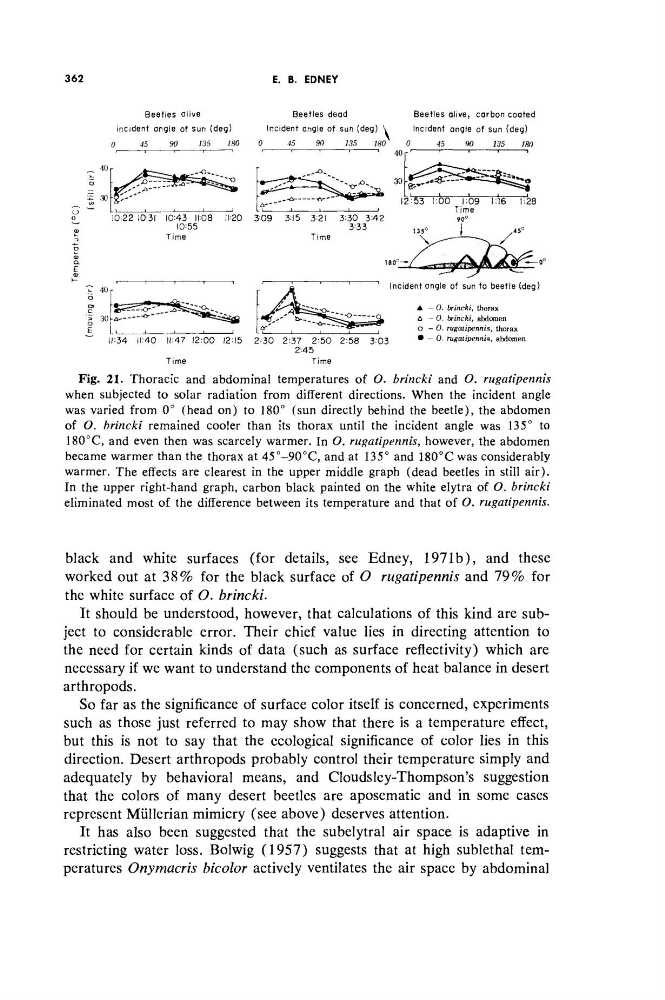
Fig. 21. Thoracic and abdominal temperatures of O. brincki and O. rugatipennis
when subjected to solar radiation from different directions. When the incident angle
was varied from 0° (head on) to 180° (sun directly behind the beetle), the abdomen
of O. brincki remained cooler than its thorax until the incident angle was 135° to
180°C, and even then was scarcely warmer. In O. rugatipennis, however, the abdomen
became warmer than the thorax at 45°-90°C, and at 135° and 180°C was considerably
warmer. The effects are clearest in the upper middle graph (dead beetles in still air).
In the upper right-hand graph, carbon black painted on the white elytra of O. brincki
eliminated most of the difference between its temperature and that of O. rugatipennis.
black and white surfaces (for details, see Edney, 1971b), and these
worked out at 38% for the black surface of O rugatipennis and 79% for
the white surface of O. brincki.
It should be understood, however, that calculations of this kind are subject to considerable error. Their chief value lies in directing attention to
the need for certain kinds of data (such as surface reflectivity) which are
necessary if we want to understand the components of heat balance in desert
arthropods.
So far as the significance of surface color itself is concerned, experiments
such as those just referred to may show that there is a temperature effect,
but this is not to say that the ecological significance of color lies in this
direction. Desert arthropods probably control their temperature simply and
adequately by behavioral means, and Cloudsley-Thompson's suggestion
that the colors of many desert beetles are aposematic and in some cases
represent Miillerian mimicry (see above) deserves attention.
It has also been suggested that the subelytral air space is adaptive in
restricting water loss. Bolwig (1957) suggests that at high sublethal temperatures Onymacris bicolor actively ventilates the air space by abdominal
E. B. EDNEY
Beetles alive
Beetles dead
Beetles alive, carbon coated
Incident angle of sun (deg)
Incident angle of sun (deg) V
Incident angle of sun (deg)
0
45
90
135
180
0
45
90
135
180
0
45
90
135
180
Time
Time
Fig. 21. Thoracic and abdominal temperatures of O. brincki and O. rugatipennis
when subjected to solar radiation from different directions. When the incident angle
was varied from 0° (head on) to 180° (sun directly behind the beetle), the abdomen
of O. brincki remained cooler than its thorax until the incident angle was 135° to
180°C, and even then was scarcely warmer. In O. rugatipennis, however, the abdomen
became warmer than the thorax at 45°-90°C, and at 135° and 180°C was considerably
warmer. The effects are clearest in the upper middle graph (dead beetles in still air).
In the upper right-hand graph, carbon black painted on the white elytra of O. brincki
eliminated most of the difference between its temperature and that of O. rugatipennis.
black and white surfaces (for details, see Edney, 1971b), and these
worked out at 38% for the black surface of O rugatipennis and 79% for
the white surface of O. brincki.
It should be understood, however, that calculations of this kind are subject to considerable error. Their chief value lies in directing attention to
the need for certain kinds of data (such as surface reflectivity) which are
necessary if we want to understand the components of heat balance in desert
arthropods.
So far as the significance of surface color itself is concerned, experiments
such as those just referred to may show that there is a temperature effect,
but this is not to say that the ecological significance of color lies in this
direction. Desert arthropods probably control their temperature simply and
adequately by behavioral means, and Cloudsley-Thompson's suggestion
that the colors of many desert beetles are aposematic and in some cases
represent Miillerian mimicry (see above) deserves attention.
It has also been suggested that the subelytral air space is adaptive in
restricting water loss. Bolwig (1957) suggests that at high sublethal temperatures Onymacris bicolor actively ventilates the air space by abdominal