

360
E. B. EDNEY
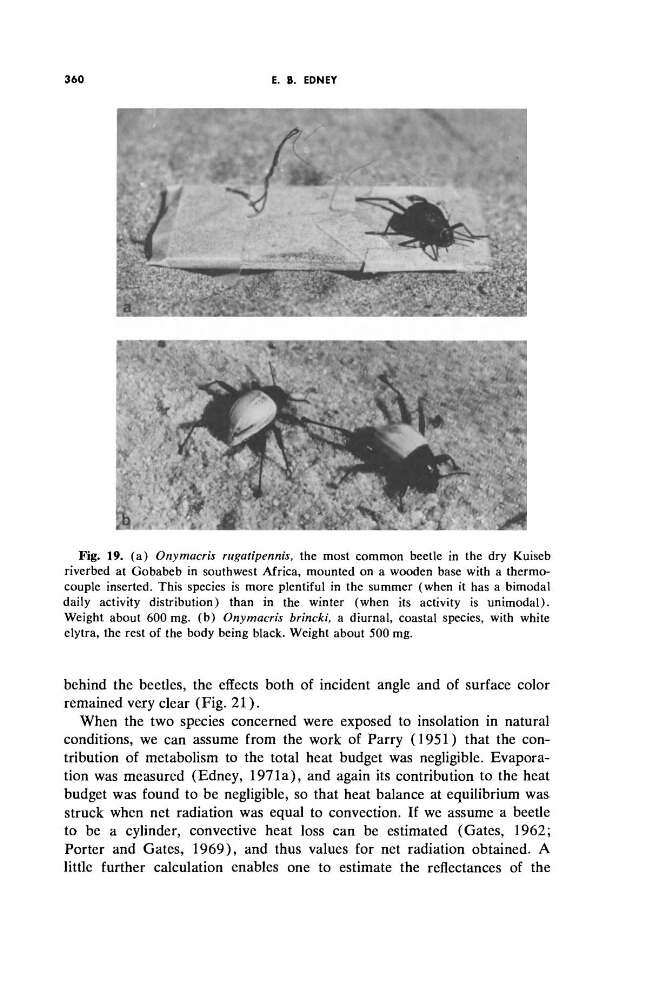
Fig. 19. (a) Onymacris rugatipennis, the most common beetle in the dry Kuiseb
riverbed at Gobabeb in southwest Africa, mounted on a wooden base with a thermocouple inserted. This species is more plentiful in the summer (when it has a bimodal
daily activity distribution) than in the winter (when its activity is unimodal).
Weight about 600 mg. (b) Onymacris brincki, a diurnal, coastal species, with white
elytra, the rest of the body being black. Weight about 500 mg.
behind the beetles, the effects both of incident angle and of surface color
remained very clear (Fig. 21 ).
When the two species concerned were exposed to insolation in natural
conditions, we can assume from the work of Parry (1951) that the contribution of metabolism to the total heat budget was negligible. Evaporation was measured (Edney, 1971a), and again its contribution to the heat
budget was found to be negligible, so that heat balance at equilibrium was
struck when net radiation was equal to convection. If we assume a beetle
to be a cylinder, convective heat loss can be estimated (Gates, 1962;
Porter and Gates., 1969), and thus values for net radiation obtained. A
little further calculation enables one to estimate the reflectances of the
E. B. EDNEY
Fig. 19. (a) Onymacris rugatipennis, the most common beetle in the dry Kuiseb
riverbed at Gobabeb in southwest Africa, mounted on a wooden base with a thermocouple inserted. This species is more plentiful in the summer (when it has a bimodal
daily activity distribution) than in the winter (when its activity is unimodal).
Weight about 600 mg. (b) Onymacris brincki, a diurnal, coastal species, with white
elytra, the rest of the body being black. Weight about 500 mg.
behind the beetles, the effects both of incident angle and of surface color
remained very clear (Fig. 21 ).
When the two species concerned were exposed to insolation in natural
conditions, we can assume from the work of Parry (1951) that the contribution of metabolism to the total heat budget was negligible. Evaporation was measured (Edney, 1971a), and again its contribution to the heat
budget was found to be negligible, so that heat balance at equilibrium was
struck when net radiation was equal to convection. If we assume a beetle
to be a cylinder, convective heat loss can be estimated (Gates, 1962;
Porter and Gates., 1969), and thus values for net radiation obtained. A
little further calculation enables one to estimate the reflectances of the