

VI. DESERT ARTHROPODS
351
couples inserted directly into the thoracic musculature, they measured body
temperatures in a variety of situations. In an environment where air movement and direct solar radiation were both very low they found that large
hoppers (nymphs) had temperatures up to 3°C higher than ambient if the
latter was about 22°C, but the excess decreased with rising ambient temperature to 31°C, above which there was actually a body temperature
depression of a few degrees. The reason for these differences is not clear—
perhaps metabolism is involved, but the temperature depression effect
suggests evaporative cooling. However, in direct sunlight there was no
difference between temperature excess in different humidities.
When exposed to solar radiation, temperature excesses were larger (up
to 8°C) in large hoppers than in small ones (2.5°C), and the latter were
established more quickly (1 minute compared with 15 minutes), as would
be expected on physical grounds. Stower and Griffiths found ambient air
temperature to be the most important of all factors in determining a resting
locust's temperature. Attitude to the sun's rays was very important, and
produced temperature differences up to 6°C in hoppers. The question of
surface color will be considered below.
These conclusions were, in general, borne out by thermal energy balance
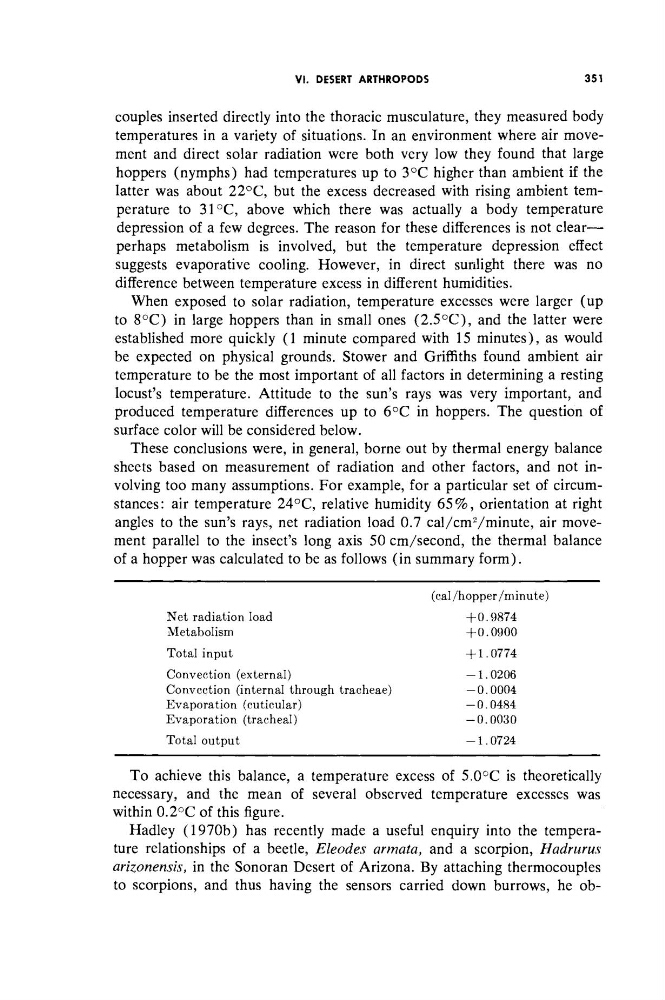
sheets based on measurement of radiation and other factors, and not involving too many assumptions. For example, for a particular set of circumstances: air temperature 24°C, relative humidity 6 5 % , orientation at right
angles to the sun's rays, net radiation load 0.7 cal/cm
2
/minute, air movement parallel to the insect's long axis 50 cm/second, the thermal balance
of a hopper was calculated to be as follows (in summary form).
(cal /hopper /minute)
Net radiation load
+ 0.9874
Metabolism
+ 0 . 0 9 0 0
Total input
+ 1 . 0 7 7 4
Convection (external)
— 1.0206
Convection (internal through tracheae)
—0.0004
Evaporation (cuticular)
—0.0484
Evaporation (trachéal)
—0.0030
Total output
- 1 . 0 7 2 4
To achieve this balance, a temperature excess of 5.0°C is theoretically
necessary, and the mean of several observed temperature excesses was
within 0.2°C of this figure.
Hadley (1970b) has recently made a useful enquiry into the temperature relationships of a beetle, Eleodes armata, and a scorpion, Hadrurus
arizonensis, in the Sonoran Desert of Arizona. By attaching thermocouples
to scorpions, and thus having the sensors carried down burrows, he ob-
351
couples inserted directly into the thoracic musculature, they measured body
temperatures in a variety of situations. In an environment where air movement and direct solar radiation were both very low they found that large
hoppers (nymphs) had temperatures up to 3°C higher than ambient if the
latter was about 22°C, but the excess decreased with rising ambient temperature to 31°C, above which there was actually a body temperature
depression of a few degrees. The reason for these differences is not clear—
perhaps metabolism is involved, but the temperature depression effect
suggests evaporative cooling. However, in direct sunlight there was no
difference between temperature excess in different humidities.
When exposed to solar radiation, temperature excesses were larger (up
to 8°C) in large hoppers than in small ones (2.5°C), and the latter were
established more quickly (1 minute compared with 15 minutes), as would
be expected on physical grounds. Stower and Griffiths found ambient air
temperature to be the most important of all factors in determining a resting
locust's temperature. Attitude to the sun's rays was very important, and
produced temperature differences up to 6°C in hoppers. The question of
surface color will be considered below.
These conclusions were, in general, borne out by thermal energy balance
sheets based on measurement of radiation and other factors, and not involving too many assumptions. For example, for a particular set of circumstances: air temperature 24°C, relative humidity 6 5 % , orientation at right
angles to the sun's rays, net radiation load 0.7 cal/cm
2
/minute, air movement parallel to the insect's long axis 50 cm/second, the thermal balance
of a hopper was calculated to be as follows (in summary form).
(cal /hopper /minute)
Net radiation load
+ 0.9874
Metabolism
+ 0 . 0 9 0 0
Total input
+ 1 . 0 7 7 4
Convection (external)
— 1.0206
Convection (internal through tracheae)
—0.0004
Evaporation (cuticular)
—0.0484
Evaporation (trachéal)
—0.0030
Total output
- 1 . 0 7 2 4
To achieve this balance, a temperature excess of 5.0°C is theoretically
necessary, and the mean of several observed temperature excesses was
within 0.2°C of this figure.
Hadley (1970b) has recently made a useful enquiry into the temperature relationships of a beetle, Eleodes armata, and a scorpion, Hadrurus
arizonensis, in the Sonoran Desert of Arizona. By attaching thermocouples
to scorpions, and thus having the sensors carried down burrows, he ob-