

332
E. B. EDNEY
be little doubt that the use of desert species in further elucidation of the
problems would be desirable and probably very profitable.
E. REABSORPTION OF WATER FROM THE RECTAL LUMEN
We must now consider in greater detail what is known of the mechanisms of reabsorption of water from the rectal lumen, as illustrated by
work on the desert locust and other insects.
Reabsorption of water by the rectum has been elegantly demonstrated
in the locust by Phillips (1964). He ligated the rectum from the more
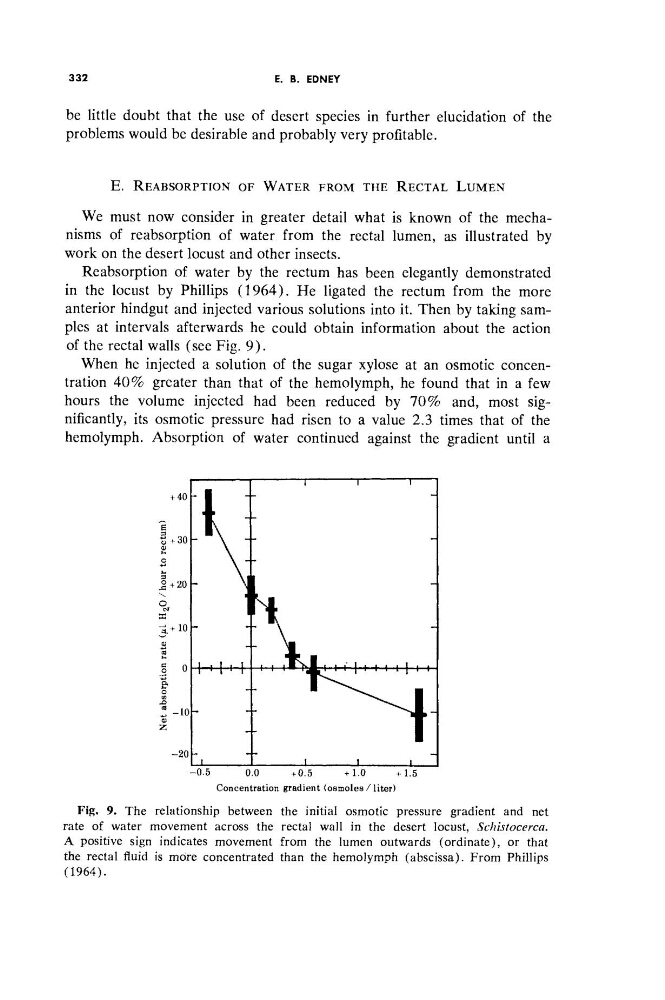
anterior hindgut and injected various solutions into it. Then by taking samples at intervals afterwards he could obtain information about the action
of the rectal walls (see Fig. 9).
When he injected a solution of the sugar xylose at an osmotic concentration 40% greater than that of the hemolymph, he found that in a few
hours the volume injected had been reduced by 70% and, most significantly, its osmotic pressure had risen to a value 2.3 times that of the
hemolymph. Absorption of water continued against the gradient until a
-0.5
0.0
+0.5
+1.0
+1.5
Concentration gradient (osmoles / liter)
Fig. 9. The relationship between the initial osmotic pressure gradient and net
rate of water movement across the rectal wall in the desert locust, Schistocerca.
A positive sign indicates movement from the lumen outwards (ordinate), or that
the rectal fluid is more concentrated than the hemolymph (abscissa). From Phillips
(1964).
E. B. EDNEY
be little doubt that the use of desert species in further elucidation of the
problems would be desirable and probably very profitable.
E. REABSORPTION OF WATER FROM THE RECTAL LUMEN
We must now consider in greater detail what is known of the mechanisms of reabsorption of water from the rectal lumen, as illustrated by
work on the desert locust and other insects.
Reabsorption of water by the rectum has been elegantly demonstrated
in the locust by Phillips (1964). He ligated the rectum from the more
anterior hindgut and injected various solutions into it. Then by taking samples at intervals afterwards he could obtain information about the action
of the rectal walls (see Fig. 9).
When he injected a solution of the sugar xylose at an osmotic concentration 40% greater than that of the hemolymph, he found that in a few
hours the volume injected had been reduced by 70% and, most significantly, its osmotic pressure had risen to a value 2.3 times that of the
hemolymph. Absorption of water continued against the gradient until a
-0.5
0.0
+0.5
+1.0
+1.5
Concentration gradient (osmoles / liter)
Fig. 9. The relationship between the initial osmotic pressure gradient and net
rate of water movement across the rectal wall in the desert locust, Schistocerca.
A positive sign indicates movement from the lumen outwards (ordinate), or that
the rectal fluid is more concentrated than the hemolymph (abscissa). From Phillips
(1964).