

330
E. B. EDNEY
and referred to on p. 334]. This function is reserved for the rectum, where
selective absorption, regulatory in effect, occurs. However, the tubule plays
a part in overall osmotic regulation by affecting the rate of secretion, and
the balance between this and the rate of reabsorption in the rectum determines the final rate of elimination.
The tsetse fly provides a good example of an insect's ability to regulate
its excretory loss of water when short of this material. Flies usually feed
on blood at intervals of 3 or 4 days, and since blood contains much water
there is a temporary excess after feeding and this has to be voided. Bursell
(1960) found that this primary excretion, which takes place during the
first few hours after feeding, is adjusted in amount to the water needs of
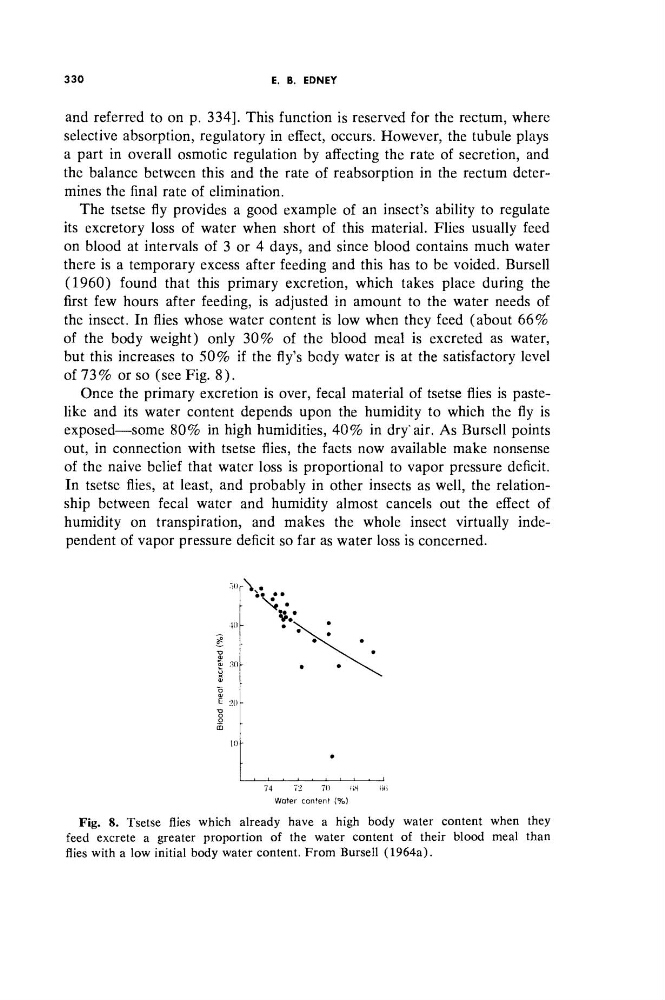
the insect. In flies whose water content is low when they feed (about 66%
of the body weight) only 30% of the blood meal is excreted as water,
but this increases to 50% if the fly's body water is at the satisfactory level
of 73 % or so (see Fig. 8 ).
Once the primary excretion is over, fecal material of tsetse flies is pastelike and its water content depends upon the humidity to which the fly is
exposed—some 80% in high humidities, 40% in dry*air. As Bursell points
out, in connection with tsetse flies, the facts now available make nonsense
of the naive belief that water loss is proportional to vapor pressure deficit.
In tsetse flies, at least, and probably in other insects as well, the relationship between fecal water and humidity almost cancels out the effect of
humidity on transpiration, and makes the whole insect virtually independent of vapor pressure deficit so far as water loss is concerned.
74
72
70
(W <><;
Water content (%)
Fig. 8. Tsetse flies which already have a high body water content when they
feed excrete a greater proportion of the water content of their blood meal than
flies with a low initial body water content. From Bursell (1964a).
E. B. EDNEY
and referred to on p. 334]. This function is reserved for the rectum, where
selective absorption, regulatory in effect, occurs. However, the tubule plays
a part in overall osmotic regulation by affecting the rate of secretion, and
the balance between this and the rate of reabsorption in the rectum determines the final rate of elimination.
The tsetse fly provides a good example of an insect's ability to regulate
its excretory loss of water when short of this material. Flies usually feed
on blood at intervals of 3 or 4 days, and since blood contains much water
there is a temporary excess after feeding and this has to be voided. Bursell
(1960) found that this primary excretion, which takes place during the
first few hours after feeding, is adjusted in amount to the water needs of
the insect. In flies whose water content is low when they feed (about 66%
of the body weight) only 30% of the blood meal is excreted as water,
but this increases to 50% if the fly's body water is at the satisfactory level
of 73 % or so (see Fig. 8 ).
Once the primary excretion is over, fecal material of tsetse flies is pastelike and its water content depends upon the humidity to which the fly is
exposed—some 80% in high humidities, 40% in dry*air. As Bursell points
out, in connection with tsetse flies, the facts now available make nonsense
of the naive belief that water loss is proportional to vapor pressure deficit.
In tsetse flies, at least, and probably in other insects as well, the relationship between fecal water and humidity almost cancels out the effect of
humidity on transpiration, and makes the whole insect virtually independent of vapor pressure deficit so far as water loss is concerned.
74
72
70
(W <><;
Water content (%)
Fig. 8. Tsetse flies which already have a high body water content when they
feed excrete a greater proportion of the water content of their blood meal than
flies with a low initial body water content. From Bursell (1964a).