

292
H. WALTER AND E. STADELMANN
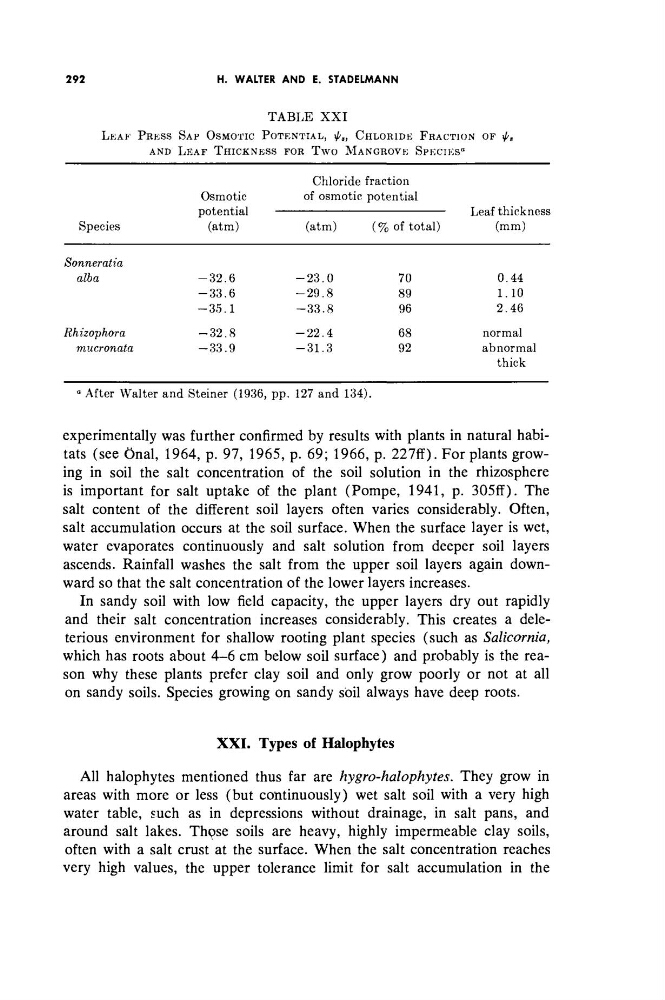
TABLE X X I
L E A F P R E S S SAP OSMOTIC POTENTIAL, ψ„ CHLORIDE FRACTION OF \J/8
AND L E A F THICKNESS FOR T W O MANGROVE SPECIES"
Species
Sonneratia
alba
Rhizophora
mucronata
Osmotic
potential
(atm)
- 3 2 . 6
- 3 3 . 6
- 3 5 . 1
- 3 2 . 8
- 3 3 . 9
Chloride fraction
of osmotic potential
(atm)
- 2 3 . 0
- 2 9 . 8
- 3 3 . 8
- 2 2 . 4
- 3 1 . 3
(% of total)
70
89
96
68
92
Leaf thickness
(mm)
0.44
1.10
2.46
normal
abnormal
thick
a After Walter and Steiner (1936, pp. 127 and 134).
experimentally was further confirmed by results with plants in natural habitats (see önal, 1964, p. 97, 1965, p. 69; 1966, p. 227ff). For plants growing in soil the salt concentration of the soil solution in the rhizosphere
is important for salt uptake of the plant (Pompe, 1941, p. 305ff). The
salt content of the different soil layers often varies considerably. Often,
salt accumulation occurs at the soil surface. When the surface layer is wet,
water evaporates continuously and salt solution from deeper soil layers
ascends. Rainfall washes the salt from the upper soil layers again downward so that the salt concentration of the lower layers increases.
In sandy soil with low field capacity, the upper layers dry out rapidly
and their salt concentration increases considerably. This creates a deleterious environment for shallow rooting plant species (such as Salicornia,
which has roots about 4-6 cm below soil surface) and probably is the reason why these plants prefer clay soil and only grow poorly or not at all
on sandy soils. Species growing on sandy soil always have deep roots.
XXI. Types of Halophytes
All halophytes mentioned thus far are hygro-halophytes. They grow in
areas with more or less (but continuously) wet salt soil with a very high
water table, such as in depressions without drainage, in salt pans, and
around salt lakes. Thçse soils are heavy, highly impermeable clay soils,
often with a salt crust at the surface. When the salt concentration reaches
very high values, the upper tolerance limit for salt accumulation in the
H. WALTER AND E. STADELMANN
TABLE X X I
L E A F P R E S S SAP OSMOTIC POTENTIAL, ψ„ CHLORIDE FRACTION OF \J/8
AND L E A F THICKNESS FOR T W O MANGROVE SPECIES"
Species
Sonneratia
alba
Rhizophora
mucronata
Osmotic
potential
(atm)
- 3 2 . 6
- 3 3 . 6
- 3 5 . 1
- 3 2 . 8
- 3 3 . 9
Chloride fraction
of osmotic potential
(atm)
- 2 3 . 0
- 2 9 . 8
- 3 3 . 8
- 2 2 . 4
- 3 1 . 3
(% of total)
70
89
96
68
92
Leaf thickness
(mm)
0.44
1.10
2.46
normal
abnormal
thick
a After Walter and Steiner (1936, pp. 127 and 134).
experimentally was further confirmed by results with plants in natural habitats (see önal, 1964, p. 97, 1965, p. 69; 1966, p. 227ff). For plants growing in soil the salt concentration of the soil solution in the rhizosphere
is important for salt uptake of the plant (Pompe, 1941, p. 305ff). The
salt content of the different soil layers often varies considerably. Often,
salt accumulation occurs at the soil surface. When the surface layer is wet,
water evaporates continuously and salt solution from deeper soil layers
ascends. Rainfall washes the salt from the upper soil layers again downward so that the salt concentration of the lower layers increases.
In sandy soil with low field capacity, the upper layers dry out rapidly
and their salt concentration increases considerably. This creates a deleterious environment for shallow rooting plant species (such as Salicornia,
which has roots about 4-6 cm below soil surface) and probably is the reason why these plants prefer clay soil and only grow poorly or not at all
on sandy soils. Species growing on sandy soil always have deep roots.
XXI. Types of Halophytes
All halophytes mentioned thus far are hygro-halophytes. They grow in
areas with more or less (but continuously) wet salt soil with a very high
water table, such as in depressions without drainage, in salt pans, and
around salt lakes. Thçse soils are heavy, highly impermeable clay soils,
often with a salt crust at the surface. When the salt concentration reaches
very high values, the upper tolerance limit for salt accumulation in the