

284
H. WALTER AND E. STADELMANN
than plants grown in KC1 or NaCl of the same concentration (Mozafar
et al, 1970, p. 479). Contrary to Heimann (1966), sodium ions cannot
be considered to be particularly deleterious to plants and the effect of high
soil salt contents on plants certainly is not merely caused by the Na ion.
For effect of the salts on the soil and its structure see also Section XVIII.
The effect of the Cl ion can only be counterbalanced by the S0 4
2
~ anion
(cf. Walter, 1960, p. 487; Karmarkar and Joshi, 1969, p. 46), since the
sulfate ion has a dehydrating effect on colloids (Walter, 1936, p. 186;
Strogonov, 1964, pp. 253 and 254). Unfortunately the sulfate ions are
taken up by plants mostly in very small amounts, and are used as a supply
of sulfur for synthesis of amino acids for proteins and enzymes containing
sulfo or sulfhydryl groups.
The Cl ion cannot be considered to be highly toxic to protoplasm since
Cl~ is found in all plants and accumulates to very high concentrations in
the cell sap of salt resistant plants. However, the Cl ion has a specific (not
only osmotic) effect on the protoplasm. A visible manifestation of this
effect is the increase of succulence of leaves (see Biebl and Kinzel, 1965, p.
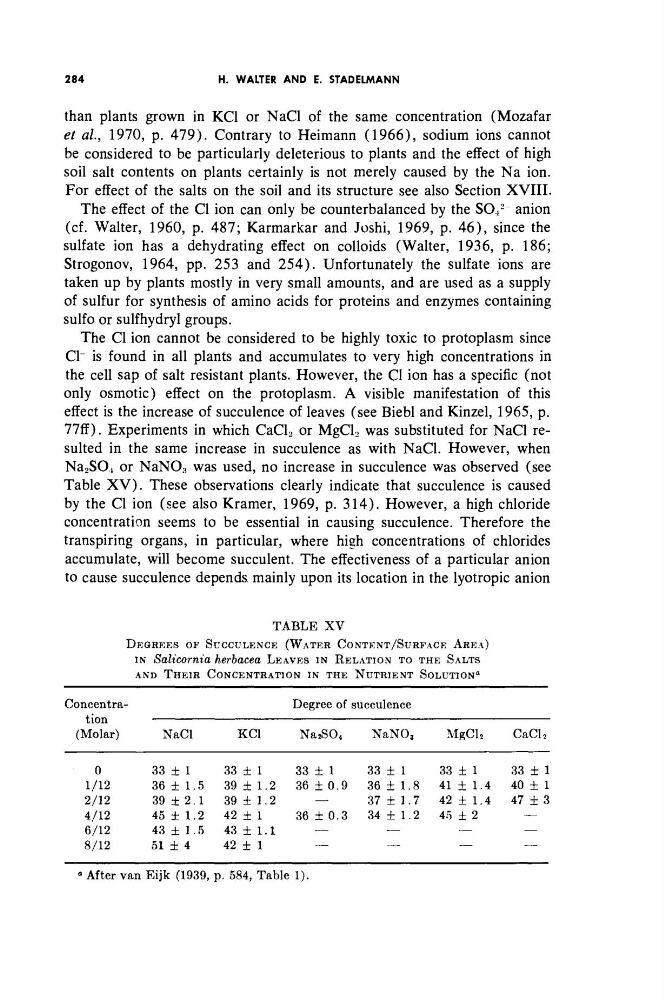
77ff). Experiments in which CaCL or MgCL was substituted for NaCl resulted in the same increase in succulence as with NaCl. However, when
Na 2 SO t or NaN0 3 was used, no increase in succulence was observed (see
Table XV). These observations clearly indicate that succulence is caused
by the Cl ion (see also Kramer, 1969, p. 314). However, a high chloride
concentration seems to be essential in causing succulence. Therefore the
transpiring organs, in particular, where high concentrations of chlorides
accumulate, will become succulent. The effectiveness of a particular anion
to cause succulence depends mainly upon its location in the lyotropic anion
TABLE X V
D E G R E E S O F SUCCULENCE ( W A T E R C O N T E N T / S U R F A C E A R E A )
IN Salicornia herbacea LEAVES IN RELATION TO THE SALTS
AND T H E I R CONCENTRATION IN THE N U T R I E N T SOLUTION"
Concentration
(Molar)
0
1/12
2/12
4/12
6/12
8/12
NaCl
33 ± 1
3 6 + 1 . 5
39 ± 2 . 1
45 ± 1.2
43 ± 1.5
51 ± 4
KC1
33 ± 1
39 + 1.
39 + 1.
42 + 1
43 + 1.
42 + 1
2
2
1
Degree of succulence
N a 2 S 0 4
33 + 1
36 ± 0 . 9
—
36 + 0 . 3
—
—
N a N 0 3
33 + 1
3 6 + 1 . 8
37 + 1.7
34 + 1.2
—
—
MgCl 2
33 + 1
4 1 + 1 . 4
42 + 1.4
45 + 2
—
—
CaCl 2
33 + 1
40 ± 1
4 7 + 3
—
—
—
° After van Eijk (1939, p . 584, Table 1).
H. WALTER AND E. STADELMANN
than plants grown in KC1 or NaCl of the same concentration (Mozafar
et al, 1970, p. 479). Contrary to Heimann (1966), sodium ions cannot
be considered to be particularly deleterious to plants and the effect of high
soil salt contents on plants certainly is not merely caused by the Na ion.
For effect of the salts on the soil and its structure see also Section XVIII.
The effect of the Cl ion can only be counterbalanced by the S0 4
2
~ anion
(cf. Walter, 1960, p. 487; Karmarkar and Joshi, 1969, p. 46), since the
sulfate ion has a dehydrating effect on colloids (Walter, 1936, p. 186;
Strogonov, 1964, pp. 253 and 254). Unfortunately the sulfate ions are
taken up by plants mostly in very small amounts, and are used as a supply
of sulfur for synthesis of amino acids for proteins and enzymes containing
sulfo or sulfhydryl groups.
The Cl ion cannot be considered to be highly toxic to protoplasm since
Cl~ is found in all plants and accumulates to very high concentrations in
the cell sap of salt resistant plants. However, the Cl ion has a specific (not
only osmotic) effect on the protoplasm. A visible manifestation of this
effect is the increase of succulence of leaves (see Biebl and Kinzel, 1965, p.
77ff). Experiments in which CaCL or MgCL was substituted for NaCl resulted in the same increase in succulence as with NaCl. However, when
Na 2 SO t or NaN0 3 was used, no increase in succulence was observed (see
Table XV). These observations clearly indicate that succulence is caused
by the Cl ion (see also Kramer, 1969, p. 314). However, a high chloride
concentration seems to be essential in causing succulence. Therefore the
transpiring organs, in particular, where high concentrations of chlorides
accumulate, will become succulent. The effectiveness of a particular anion
to cause succulence depends mainly upon its location in the lyotropic anion
TABLE X V
D E G R E E S O F SUCCULENCE ( W A T E R C O N T E N T / S U R F A C E A R E A )
IN Salicornia herbacea LEAVES IN RELATION TO THE SALTS
AND T H E I R CONCENTRATION IN THE N U T R I E N T SOLUTION"
Concentration
(Molar)
0
1/12
2/12
4/12
6/12
8/12
NaCl
33 ± 1
3 6 + 1 . 5
39 ± 2 . 1
45 ± 1.2
43 ± 1.5
51 ± 4
KC1
33 ± 1
39 + 1.
39 + 1.
42 + 1
43 + 1.
42 + 1
2
2
1
Degree of succulence
N a 2 S 0 4
33 + 1
36 ± 0 . 9
—
36 + 0 . 3
—
—
N a N 0 3
33 + 1
3 6 + 1 . 8
37 + 1.7
34 + 1.2
—
—
MgCl 2
33 + 1
4 1 + 1 . 4
42 + 1.4
45 + 2
—
—
CaCl 2
33 + 1
40 ± 1
4 7 + 3
—
—
—
° After van Eijk (1939, p . 584, Table 1).