

274
H. WALTER AND E. STADELMANN
280
2V0
200
ISO
120
80
W
0
280
2V0
200
180
120
80
UO
0
O
x:
M
fc
"V .
σ»
£
-^ Φ ω o
o>
ω
O
I
Light-dark time (hours)
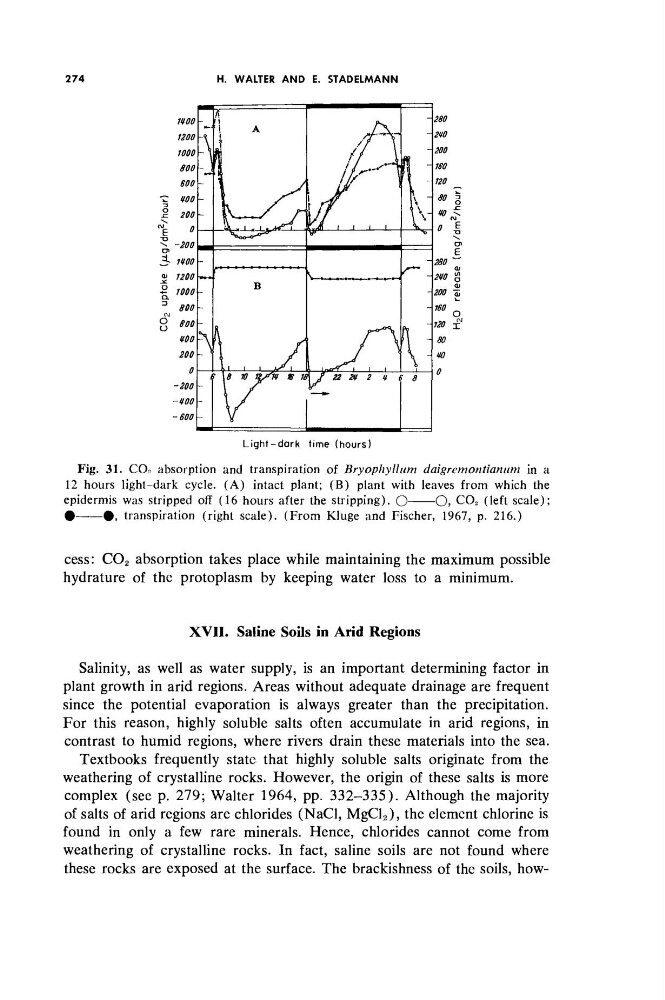
Fig. 31. CO.. absorption and transpiration of Bryophylhim daigremontianum in a
12 hours light-dark cycle. (A) intact plant; (B) plant with leaves from which the
epidermis was stripped off (16 hours after the stripping). O
O, C0 2 (left scale);
#
# , transpiration (right scale). (From Kluge and Fischer, 1967, p. 216.)
cess: C 0 2 absorption takes place while maintaining the maximum possible
hydrature of the protoplasm by keeping water loss to a minimum.
XVII. Saline Soils in Arid Regions
Salinity, as well as water supply, is an important determining factor in
plant growth in arid regions. Areas without adequate drainage are frequent
since the potential evaporation is always greater than the precipitation.
For this reason, highly soluble salts often accumulate in arid regions, in
contrast to humid regions, where rivers drain these materials into the sea.
Textbooks frequently state that highly soluble salts originate from the
weathering of crystalline rocks. However, the origin of these salts is more
complex (see p. 279; Walter 1964, pp. 332-335). Although the majority
of salts of arid regions are chlorides (NaCl, MgCl 2 ), the element chlorine is
found in only a few rare minerals. Hence, chlorides cannot come from
weathering of crystalline rocks. In fact, saline soils are not found where
these rocks are exposed at the surface. The brackishness of the soils, how-
H. WALTER AND E. STADELMANN
280
2V0
200
ISO
120
80
W
0
280
2V0
200
180
120
80
UO
0
O
x:
M
fc
"V .
σ»
£
-^ Φ ω o
o>
ω
O
I
Light-dark time (hours)
Fig. 31. CO.. absorption and transpiration of Bryophylhim daigremontianum in a
12 hours light-dark cycle. (A) intact plant; (B) plant with leaves from which the
epidermis was stripped off (16 hours after the stripping). O
O, C0 2 (left scale);
#
# , transpiration (right scale). (From Kluge and Fischer, 1967, p. 216.)
cess: C 0 2 absorption takes place while maintaining the maximum possible
hydrature of the protoplasm by keeping water loss to a minimum.
XVII. Saline Soils in Arid Regions
Salinity, as well as water supply, is an important determining factor in
plant growth in arid regions. Areas without adequate drainage are frequent
since the potential evaporation is always greater than the precipitation.
For this reason, highly soluble salts often accumulate in arid regions, in
contrast to humid regions, where rivers drain these materials into the sea.
Textbooks frequently state that highly soluble salts originate from the
weathering of crystalline rocks. However, the origin of these salts is more
complex (see p. 279; Walter 1964, pp. 332-335). Although the majority
of salts of arid regions are chlorides (NaCl, MgCl 2 ), the element chlorine is
found in only a few rare minerals. Hence, chlorides cannot come from
weathering of crystalline rocks. In fact, saline soils are not found where
these rocks are exposed at the surface. The brackishness of the soils, how-