

V. NEW APPROACH TO WATER RELATIONS OF DESERT PLANTS
269
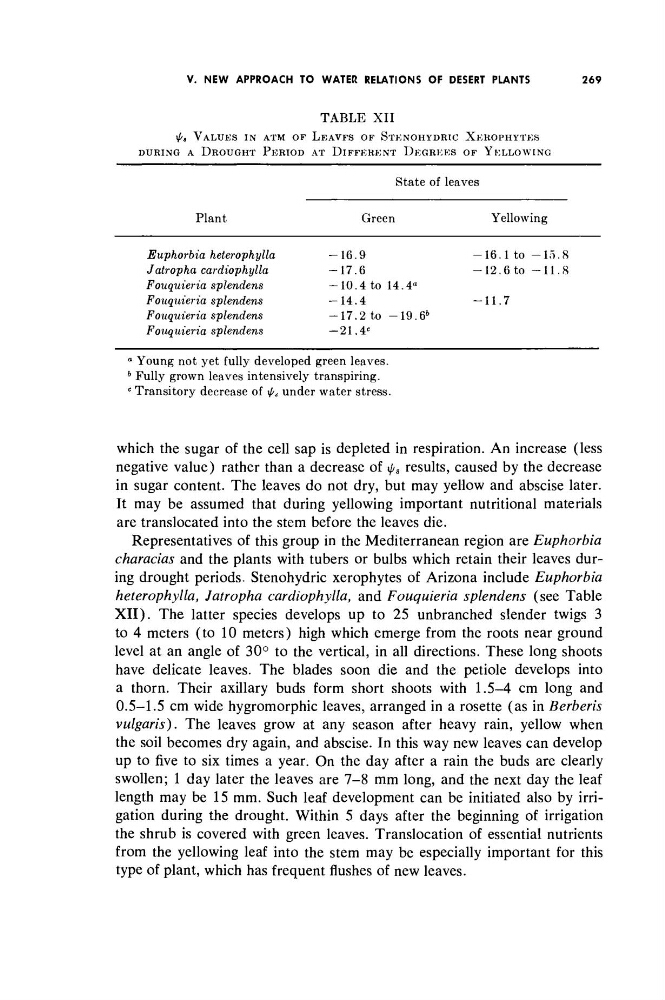
TABLE X I I
φ8 VALUES IN ATM OF LEAVFS OF STENOHYDRIC X E R O P H Y T E S
DURING A DROUGHT P E R I O D AT D I F F E R E N T D E G R E E S OF YELLOWING
Plant
Euphorbia heterophylla
Jatropha cardiophylla
Fouquieria splendens
Fouquieria splendens
Fouquieria splendens
Fouquieria splendens
State of leaves
Green
Yellowing
- 1 6 . 9
- 1 6 . 1 to - 1 5 . 8
- 1 7 . 6
- 1 2 . 6 t o - 1 1 . 8
- 1 0 . 4 to 14.4«
- 1 4 . 4
- 1 1 . 7
- 1 7 . 2 to - 1 9 . 6
6
- 2 1 . 4
C
α Young not yet fully developed green leaves.
6 Fully grown leaves intensively transpiring.
c Transitory decrease of φ* under water stress.
which the sugar of the cell sap is depleted in respiration. An increase (less
negative value) rather than a decrease of ψ 8 results, caused by the decrease
in sugar content. The leaves do not dry, but may yellow and abscise later.
It may be assumed that during yellowing important nutritional materials
are translocated into the stem before the leaves die.
Representatives of this group in the Mediterranean region are Euphorbia
characias and the plants with tubers or bulbs which retain their leaves during drought periods. Stenohydric xerophytes of Arizona include Euphorbia
heterophylla, Jatropha cardiophylla, and Fouquieria splendens (see Table
XII). The latter species develops up to 25 unbranched slender twigs 3
to 4 meters (to 10 meters) high which emerge from the roots near ground
level at an angle of 30° to the vertical, in all directions. These long shoots
have delicate leaves. The blades soon die and the petiole develops into
a thorn. Their axillary buds form short shoots with 1.5-4 cm long and
0.5-1.5 cm wide hygromorphic leaves, arranged in a rosette (as in Berberis
vulgaris). The leaves grow at any season after heavy rain, yellow when
the soil becomes dry again, and abscise. In this way new leaves can develop
up to five to six times a year. On the day after a rain the buds are clearly
swollen; 1 day later the leaves are 7-8 mm long, and the next day the leaf
length may be 15 mm. Such leaf development can be initiated also by irrigation during the drought. Within 5 days after the beginning of irrigation
the shrub is covered with green leaves. Translocation of essential nutrients
from the yellowing leaf into the stem may be especially important for this
type of plant, which has frequent flushes of new leaves.
269
TABLE X I I
φ8 VALUES IN ATM OF LEAVFS OF STENOHYDRIC X E R O P H Y T E S
DURING A DROUGHT P E R I O D AT D I F F E R E N T D E G R E E S OF YELLOWING
Plant
Euphorbia heterophylla
Jatropha cardiophylla
Fouquieria splendens
Fouquieria splendens
Fouquieria splendens
Fouquieria splendens
State of leaves
Green
Yellowing
- 1 6 . 9
- 1 6 . 1 to - 1 5 . 8
- 1 7 . 6
- 1 2 . 6 t o - 1 1 . 8
- 1 0 . 4 to 14.4«
- 1 4 . 4
- 1 1 . 7
- 1 7 . 2 to - 1 9 . 6
6
- 2 1 . 4
C
α Young not yet fully developed green leaves.
6 Fully grown leaves intensively transpiring.
c Transitory decrease of φ* under water stress.
which the sugar of the cell sap is depleted in respiration. An increase (less
negative value) rather than a decrease of ψ 8 results, caused by the decrease
in sugar content. The leaves do not dry, but may yellow and abscise later.
It may be assumed that during yellowing important nutritional materials
are translocated into the stem before the leaves die.
Representatives of this group in the Mediterranean region are Euphorbia
characias and the plants with tubers or bulbs which retain their leaves during drought periods. Stenohydric xerophytes of Arizona include Euphorbia
heterophylla, Jatropha cardiophylla, and Fouquieria splendens (see Table
XII). The latter species develops up to 25 unbranched slender twigs 3
to 4 meters (to 10 meters) high which emerge from the roots near ground
level at an angle of 30° to the vertical, in all directions. These long shoots
have delicate leaves. The blades soon die and the petiole develops into
a thorn. Their axillary buds form short shoots with 1.5-4 cm long and
0.5-1.5 cm wide hygromorphic leaves, arranged in a rosette (as in Berberis
vulgaris). The leaves grow at any season after heavy rain, yellow when
the soil becomes dry again, and abscise. In this way new leaves can develop
up to five to six times a year. On the day after a rain the buds are clearly
swollen; 1 day later the leaves are 7-8 mm long, and the next day the leaf
length may be 15 mm. Such leaf development can be initiated also by irrigation during the drought. Within 5 days after the beginning of irrigation
the shrub is covered with green leaves. Translocation of essential nutrients
from the yellowing leaf into the stem may be especially important for this
type of plant, which has frequent flushes of new leaves.