

V. NEW APPROACH TO WATER RELATIONS OF DESERT PLANTS
265
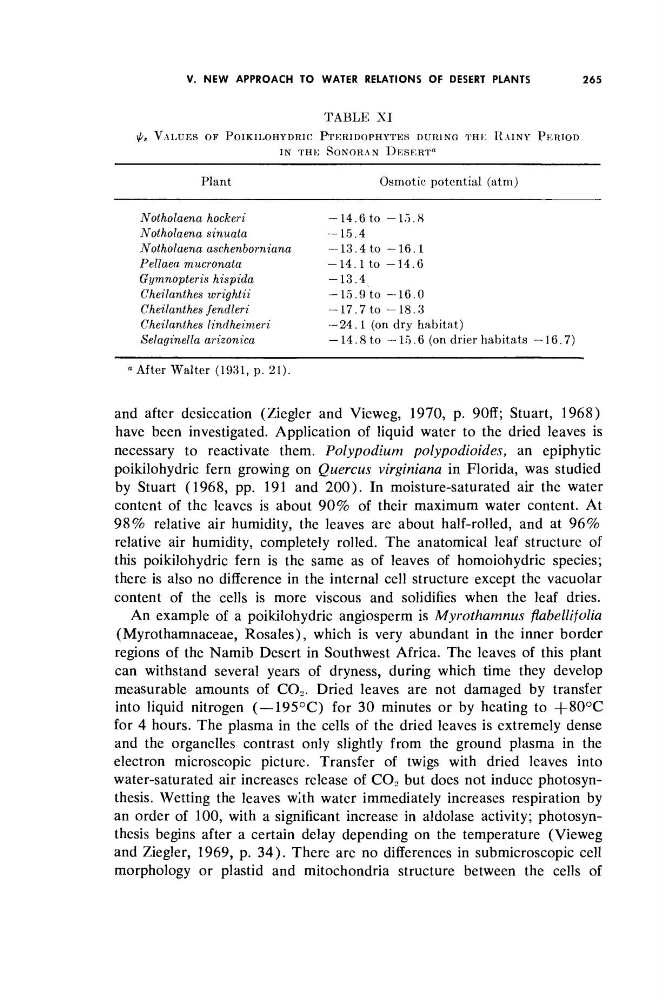
TABLE X I
\ps VALUES OF POIKILOHYDRIC PTERIDOPHYTES DURING THE RAINY P E R I O D
IN THE SO NORA N DESERT"
Plant
Osmotic potential (atm)
Notholaena hockeri
—14.6 to —15.8
Notholaena sinuata
—15.4
Notholaena aschenborniana
—13.4 to —16.1
Pellaea mucronata
— 14.1 to —14.6
Gymnopteris hispida
—13.4
Chélianthes wrightii
—15.9 to —16.0
Chélianthes fendleri
—17.7 to —18.3
Cheilanthes lindheimeri
—24.1 (on dry habitat)
Selaginella arizonica
—14.8 to —15.6 (on drier habitats —16.7)
a After Walter (1931, p . 21).
and after desiccation (Ziegler and Vieweg, 1970, p. 90ff; Stuart, 1968)
have been investigated. Application of liquid water to the dried leaves is
necessary to reactivate them. Polypodium polypodioides, an epiphytic
poikilohydric fern growing on Quercus virginiana in Florida, was studied
by Stuart (1968, pp. 191 and 200). In moisture-saturated air the water
content of the leaves is about 90% of their maximum water content. At
98% relative air humidity, the leaves are about half-rolled, and at 96%
relative air humidity, completely rolled. The anatomical leaf structure of
this poikilohydric fern is the same as of leaves of homoiohydric species;
there is also no difference in the internal cell structure except the vacuolar
content of the cells is more viscous and solidifies when the leaf dries.
An example of a poikilohydric angiosperm is Myrothamnus flabellifolia
(Myrothamnaceae, Rosales), which is very abundant in the inner border
regions of the Namib Desert in Southwest Africa. The leaves of this plant
can withstand several years of dryness, during which time they develop
measurable amounts of C0 2 . Dried leaves are not damaged by transfer
into liquid nitrogen ( —195°C) for 30 minutes or by heating to + 8 0 ° C
for 4 hours. The plasma in the cells of the dried leaves is extremely dense
and the organelles contrast only slightly from the ground plasma in the
electron microscopic picture. Transfer of twigs with dried leaves into
water-saturated air increases release of C 0 2 but does not induce photosynthesis. Wetting the leaves with water immediately increases respiration by
an order of 100, with a significant increase in aldolase activity; photosynthesis begins after a certain delay depending on the temperature (Vieweg
and Ziegler, 1969, p. 34). There are no differences in submicroscopic cell
morphology or plastid and mitochondria structure between the cells of
265
TABLE X I
\ps VALUES OF POIKILOHYDRIC PTERIDOPHYTES DURING THE RAINY P E R I O D
IN THE SO NORA N DESERT"
Plant
Osmotic potential (atm)
Notholaena hockeri
—14.6 to —15.8
Notholaena sinuata
—15.4
Notholaena aschenborniana
—13.4 to —16.1
Pellaea mucronata
— 14.1 to —14.6
Gymnopteris hispida
—13.4
Chélianthes wrightii
—15.9 to —16.0
Chélianthes fendleri
—17.7 to —18.3
Cheilanthes lindheimeri
—24.1 (on dry habitat)
Selaginella arizonica
—14.8 to —15.6 (on drier habitats —16.7)
a After Walter (1931, p . 21).
and after desiccation (Ziegler and Vieweg, 1970, p. 90ff; Stuart, 1968)
have been investigated. Application of liquid water to the dried leaves is
necessary to reactivate them. Polypodium polypodioides, an epiphytic
poikilohydric fern growing on Quercus virginiana in Florida, was studied
by Stuart (1968, pp. 191 and 200). In moisture-saturated air the water
content of the leaves is about 90% of their maximum water content. At
98% relative air humidity, the leaves are about half-rolled, and at 96%
relative air humidity, completely rolled. The anatomical leaf structure of
this poikilohydric fern is the same as of leaves of homoiohydric species;
there is also no difference in the internal cell structure except the vacuolar
content of the cells is more viscous and solidifies when the leaf dries.
An example of a poikilohydric angiosperm is Myrothamnus flabellifolia
(Myrothamnaceae, Rosales), which is very abundant in the inner border
regions of the Namib Desert in Southwest Africa. The leaves of this plant
can withstand several years of dryness, during which time they develop
measurable amounts of C0 2 . Dried leaves are not damaged by transfer
into liquid nitrogen ( —195°C) for 30 minutes or by heating to + 8 0 ° C
for 4 hours. The plasma in the cells of the dried leaves is extremely dense
and the organelles contrast only slightly from the ground plasma in the
electron microscopic picture. Transfer of twigs with dried leaves into
water-saturated air increases release of C 0 2 but does not induce photosynthesis. Wetting the leaves with water immediately increases respiration by
an order of 100, with a significant increase in aldolase activity; photosynthesis begins after a certain delay depending on the temperature (Vieweg
and Ziegler, 1969, p. 34). There are no differences in submicroscopic cell
morphology or plastid and mitochondria structure between the cells of