

250
H. WALTER AND E. STADELMANN
Open soil
II
III
IV
increasing plant density
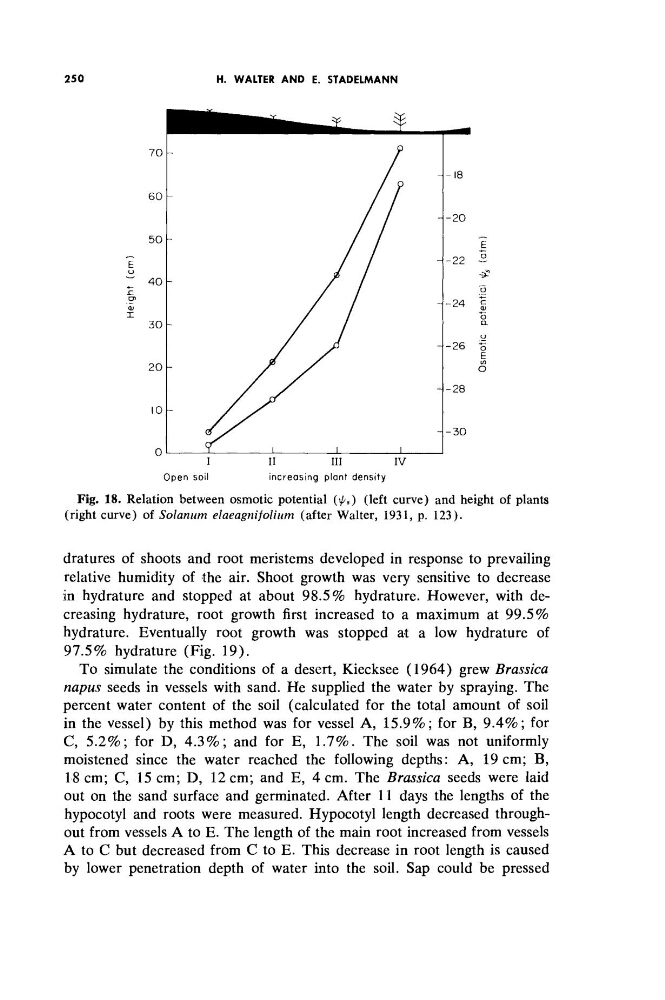
Fig. 18. Relation between osmotic potential (φ 8 ) (left curve) and height of plants
(right curve) of Solarium elaeagnifolium (after Walter, 1931, p. 123).
dratures of shoots and root meristems developed in response to prevailing
relative humidity of the air. Shoot growth was very sensitive to decrease
in hydrature and stopped at about 98.5% hydrature. However, with decreasing hydrature, root growth first increased to a maximum at 99.5%
hydrature. Eventually root growth was stopped at a low hydrature of
97.5% hydrature (Fig. 19).
To simulate the conditions of a desert, Kiecksee (1964) grew Brassica
napus seeds in vessels with sand. He supplied the water by spraying. The
percent water content of the soil (calculated for the total amount of soil
in the vessel) by this method was for vessel A, 15.9%; for B, 9.4%; for
C, 5.2%; for D, 4 . 3 % ; and for E, 1.7%. The soil was not uniformly
moistened since the water reached the following depths: A, 19 cm; B,
18 cm; C, 15 cm; D, 12 cm; and E, 4 cm. The Brassica seeds were laid
out on the sand surface and germinated. After 11 days the lengths of the
hypocotyl and roots were measured. Hypocotyl length decreased throughout from vessels A to E. The length of the main root increased from vessels
A to C but decreased from C to E. This decrease in root length is caused
by lower penetration depth of water into the soil. Sap could be pressed
H. WALTER AND E. STADELMANN
Open soil
II
III
IV
increasing plant density
Fig. 18. Relation between osmotic potential (φ 8 ) (left curve) and height of plants
(right curve) of Solarium elaeagnifolium (after Walter, 1931, p. 123).
dratures of shoots and root meristems developed in response to prevailing
relative humidity of the air. Shoot growth was very sensitive to decrease
in hydrature and stopped at about 98.5% hydrature. However, with decreasing hydrature, root growth first increased to a maximum at 99.5%
hydrature. Eventually root growth was stopped at a low hydrature of
97.5% hydrature (Fig. 19).
To simulate the conditions of a desert, Kiecksee (1964) grew Brassica
napus seeds in vessels with sand. He supplied the water by spraying. The
percent water content of the soil (calculated for the total amount of soil
in the vessel) by this method was for vessel A, 15.9%; for B, 9.4%; for
C, 5.2%; for D, 4 . 3 % ; and for E, 1.7%. The soil was not uniformly
moistened since the water reached the following depths: A, 19 cm; B,
18 cm; C, 15 cm; D, 12 cm; and E, 4 cm. The Brassica seeds were laid
out on the sand surface and germinated. After 11 days the lengths of the
hypocotyl and roots were measured. Hypocotyl length decreased throughout from vessels A to E. The length of the main root increased from vessels
A to C but decreased from C to E. This decrease in root length is caused
by lower penetration depth of water into the soil. Sap could be pressed