

V. NEW APPROACH TO WATER RELATIONS OF DESERT PLANTS
241
c
S 150
100
-10
σ
1 -20
u
~o
E
to
° -25
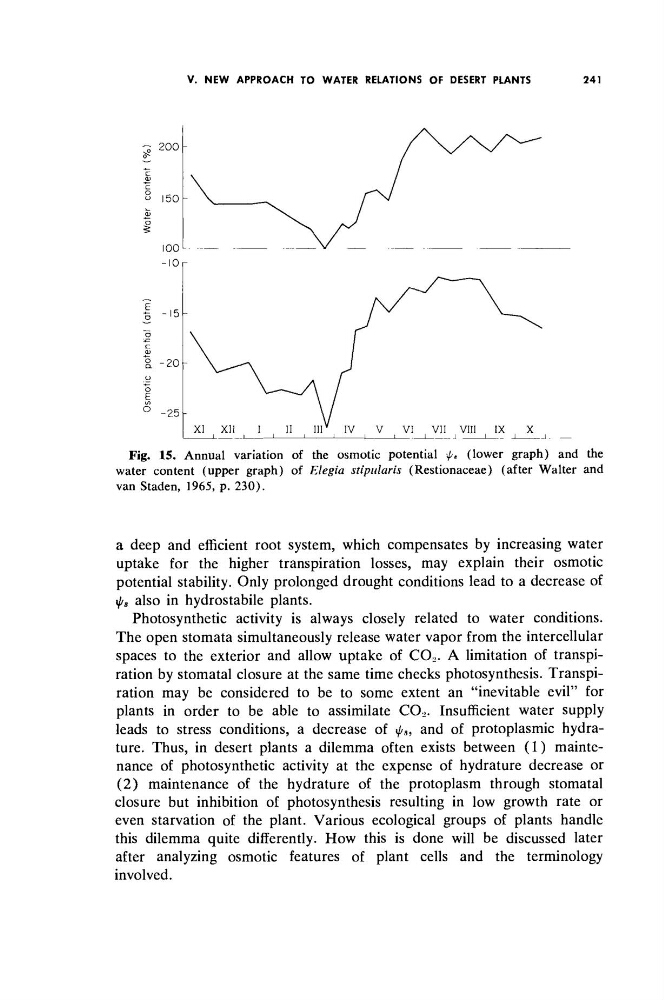
Fig. 15. Annual variation of the osmotic potential φ, (lower graph) and the
water content (upper graph) of Elegia stipularis (Restionaceae) (after Walter and
van Staden, 1965, p. 230).
a deep and efficient root system, which compensates by increasing water
uptake for the higher transpiration losses, may explain their osmotic
potential stability. Only prolonged drought conditions lead to a decrease of
φ 8 also in hydrostabile plants.
Photosynthetic activity is always closely related to water conditions.
The open stomata simultaneously release water vapor from the intercellular
spaces to the exterior and allow uptake of CO.. A limitation of transpiration by stomatal closure at the same time checks photosynthesis. Transpiration may be considered to be to some extent an "inevitable evil" for
plants in order to be able to assimilate C0 2 . Insufficient water supply
leads to stress conditions, a decrease of ψ 8 , and of protoplasmic hydrature. Thus, in desert plants a dilemma often exists between (1) maintenance of photosynthetic activity at the expense of hydrature decrease or
(2) maintenance of the hydrature of the protoplasm through stomatal
closure but inhibition of photosynthesis resulting in low growth rate or
even starvation of the plant. Various ecological groups of plants handle
this dilemma quite differently. How this is done will be discussed later
after analyzing osmotic features of plant cells and the terminology
involved.
241
c
S 150
100
-10
σ
1 -20
u
~o
E
to
° -25
Fig. 15. Annual variation of the osmotic potential φ, (lower graph) and the
water content (upper graph) of Elegia stipularis (Restionaceae) (after Walter and
van Staden, 1965, p. 230).
a deep and efficient root system, which compensates by increasing water
uptake for the higher transpiration losses, may explain their osmotic
potential stability. Only prolonged drought conditions lead to a decrease of
φ 8 also in hydrostabile plants.
Photosynthetic activity is always closely related to water conditions.
The open stomata simultaneously release water vapor from the intercellular
spaces to the exterior and allow uptake of CO.. A limitation of transpiration by stomatal closure at the same time checks photosynthesis. Transpiration may be considered to be to some extent an "inevitable evil" for
plants in order to be able to assimilate C0 2 . Insufficient water supply
leads to stress conditions, a decrease of ψ 8 , and of protoplasmic hydrature. Thus, in desert plants a dilemma often exists between (1) maintenance of photosynthetic activity at the expense of hydrature decrease or
(2) maintenance of the hydrature of the protoplasm through stomatal
closure but inhibition of photosynthesis resulting in low growth rate or
even starvation of the plant. Various ecological groups of plants handle
this dilemma quite differently. How this is done will be discussed later
after analyzing osmotic features of plant cells and the terminology
involved.