

236
H. WALTER AND E. STADELMANN
0
0
0
1
2
2
.3
.4
.7
.7
.3
.5
not detectable
3
4
6
17
18
17
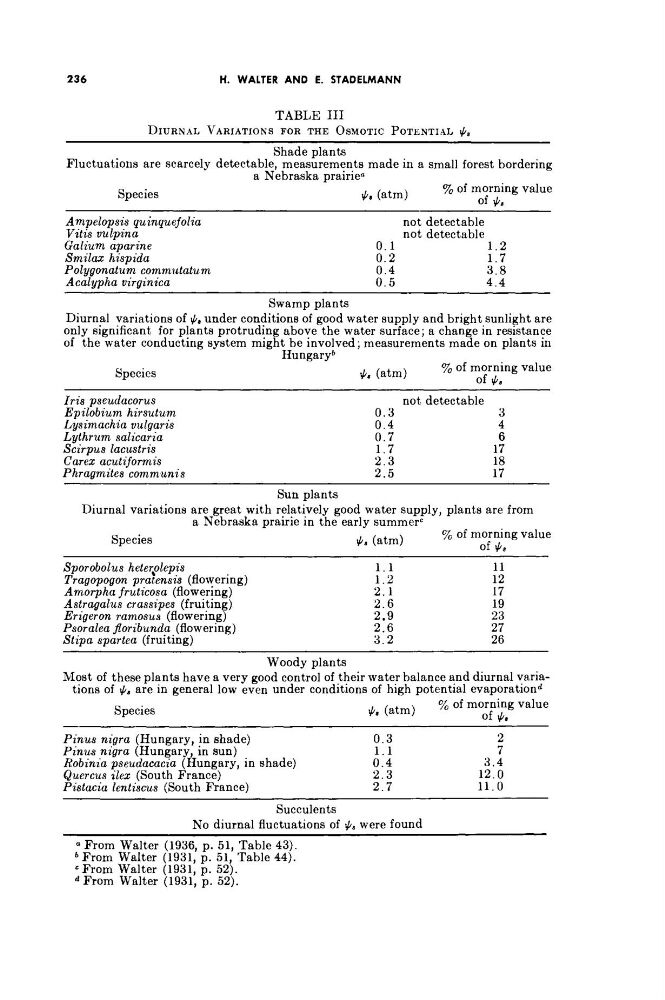
TABLE I I I
D I U R N A L VARIATIONS FOR THE OSMOTIC POTENTIAL ψ8
Shade plants
Fluctuations are scarcely detectable, measurements made in a small forest bordering
a Nebraska prairie"
Species
ψ, (atm)
% of morning value
Ampélopsis quinquefolia
not detectable
Vitis vulpina
not detectable
Galium aparine
0.1
1.2
Smilax hispida
0.2
1.7
Polygonatum commutatum
0.4
3.8
Acalypha virginica
0.5
4 . 4
Swamp plants
Diurnal variations of ψ Λ under conditions of good water supply and bright sunlight are
only significant for plants protruding above the water surface ; a change in resistance
of the water conducting system might be involved ; measurements made on plants in
Hungary
6
Species
φ. (atm)
% of morning value
Iris pseudacorus
Epilobium
hirsutum
Lysimachia vulgar is
Lythrum salicaria
Scirpus lacustris
Carex acutiformis
Phragmites
communis
Sun plants
Diurnal variations are great with relatively good water supply, plants are from
a Nebraska prairie in the early summer'
Species
ψ. (atm)
% of morning value
Sporobolus heterplepis
Tragopogon pratensis (flowering)
Amorpha fruticosa (flowering)
Astragalus crassipes (fruiting)
Erigeron ramosus (flowering)
Psoralea floribunda (flowering)
Stipa spartea (fruiting)
Woody plants
Most of these plants have a very good control of their water balance and diurnal variations of ψ Β are in general low even under conditions of high potential evaporation
α
.
# / ± \
% of morning value
Species
ψ, (atm)
/0
Q{
^
Pinus nigra (Hungary, in shade)
Pinus nigra (Hungary, in sun)
Robinia pseudacacia (Hungary, in shade)
Quercus ilex (South France)
Pistacia lentiscus (South France)
Succulents
No diurnal fluctuations of φ 8 were found
° From Walter (1936, p . 51, Table 43).
b From Walter (1931, p . 51, Table 44).
«From Walter (1931, p . 52).
d From Walter (1931, p. 52).
1.1
1.2
2 . 1
2.6
2.9
2.6
3.2
11
12
17
19
23
27
26
0.3
1.1
0.4
2 . 3
2.7
2
7
3.4
12.0
11.0
H. WALTER AND E. STADELMANN
0
0
0
1
2
2
.3
.4
.7
.7
.3
.5
not detectable
3
4
6
17
18
17
TABLE I I I
D I U R N A L VARIATIONS FOR THE OSMOTIC POTENTIAL ψ8
Shade plants
Fluctuations are scarcely detectable, measurements made in a small forest bordering
a Nebraska prairie"
Species
ψ, (atm)
% of morning value
Ampélopsis quinquefolia
not detectable
Vitis vulpina
not detectable
Galium aparine
0.1
1.2
Smilax hispida
0.2
1.7
Polygonatum commutatum
0.4
3.8
Acalypha virginica
0.5
4 . 4
Swamp plants
Diurnal variations of ψ Λ under conditions of good water supply and bright sunlight are
only significant for plants protruding above the water surface ; a change in resistance
of the water conducting system might be involved ; measurements made on plants in
Hungary
6
Species
φ. (atm)
% of morning value
Iris pseudacorus
Epilobium
hirsutum
Lysimachia vulgar is
Lythrum salicaria
Scirpus lacustris
Carex acutiformis
Phragmites
communis
Sun plants
Diurnal variations are great with relatively good water supply, plants are from
a Nebraska prairie in the early summer'
Species
ψ. (atm)
% of morning value
Sporobolus heterplepis
Tragopogon pratensis (flowering)
Amorpha fruticosa (flowering)
Astragalus crassipes (fruiting)
Erigeron ramosus (flowering)
Psoralea floribunda (flowering)
Stipa spartea (fruiting)
Woody plants
Most of these plants have a very good control of their water balance and diurnal variations of ψ Β are in general low even under conditions of high potential evaporation
α
.
# / ± \
% of morning value
Species
ψ, (atm)
/0
Q{
^
Pinus nigra (Hungary, in shade)
Pinus nigra (Hungary, in sun)
Robinia pseudacacia (Hungary, in shade)
Quercus ilex (South France)
Pistacia lentiscus (South France)
Succulents
No diurnal fluctuations of φ 8 were found
° From Walter (1936, p . 51, Table 43).
b From Walter (1931, p . 51, Table 44).
«From Walter (1931, p . 52).
d From Walter (1931, p. 52).
1.1
1.2
2 . 1
2.6
2.9
2.6
3.2
11
12
17
19
23
27
26
0.3
1.1
0.4
2 . 3
2.7
2
7
3.4
12.0
11.0