

226
H. WALTER AND E. STADELMANN
4(KCORO(20m)
35.3, riOJ
27.7 A 53
40.0
TUCSON (739m)
19.5 293|
[7A-76]Ariz.
i 23I ^ ^
1
]T0BRUK(A6m)
19.0 1A6 Γ
[7-25]
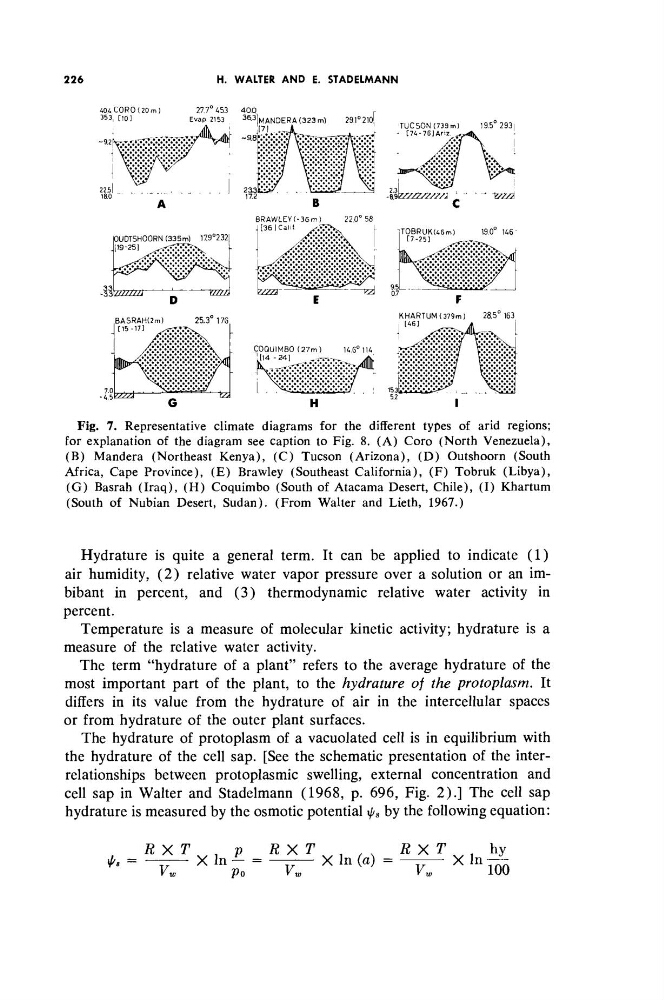
Fig. 7. Representative climate diagrams for the different types of arid regions;
for explanation of the diagram see caption to Fig. 8. (A) Coro (North Venezuela),
(B) Mandera (Northeast Kenya), (C) Tucson (Arizona), (D) Outshoorn (South
Africa, Cape Province), (E) Brawley (Southeast California), (F) Tobruk (Libya),
(G) Basrah (Iraq), (H) Coquimbo (South of Atacama Desert, Chile), (I) Khartum
(South of Nubian Desert, Sudan). (From Walter and Lieth, 1967.)
Hydrature is quite a general term. It can be applied to indicate (1)
air humidity, (2) relative water vapor pressure over a solution or an imbibant in percent, and (3) thermodynamic relative water activity in
percent.
Temperature is a measure of molecular kinetic activity; hydrature is a
measure of the relative water activity.
The term "hydrature of a plant" refers to the average hydrature of the
most important part of the plant, to the hydrature of the protoplasm. It
differs in its value from the hydrature of air in the intercellular spaces
or from hydrature of the outer plant surfaces.
The hydrature of protoplasm of a vacuolated cell is in equilibrium with
the hydrature of the cell sap. [See the schematic presentation of the interrelationships between protoplasmic swelling, external concentration and
cell sap in Walter and Stadelmann (1968, p. 696, Fig. 2).] The cell sap
hydrature is measured by the osmotic potential ψ 8 by the following equation:
#
R X T
v i p
R X T
v i / x
R x
T w i
h y
ψ 8 = — — - X In - = — — X In (a) = — — X In —
Vw
Po
Vw
Vw
100
H. WALTER AND E. STADELMANN
4(KCORO(20m)
35.3, riOJ
27.7 A 53
40.0
TUCSON (739m)
19.5 293|
[7A-76]Ariz.
i 23I ^ ^
1
]T0BRUK(A6m)
19.0 1A6 Γ
[7-25]
Fig. 7. Representative climate diagrams for the different types of arid regions;
for explanation of the diagram see caption to Fig. 8. (A) Coro (North Venezuela),
(B) Mandera (Northeast Kenya), (C) Tucson (Arizona), (D) Outshoorn (South
Africa, Cape Province), (E) Brawley (Southeast California), (F) Tobruk (Libya),
(G) Basrah (Iraq), (H) Coquimbo (South of Atacama Desert, Chile), (I) Khartum
(South of Nubian Desert, Sudan). (From Walter and Lieth, 1967.)
Hydrature is quite a general term. It can be applied to indicate (1)
air humidity, (2) relative water vapor pressure over a solution or an imbibant in percent, and (3) thermodynamic relative water activity in
percent.
Temperature is a measure of molecular kinetic activity; hydrature is a
measure of the relative water activity.
The term "hydrature of a plant" refers to the average hydrature of the
most important part of the plant, to the hydrature of the protoplasm. It
differs in its value from the hydrature of air in the intercellular spaces
or from hydrature of the outer plant surfaces.
The hydrature of protoplasm of a vacuolated cell is in equilibrium with
the hydrature of the cell sap. [See the schematic presentation of the interrelationships between protoplasmic swelling, external concentration and
cell sap in Walter and Stadelmann (1968, p. 696, Fig. 2).] The cell sap
hydrature is measured by the osmotic potential ψ 8 by the following equation:
#
R X T
v i p
R X T
v i / x
R x
T w i
h y
ψ 8 = — — - X In - = — — X In (a) = — — X In —
Vw
Po
Vw
Vw
100