

V. NEW APPROACH TO WATER RELATIONS OF DESERT PLANTS
223
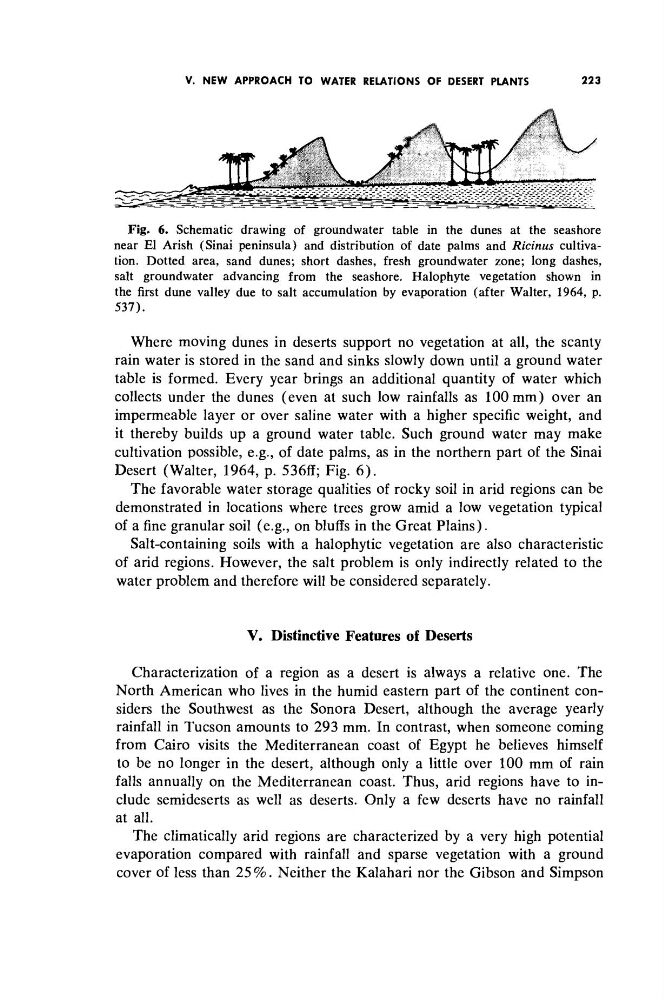
Fig. 6. Schematic drawing of groundwater table in the dunes at the seashore
near El Arish (Sinai peninsula) and distribution of date palms and Ricinus cultivation. Dotted area, sand dunes; short dashes, fresh groundwater zone; long dashes,
salt groundwater advancing from the seashore. Halophyte vegetation shown in
the first dune valley due to salt accumulation by evaporation (after Walter, 1964, p.
537).
Where moving dunes in deserts support no vegetation at all, the scanty
rain water is stored in the sand and sinks slowly down until a ground water
table is formed. Every year brings an additional quantity of water which
collects under the dunes (even at such low rainfalls as 100 mm) over an
impermeable layer or over saline water with a higher specific weight, and
it thereby builds up a ground water table. Such ground water may make
cultivation possible, e.g., of date palms, as in the northern part of the Sinai
Desert (Walter, 1964, p. 536ff; Fig. 6).
The favorable water storage qualities of rocky soil in arid regions can be
demonstrated in locations where trees grow amid a low vegetation typical
of a fine granular soil (e.g., on bluffs in the Great Plains).
Salt-containing soils with a halophytic vegetation are also characteristic
of arid regions. However, the salt problem is only indirectly related to the
water problem and therefore will be considered separately.
V. Distinctive Features of Deserts
Characterization of a region as a desert is always a relative one. The
North American who lives in the humid eastern part of the continent considers the Southwest as the Sonora Desert, although the average yearly
rainfall in Tucson amounts to 293 mm. In contrast, when someone coming
from Cairo visits the Mediterranean coast of Egypt he believes himself
to be no longer in the desert, although only a little over 100 mm of rain
falls annually on the Mediterranean coast. Thus, arid regions have to include semideserts as well as deserts. Only a few deserts have no rainfall
at all.
The climatically arid regions are characterized by a very high potential
evaporation compared with rainfall and sparse vegetation with a ground
cover of less than 25 %. Neither the Kalahari nor the Gibson and Simpson
223
Fig. 6. Schematic drawing of groundwater table in the dunes at the seashore
near El Arish (Sinai peninsula) and distribution of date palms and Ricinus cultivation. Dotted area, sand dunes; short dashes, fresh groundwater zone; long dashes,
salt groundwater advancing from the seashore. Halophyte vegetation shown in
the first dune valley due to salt accumulation by evaporation (after Walter, 1964, p.
537).
Where moving dunes in deserts support no vegetation at all, the scanty
rain water is stored in the sand and sinks slowly down until a ground water
table is formed. Every year brings an additional quantity of water which
collects under the dunes (even at such low rainfalls as 100 mm) over an
impermeable layer or over saline water with a higher specific weight, and
it thereby builds up a ground water table. Such ground water may make
cultivation possible, e.g., of date palms, as in the northern part of the Sinai
Desert (Walter, 1964, p. 536ff; Fig. 6).
The favorable water storage qualities of rocky soil in arid regions can be
demonstrated in locations where trees grow amid a low vegetation typical
of a fine granular soil (e.g., on bluffs in the Great Plains).
Salt-containing soils with a halophytic vegetation are also characteristic
of arid regions. However, the salt problem is only indirectly related to the
water problem and therefore will be considered separately.
V. Distinctive Features of Deserts
Characterization of a region as a desert is always a relative one. The
North American who lives in the humid eastern part of the continent considers the Southwest as the Sonora Desert, although the average yearly
rainfall in Tucson amounts to 293 mm. In contrast, when someone coming
from Cairo visits the Mediterranean coast of Egypt he believes himself
to be no longer in the desert, although only a little over 100 mm of rain
falls annually on the Mediterranean coast. Thus, arid regions have to include semideserts as well as deserts. Only a few deserts have no rainfall
at all.
The climatically arid regions are characterized by a very high potential
evaporation compared with rainfall and sparse vegetation with a ground
cover of less than 25 %. Neither the Kalahari nor the Gibson and Simpson