

V. NEW APPROACH TO WATER RELATIONS OF DESERT PLANTS
221
on the amount of water percolating into the soil after rain, but also on
the amount evaporated from the soil surface. Only the upper soil layers
are moistened in plain habitats of arid regions, and the maximum depth
of the penetrating water depends on the texture and the field capacity of
the soil. This can be explained in the following example: Assuming that
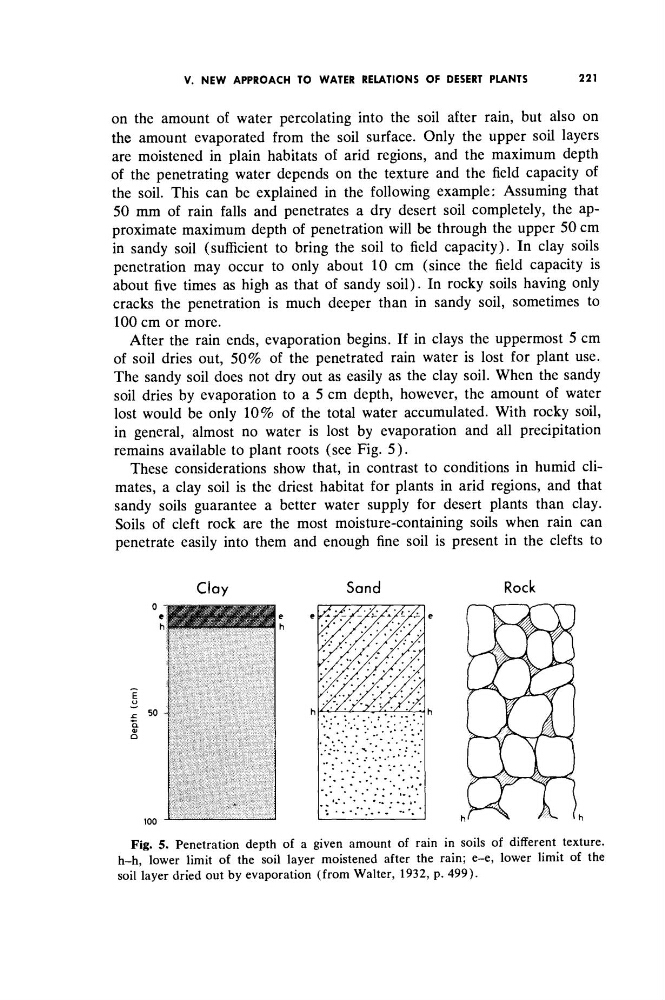
50 mm of rain falls and penetrates a dry desert soil completely, the approximate maximum depth of penetration will be through the upper 50 cm
in sandy soil (sufficient to bring the soil to field capacity). In clay soils
penetration may occur to only about 10 cm (since the field capacity is
about five times as high as that of sandy soil). In rocky soils having only
cracks the penetration is much deeper than in sandy soil, sometimes to
100 cm or more.
After the rain ends, evaporation begins. If in clays the uppermost 5 cm
of soil dries out, 50% of the penetrated rain water is lost for plant use.
The sandy soil does not dry out as easily as the clay soil. When the sandy
soil dries by evaporation to a 5 cm depth, however, the amount of water
lost would be only 10% of the total water accumulated. With rocky soil,
in general, almost no water is lost by evaporation and all precipitation
remains available to plant roots (see Fig. 5).
These considerations show that, in contrast to conditions in humid climates, a clay soil is the driest habitat for plants in arid regions, and that
sandy soils guarantee a better water supply for desert plants than clay.
Soils of cleft rock are the most moisture-containing soils when rain can
penetrate easily into them and enough fine soil is present in the clefts to
Clay
mmmmmmm
m^mmmmm
Sand
Rock
100
Fig. 5. Penetration depth of a given amount of rain in soils of different texture.
h-h, lower limit of the soil layer moistened after the rain; e-e, lower limit of the
soil layer dried out by evaporation (from Walter, 1932, p. 499).
221
on the amount of water percolating into the soil after rain, but also on
the amount evaporated from the soil surface. Only the upper soil layers
are moistened in plain habitats of arid regions, and the maximum depth
of the penetrating water depends on the texture and the field capacity of
the soil. This can be explained in the following example: Assuming that
50 mm of rain falls and penetrates a dry desert soil completely, the approximate maximum depth of penetration will be through the upper 50 cm
in sandy soil (sufficient to bring the soil to field capacity). In clay soils
penetration may occur to only about 10 cm (since the field capacity is
about five times as high as that of sandy soil). In rocky soils having only
cracks the penetration is much deeper than in sandy soil, sometimes to
100 cm or more.
After the rain ends, evaporation begins. If in clays the uppermost 5 cm
of soil dries out, 50% of the penetrated rain water is lost for plant use.
The sandy soil does not dry out as easily as the clay soil. When the sandy
soil dries by evaporation to a 5 cm depth, however, the amount of water
lost would be only 10% of the total water accumulated. With rocky soil,
in general, almost no water is lost by evaporation and all precipitation
remains available to plant roots (see Fig. 5).
These considerations show that, in contrast to conditions in humid climates, a clay soil is the driest habitat for plants in arid regions, and that
sandy soils guarantee a better water supply for desert plants than clay.
Soils of cleft rock are the most moisture-containing soils when rain can
penetrate easily into them and enough fine soil is present in the clefts to
Clay
mmmmmmm
m^mmmmm
Sand
Rock
100
Fig. 5. Penetration depth of a given amount of rain in soils of different texture.
h-h, lower limit of the soil layer moistened after the rain; e-e, lower limit of the
soil layer dried out by evaporation (from Walter, 1932, p. 499).