

216
H. WALTER AND E. STADELMANN
6000
5000
I 4000
σ
.c
\
~ 3000
a
o 2000
at
1000
0
100
200
300
400
500
600
Average yearly precipitation (mm)
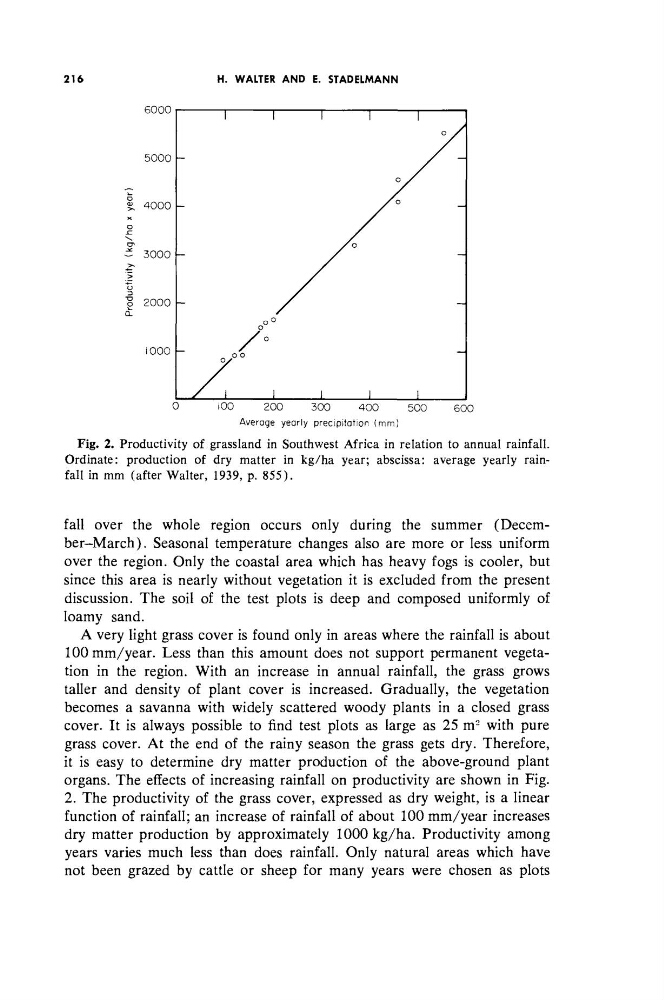
Fig. 2. Productivity of grassland in Southwest Africa in relation to annual rainfall.
Ordinate: production of dry matter in kg/ha year; abscissa: average yearly rainfall in mm (after Walter, 1939, p. 855).
fall over the whole region occurs only during the summer (December-March). Seasonal temperature changes also are more or less uniform
over the region. Only the coastal area which has heavy fogs is cooler, but
since this area is nearly without vegetation it is excluded from the present
discussion. The soil of the test plots is deep and composed uniformly of
loamy sand.
A very light grass cover is found only in areas where the rainfall is about
100 mm/year. Less than this amount does not support permanent vegetation in the region. With an increase in annual rainfall, the grass grows
taller and density of plant cover is increased. Gradually, the vegetation
becomes a savanna with widely scattered woody plants in a closed grass
cover. It is always possible to find test plots as large as 25 m
2
with pure
grass cover. At the end of the rainy season the grass gets dry. Therefore,
it is easy to determine dry matter production of the above-ground plant
organs. The effects of increasing rainfall on productivity are shown in Fig.
2. The productivity of the grass cover, expressed as dry weight, is a linear
function of rainfall; an increase of rainfall of about 100 mm/year increases
dry matter production by approximately 1000 kg/ha. Productivity among
years varies much less than does rainfall. Only natural areas which have
not been grazed by cattle or sheep for many years were chosen as plots
1
k
[~
1 /°
|
O O
/
/
1
1
1
1
1
o /
S°
1
1
1
o /\
A
A
A
H. WALTER AND E. STADELMANN
6000
5000
I 4000
σ
.c
\
~ 3000
a
o 2000
at
1000
0
100
200
300
400
500
600
Average yearly precipitation (mm)
Fig. 2. Productivity of grassland in Southwest Africa in relation to annual rainfall.
Ordinate: production of dry matter in kg/ha year; abscissa: average yearly rainfall in mm (after Walter, 1939, p. 855).
fall over the whole region occurs only during the summer (December-March). Seasonal temperature changes also are more or less uniform
over the region. Only the coastal area which has heavy fogs is cooler, but
since this area is nearly without vegetation it is excluded from the present
discussion. The soil of the test plots is deep and composed uniformly of
loamy sand.
A very light grass cover is found only in areas where the rainfall is about
100 mm/year. Less than this amount does not support permanent vegetation in the region. With an increase in annual rainfall, the grass grows
taller and density of plant cover is increased. Gradually, the vegetation
becomes a savanna with widely scattered woody plants in a closed grass
cover. It is always possible to find test plots as large as 25 m
2
with pure
grass cover. At the end of the rainy season the grass gets dry. Therefore,
it is easy to determine dry matter production of the above-ground plant
organs. The effects of increasing rainfall on productivity are shown in Fig.
2. The productivity of the grass cover, expressed as dry weight, is a linear
function of rainfall; an increase of rainfall of about 100 mm/year increases
dry matter production by approximately 1000 kg/ha. Productivity among
years varies much less than does rainfall. Only natural areas which have
not been grazed by cattle or sheep for many years were chosen as plots
1
k
[~
1 /°
|
O O
/
/
1
1
1
1
1
o /
S°
1
1
1
o /\
A
A
A