

12
STANLEY N. DAVIS
taken up by xerophytic vegetation and be released more slowly by transpiration during succeeding weeks or months.
The minuscule quantity of water that becomes groundwater recharge
enters the deep subsurface through beds of ephemeral streams, cracks in
bare rock surfaces, talus at the bases of cliffs, and sand dunes. Soil-moisture deficiencies are normally so large that water from single rains of 20
to 40 mm can be stored easily in the upper meter of soil where it is eventually returned to the atmosphere by évapotranspiration. In contrast, rock
rubble, as might be found in talus or stream beds, can only store a small
amount of water (El Boushi and Davis, 1969), so a precipitation of
10 mm would commonly produce recharge. Furthermore, water tends to
be concentrated along stream channels longer than the duration of the rainfall. This added time allows stream bed materials of low permeability to
transmit significant amounts of water into the subsurface.
Sand dunes have long been recognized as important sites for groundwater recharge (Löwy, 1953; Moussu and Moussu, 1952; Ogilbee, 1964).
The dune sand has a capacity to store between 1.5 and 8.0% water by
volume after several months of gravity drainage. If the sand is dry, this
volume of water must be absorbed before excess water drains downward
to become recharge. As an example, if 3 % water by volume is required
in 1 meter of dry sand, then 30 mm of rain will be needed to initiate
groundwater recharge through the thickness of 1 meter. Inasmuch as the
permeability of dune sand is high enough to accept almost any intensity
of rain, runoff of surface water from sand dunes will rarely, if ever, occur.
Intense storms will, therefore, favor direct recharge into sand dunes.
In actively migrating dunes, dry sand accumulates on the leeward side
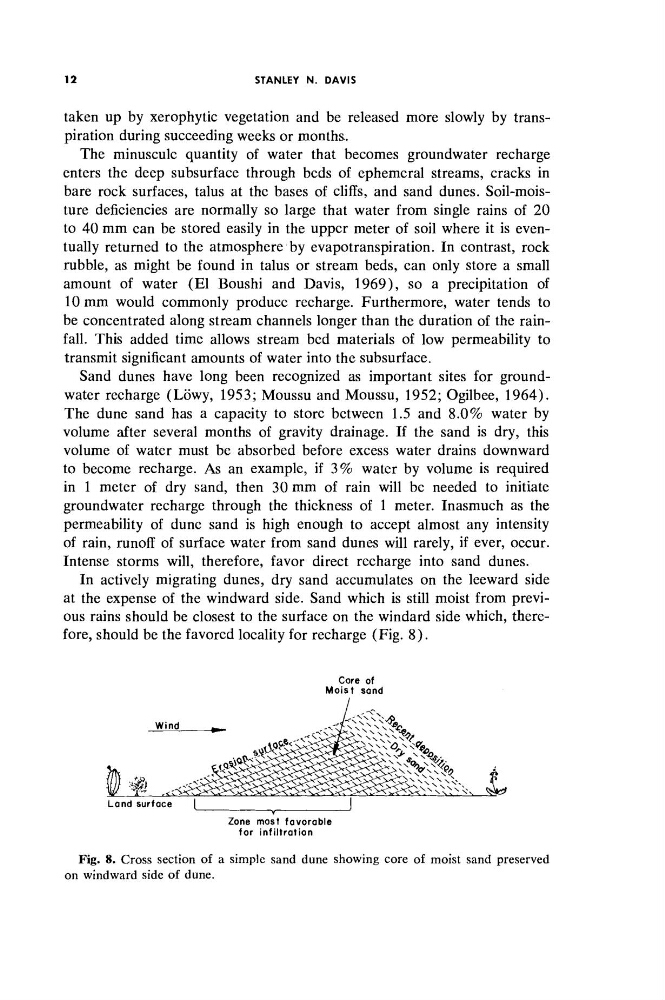
at the expense of the windward side. Sand which is still moist from previous rains should be closest to the surface on the windard side which, therefore, should be the favored locality for recharge (Fig. 8).
Core of
Moist sand
Zone most favorable
for infiltration
Fig. 8. Cross section of a simple sand dune showing core of moist sand preserved
on windward side of dune.
STANLEY N. DAVIS
taken up by xerophytic vegetation and be released more slowly by transpiration during succeeding weeks or months.
The minuscule quantity of water that becomes groundwater recharge
enters the deep subsurface through beds of ephemeral streams, cracks in
bare rock surfaces, talus at the bases of cliffs, and sand dunes. Soil-moisture deficiencies are normally so large that water from single rains of 20
to 40 mm can be stored easily in the upper meter of soil where it is eventually returned to the atmosphere by évapotranspiration. In contrast, rock
rubble, as might be found in talus or stream beds, can only store a small
amount of water (El Boushi and Davis, 1969), so a precipitation of
10 mm would commonly produce recharge. Furthermore, water tends to
be concentrated along stream channels longer than the duration of the rainfall. This added time allows stream bed materials of low permeability to
transmit significant amounts of water into the subsurface.
Sand dunes have long been recognized as important sites for groundwater recharge (Löwy, 1953; Moussu and Moussu, 1952; Ogilbee, 1964).
The dune sand has a capacity to store between 1.5 and 8.0% water by
volume after several months of gravity drainage. If the sand is dry, this
volume of water must be absorbed before excess water drains downward
to become recharge. As an example, if 3 % water by volume is required
in 1 meter of dry sand, then 30 mm of rain will be needed to initiate
groundwater recharge through the thickness of 1 meter. Inasmuch as the
permeability of dune sand is high enough to accept almost any intensity
of rain, runoff of surface water from sand dunes will rarely, if ever, occur.
Intense storms will, therefore, favor direct recharge into sand dunes.
In actively migrating dunes, dry sand accumulates on the leeward side
at the expense of the windward side. Sand which is still moist from previous rains should be closest to the surface on the windard side which, therefore, should be the favored locality for recharge (Fig. 8).
Core of
Moist sand
Zone most favorable
for infiltration
Fig. 8. Cross section of a simple sand dune showing core of moist sand preserved
on windward side of dune.