

186
E. IMRE FRIEDMANN AND MARGALITH GALUN
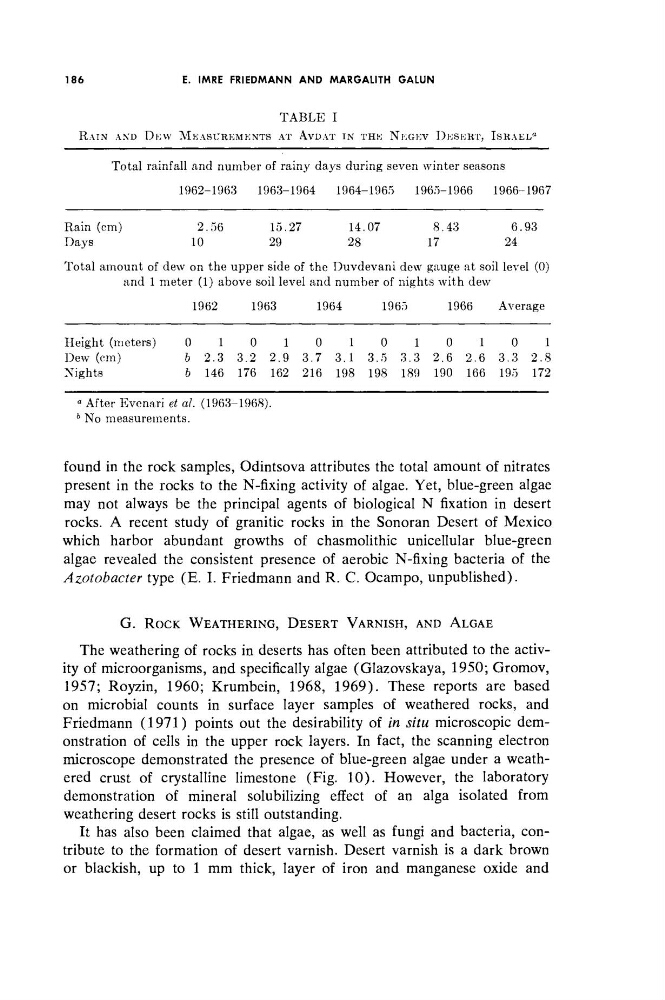
TABLE I
R A I N AND D E W M E A S U R E M E N T S AT AVDAT IN THE N E G E V D E S E R T , I S R A E L
0
Total rainfall and number of rainy days during seven winter seasons
1962-1963
1963-1964
1964-1965
1965-1966
1966-1967
Rain (cm)
2.56
15.27
14.07
8.43
6.93
Days
10
29
28
17
24
Total amount of dew on the upper side of the Duvdevani dew gauge at soil level (0)
and 1 meter (1) above soil level and number of nights \vith dew
1962
1963
1964
1965
1966
Average
Height (meters)
0
1
0
1
0
1
0
1
0
1
0
1
Dew (cm)
b 2 . 3 3.2 2 . 9 3.7 3.1 3.5 3.3 2 . 6 2.6 3.3 2 . 8
Nights
b 146 176 162 216 198 198 189 190 166 195 172
« After Evenari et al. (1963-1968).
6 No measurements.
found in the rock samples, Odintsova attributes the total amount of nitrates
present in the rocks to the N-fixing activity of algae. Yet, blue-green algae
may not always be the principal agents of biological N fixation in desert
rocks. A recent study of granitic rocks in the Sonor an Desert of Mexico
which harbor abundant growths of chasmolithic unicellular blue-green
algae revealed the consistent presence of aerobic N-fixing bacteria of the
Azotobacter type (E. I. Friedmann and R. C. Ocampo, unpublished).
G. ROCK WEATHERING, DESERT VARNISH, AND ALGAE
The weathering of rocks in deserts has often been attributed to the activity of microorganisms, and specifically algae (Glazovskaya, 1950; Gromov,
1957; Royzin, 1960; Krumbein, 1968, 1969). These reports are based
on microbial counts in surface layer samples of weathered rocks, and
Friedmann (1971) points out the desirability of in situ microscopic demonstration of cells in the upper rock layers. In fact, the scanning electron
microscope demonstrated the presence of blue-green algae under a weathered crust of crystalline limestone (Fig. 10). However, the laboratory
demonstration of mineral solubilizing effect of an alga isolated from
weathering desert rocks is still outstanding.
It has also been claimed that algae, as well as fungi and bacteria, contribute to the formation of desert varnish. Desert varnish is a dark brown
or blackish, up to 1 mm thick, layer of iron and manganese oxide and
E. IMRE FRIEDMANN AND MARGALITH GALUN
TABLE I
R A I N AND D E W M E A S U R E M E N T S AT AVDAT IN THE N E G E V D E S E R T , I S R A E L
0
Total rainfall and number of rainy days during seven winter seasons
1962-1963
1963-1964
1964-1965
1965-1966
1966-1967
Rain (cm)
2.56
15.27
14.07
8.43
6.93
Days
10
29
28
17
24
Total amount of dew on the upper side of the Duvdevani dew gauge at soil level (0)
and 1 meter (1) above soil level and number of nights \vith dew
1962
1963
1964
1965
1966
Average
Height (meters)
0
1
0
1
0
1
0
1
0
1
0
1
Dew (cm)
b 2 . 3 3.2 2 . 9 3.7 3.1 3.5 3.3 2 . 6 2.6 3.3 2 . 8
Nights
b 146 176 162 216 198 198 189 190 166 195 172
« After Evenari et al. (1963-1968).
6 No measurements.
found in the rock samples, Odintsova attributes the total amount of nitrates
present in the rocks to the N-fixing activity of algae. Yet, blue-green algae
may not always be the principal agents of biological N fixation in desert
rocks. A recent study of granitic rocks in the Sonor an Desert of Mexico
which harbor abundant growths of chasmolithic unicellular blue-green
algae revealed the consistent presence of aerobic N-fixing bacteria of the
Azotobacter type (E. I. Friedmann and R. C. Ocampo, unpublished).
G. ROCK WEATHERING, DESERT VARNISH, AND ALGAE
The weathering of rocks in deserts has often been attributed to the activity of microorganisms, and specifically algae (Glazovskaya, 1950; Gromov,
1957; Royzin, 1960; Krumbein, 1968, 1969). These reports are based
on microbial counts in surface layer samples of weathered rocks, and
Friedmann (1971) points out the desirability of in situ microscopic demonstration of cells in the upper rock layers. In fact, the scanning electron
microscope demonstrated the presence of blue-green algae under a weathered crust of crystalline limestone (Fig. 10). However, the laboratory
demonstration of mineral solubilizing effect of an alga isolated from
weathering desert rocks is still outstanding.
It has also been claimed that algae, as well as fungi and bacteria, contribute to the formation of desert varnish. Desert varnish is a dark brown
or blackish, up to 1 mm thick, layer of iron and manganese oxide and