

172
E. IMRE FRIEDMANN AND MARGALITH GALUN
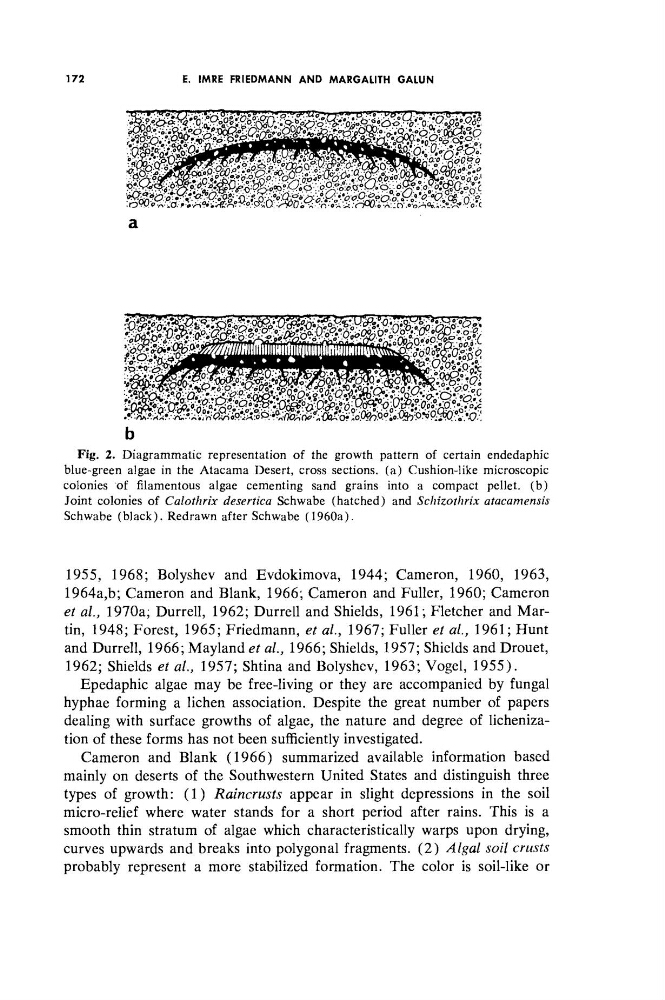
Fig. 2. Diagrammatic representation of the growth pattern of certain endedaphic
blue-green algae in the Atacama Desert, cross sections, (a) Cushion-like microscopic
colonies of filamentous algae cementing sand grains into a compact pellet, (b)
Joint colonies of Calothrix desertica Schwabe (hatched) and Schizothrix atacamensis
Schwabe (black). Redrawn after Schwabe (1960a).
1955, 1968; Bolyshev and Evdokimova, 1944; Cameron, 1960, 1963,
1964a,b; Cameron and Blank, 1966; Cameron and Fuller, 1960; Cameron
et al, 1970a; Durrell, 1962; Durrell and Shields, 1961; Fletcher and Martin, 1948; Forest, 1965; Friedmann, et al, 1967; Fuller et al, 1961; Hunt
and Durrell, 1966; Mayland et al, 1966; Shields, 1957; Shields and Drouet,
1962; Shields et al, 1957; Shtina and Bolyshev, 1963; Vogel, 1955).
Epedaphic algae may be free-living or they are accompanied by fungal
hyphae forming a lichen association. Despite the great number of papers
dealing with surface growths of algae, the nature and degree of lichenization of these forms has not been sufficiently investigated.
Cameron and Blank (1966) summarized available information based
mainly on deserts of the Southwestern United States and distinguish three
types of growth: (1) Raincrusts appear in slight depressions in the soil
micro-relief where water stands for a short period after rains. This is a
smooth thin stratum of algae which characteristically warps upon drying,
curves upwards and breaks into polygonal fragments. (2) Algal soil crusts
probably represent a more stabilized formation. The color is soil-like or
E. IMRE FRIEDMANN AND MARGALITH GALUN
Fig. 2. Diagrammatic representation of the growth pattern of certain endedaphic
blue-green algae in the Atacama Desert, cross sections, (a) Cushion-like microscopic
colonies of filamentous algae cementing sand grains into a compact pellet, (b)
Joint colonies of Calothrix desertica Schwabe (hatched) and Schizothrix atacamensis
Schwabe (black). Redrawn after Schwabe (1960a).
1955, 1968; Bolyshev and Evdokimova, 1944; Cameron, 1960, 1963,
1964a,b; Cameron and Blank, 1966; Cameron and Fuller, 1960; Cameron
et al, 1970a; Durrell, 1962; Durrell and Shields, 1961; Fletcher and Martin, 1948; Forest, 1965; Friedmann, et al, 1967; Fuller et al, 1961; Hunt
and Durrell, 1966; Mayland et al, 1966; Shields, 1957; Shields and Drouet,
1962; Shields et al, 1957; Shtina and Bolyshev, 1963; Vogel, 1955).
Epedaphic algae may be free-living or they are accompanied by fungal
hyphae forming a lichen association. Despite the great number of papers
dealing with surface growths of algae, the nature and degree of lichenization of these forms has not been sufficiently investigated.
Cameron and Blank (1966) summarized available information based
mainly on deserts of the Southwestern United States and distinguish three
types of growth: (1) Raincrusts appear in slight depressions in the soil
micro-relief where water stands for a short period after rains. This is a
smooth thin stratum of algae which characteristically warps upon drying,
curves upwards and breaks into polygonal fragments. (2) Algal soil crusts
probably represent a more stabilized formation. The color is soil-like or