

136
CLAUDE J. GRENOT
where in the Sahara. Examples are Myrtus, with M. nivellei similar to M.
communis, and Olea, with O. laperrini closely related to O. europaea
(Monod, 1931, 1939; Ozenda, 1958). In Hoggar, Tibesti, and Ajjers
Tassili, the degree of endemism is high, and it increases with altitude. The
presence of these endemic species is proof of an ancient extension of the
Mediterranean flora into these regions prior to the arrival of the desert climate during a later period.
However, there are other ecologically isolated regions where there is
considerable endemism, such as at the great saharan ergs. The flora of
the Great Oriental Erg is composed of only 100 species, of which several
are endemic.
3. Systematic Composition
The phanerogamic flora is quite varied in its systematic and geographic
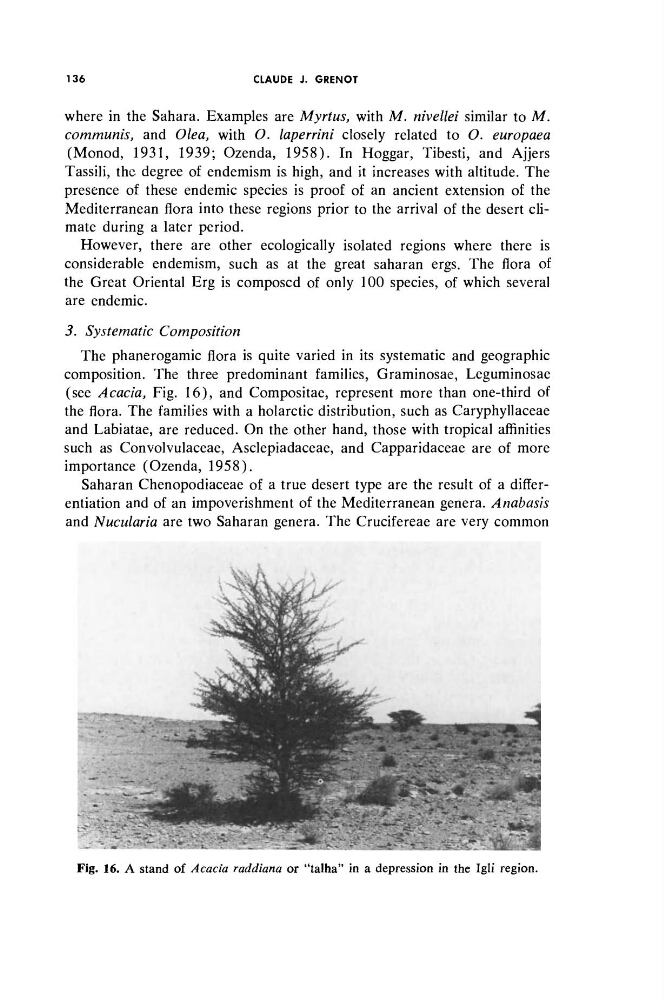
composition. The three predominant families, Graminosae, Leguminosae
(see Acacia, Fig. 16), and Compositae, represent more than one-third of
the flora. The families with a holarctic distribution, such as Caryphyllaceae
and Labiatae, are reduced. On the other hand, those with tropical affinities
such as Convolvulaceae, Asclepiadaceae, and Capparidaceae are of more
importance (Ozenda, 1958).
Saharan Chenopodiaceae of a true desert type are the result of a differentiation and of an impoverishment of the Mediterranean genera. Anabasis
and Nucularia are two Saharan genera. The Crucifereae are very common
Fig. 16. A stand of Acacia raddiana or "talha" in a depression in the Igli region.
CLAUDE J. GRENOT
where in the Sahara. Examples are Myrtus, with M. nivellei similar to M.
communis, and Olea, with O. laperrini closely related to O. europaea
(Monod, 1931, 1939; Ozenda, 1958). In Hoggar, Tibesti, and Ajjers
Tassili, the degree of endemism is high, and it increases with altitude. The
presence of these endemic species is proof of an ancient extension of the
Mediterranean flora into these regions prior to the arrival of the desert climate during a later period.
However, there are other ecologically isolated regions where there is
considerable endemism, such as at the great saharan ergs. The flora of
the Great Oriental Erg is composed of only 100 species, of which several
are endemic.
3. Systematic Composition
The phanerogamic flora is quite varied in its systematic and geographic
composition. The three predominant families, Graminosae, Leguminosae
(see Acacia, Fig. 16), and Compositae, represent more than one-third of
the flora. The families with a holarctic distribution, such as Caryphyllaceae
and Labiatae, are reduced. On the other hand, those with tropical affinities
such as Convolvulaceae, Asclepiadaceae, and Capparidaceae are of more
importance (Ozenda, 1958).
Saharan Chenopodiaceae of a true desert type are the result of a differentiation and of an impoverishment of the Mediterranean genera. Anabasis
and Nucularia are two Saharan genera. The Crucifereae are very common
Fig. 16. A stand of Acacia raddiana or "talha" in a depression in the Igli region.