

III. PHYSICAL AND VEGETATIONAL ASPECTS OF THE SAHARA
119
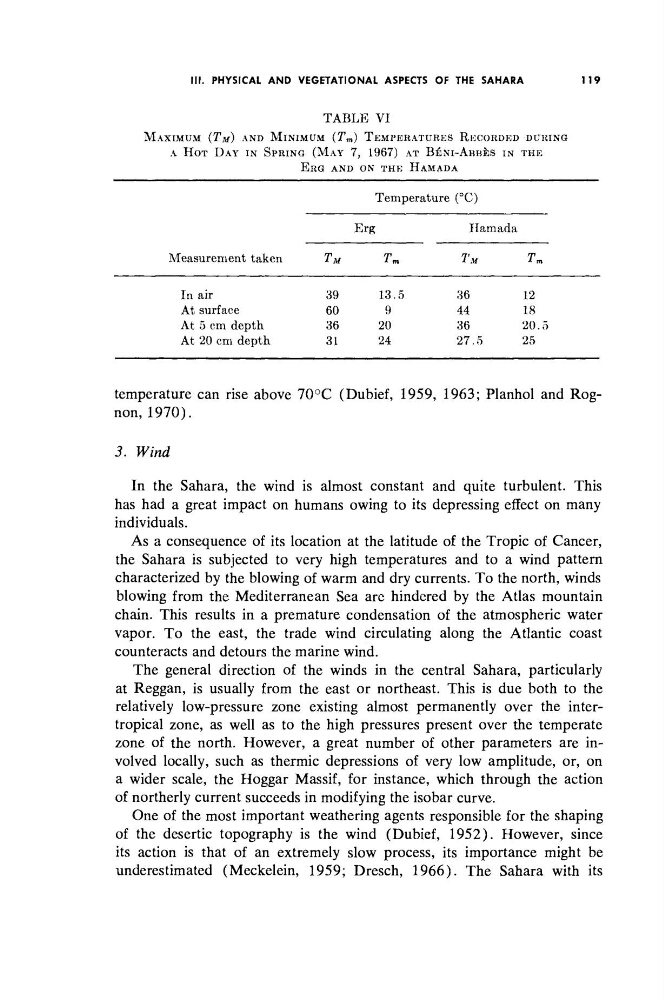
TABLE VI
MAXIMUM (TM) AND M I N I M U M (Tm)
TEMPERATURES RECORDED DURING
A H O T D A Y IN SPRING ( M A Y 7, 1967) AT B É N I - A B B È S IN THE
E R G AND ON THE HAMADA
Measurement taken
In air
At surface
At 5 cm depth
At 20 cm depth
T M
39
60
36
31
Temperature (°C)
Erg
T m
13.5
9
20
24
Hamada
TM
T m
36
12
44
18
36
20.5
27.5
25
temperature can rise above 70°C (Dubief, 1959, 1963; Planhol and Rognon, 1970).
3. Wind
In the Sahara, the wind is almost constant and quite turbulent. This
has had a great impact on humans owing to its depressing effect on many
individuals.
As a consequence of its location at the latitude of the Tropic of Cancer,
the Sahara is subjected to very high temperatures and to a wind pattern
characterized by the blowing of warm and dry currents. To the north, winds
blowing from the Mediterranean Sea are hindered by the Atlas mountain
chain. This results in a premature condensation of the atmospheric water
vapor. To the east, the trade wind circulating along the Atlantic coast
counteracts and detours the marine wind.
The general direction of the winds in the central Sahara, particularly
at Reggan, is usually from the east or northeast. This is due both to the
relatively low-pressure zone existing almost permanently over the intertropical zone, as well as to the high pressures present over the temperate
zone of the north. However, a great number of other parameters are involved locally, such as thermic depressions of very low amplitude, or, on
a wider scale, the Hoggar Massif, for instance, which through the action
of northerly current succeeds in modifying the isobar curve.
One of the most important weathering agents responsible for the shaping
of the desertic topography is the wind (Dubief, 1952). However, since
its action is that of an extremely slow process, its importance might be
underestimated (Meckelein, 1959; Dresch, 1966). The Sahara with its
119
TABLE VI
MAXIMUM (TM) AND M I N I M U M (Tm)
TEMPERATURES RECORDED DURING
A H O T D A Y IN SPRING ( M A Y 7, 1967) AT B É N I - A B B È S IN THE
E R G AND ON THE HAMADA
Measurement taken
In air
At surface
At 5 cm depth
At 20 cm depth
T M
39
60
36
31
Temperature (°C)
Erg
T m
13.5
9
20
24
Hamada
TM
T m
36
12
44
18
36
20.5
27.5
25
temperature can rise above 70°C (Dubief, 1959, 1963; Planhol and Rognon, 1970).
3. Wind
In the Sahara, the wind is almost constant and quite turbulent. This
has had a great impact on humans owing to its depressing effect on many
individuals.
As a consequence of its location at the latitude of the Tropic of Cancer,
the Sahara is subjected to very high temperatures and to a wind pattern
characterized by the blowing of warm and dry currents. To the north, winds
blowing from the Mediterranean Sea are hindered by the Atlas mountain
chain. This results in a premature condensation of the atmospheric water
vapor. To the east, the trade wind circulating along the Atlantic coast
counteracts and detours the marine wind.
The general direction of the winds in the central Sahara, particularly
at Reggan, is usually from the east or northeast. This is due both to the
relatively low-pressure zone existing almost permanently over the intertropical zone, as well as to the high pressures present over the temperate
zone of the north. However, a great number of other parameters are involved locally, such as thermic depressions of very low amplitude, or, on
a wider scale, the Hoggar Massif, for instance, which through the action
of northerly current succeeds in modifying the isobar curve.
One of the most important weathering agents responsible for the shaping
of the desertic topography is the wind (Dubief, 1952). However, since
its action is that of an extremely slow process, its importance might be
underestimated (Meckelein, 1959; Dresch, 1966). The Sahara with its