

2
STANLEY N. DAVIS
of groundwater systems is, therefore, important to the study of many aspects of desert biology.
Prehistoric man undoubtedly excavated his first wells in arid and semiarid regions in an effort to survive in this harsh environment. These early
wells were probably not much more than slightly deepened water holes.
By the start of recorded history, however, wells were common throughout
the Middle East. About 3000 years ago, both deep wells and extensive
horizontal gallaries were in use in China, Iran, Egypt, Jordan, and adjacent
countries (Davis and De Wiest, 1966; Tolman, 1937; Meinzer, 1942).
Despite an advanced technology of water recovery, theories concerning
the origin and movement of groundwater were not developed until modern
times. The brilliant writings of al-Bïrunï (973-1048 AD) gave only a
bare outline of the movement of groundwater in artesian systems. The
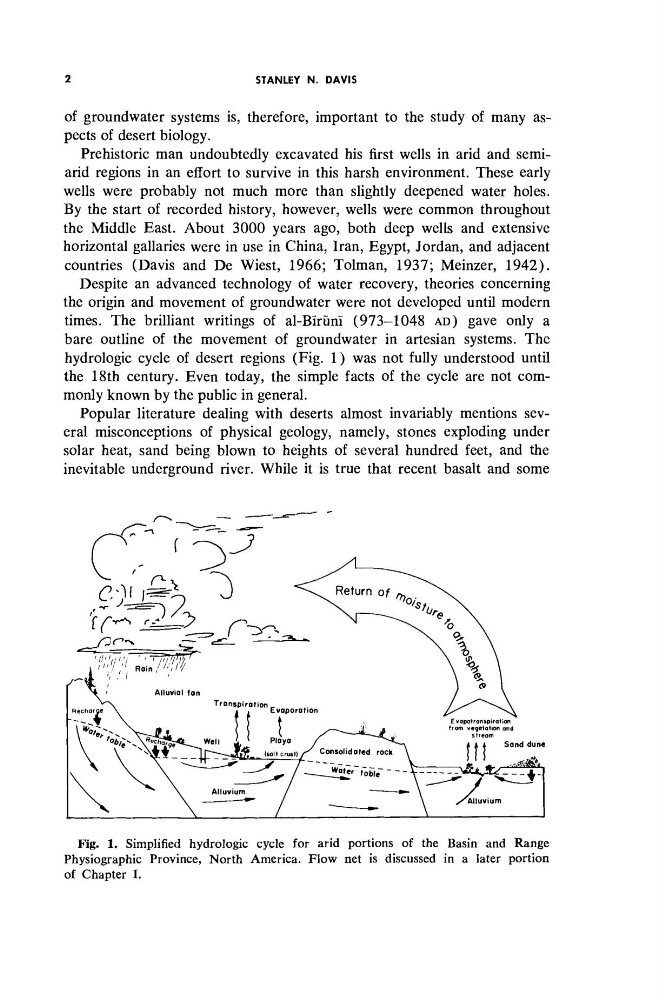
hydrologie cycle of desert regions (Fig. 1 ) was not fully understood until
the 18th century. Even today, the simple facts of the cycle are not commonly known by the public in general.
Popular literature dealing with deserts almost invariably mentions several misconceptions of physical geology, namely, stones exploding under
solar heat, sand being blown to heights of several hundred feet, and the
inevitable underground river. While it is true that recent basalt and some
Fig. 1. Simplified hydrologie cycle for arid portions of the Basin and Range
Physiographic Province, North America. Flow net is discussed in a later portion
of Chapter I.
STANLEY N. DAVIS
of groundwater systems is, therefore, important to the study of many aspects of desert biology.
Prehistoric man undoubtedly excavated his first wells in arid and semiarid regions in an effort to survive in this harsh environment. These early
wells were probably not much more than slightly deepened water holes.
By the start of recorded history, however, wells were common throughout
the Middle East. About 3000 years ago, both deep wells and extensive
horizontal gallaries were in use in China, Iran, Egypt, Jordan, and adjacent
countries (Davis and De Wiest, 1966; Tolman, 1937; Meinzer, 1942).
Despite an advanced technology of water recovery, theories concerning
the origin and movement of groundwater were not developed until modern
times. The brilliant writings of al-Bïrunï (973-1048 AD) gave only a
bare outline of the movement of groundwater in artesian systems. The
hydrologie cycle of desert regions (Fig. 1 ) was not fully understood until
the 18th century. Even today, the simple facts of the cycle are not commonly known by the public in general.
Popular literature dealing with deserts almost invariably mentions several misconceptions of physical geology, namely, stones exploding under
solar heat, sand being blown to heights of several hundred feet, and the
inevitable underground river. While it is true that recent basalt and some
Fig. 1. Simplified hydrologie cycle for arid portions of the Basin and Range
Physiographic Province, North America. Flow net is discussed in a later portion
of Chapter I.