

Ε, C30 Sterols
79
molecular weights 386, 398, 400, 412, 414, and 426 (Gupta and Scheuer,
1969). By preparative glc five components could be separated (the 412/414
pair remained unresolved). The interesting constituent of molecular weight
426 had an unusually long retention time and was present in about 20% of
the mixture. Its physical constants, mp 180°-182°, [a] D -44.7°, suggested that
this sterol might be Bergmann's gorgosterol.
This proved to be correct when Gupta made a direct comparison with
authentic gorgosterol supplied by Ciereszko (Ciereszko et al., 1968). Ciereszko
et al. (1968) had examined the sterols of a number of coelenterates, including
the gorgonian Plexaura flexuosa (Bergmann's original source of gorgosterol),
by mass spectrometry and showed the presence of a compound of molecular
weight 426 in most of the animals. Ciereszko et al. (1968) further showed that
the occurrence of gorgosterol was associated with the zooxanthellae, the
symbiotic unicellular algae. Ciereszko et al. (1968) also made the interesting
observation that under anaerobic conditions gorgosterol is reduced in the
zooanthellae to a dihydrogorgosterol, C30H52O, of molecular weight 428.
The existence of a dihydrogorgosterol of molecular weight 428 allows for an
interesting speculation as to the identity of Attaway and Parker's (1970)
sterol of molecular weight 428 that they detected in a sterol mixture derived
from a recent marine sediment taken at Baffin Bay, Texas. Cholesterol
(C 27 ), campesterol (C 28 ), stigmasterol (C 29 ), and ^-sitosterol (C 29 ) were the
identified sterols.
Gupta (1967) concluded from the signals of a 100 MHz nmr spectrum of
gorgosterol that the unusual feature of gorgosterol was a cyclopropane moiety,
but his attempts to open the ring either reductively or by hydrogen halide
treatment failed.
In a cooperative continuation of this research Hale et al. (1970) succeeded
in opening the cyclopropane ring of dihydrogorgosteryl acetate with hydrochloric acid in acetic acid. The ensuing olefinic mixture was ozonized and the
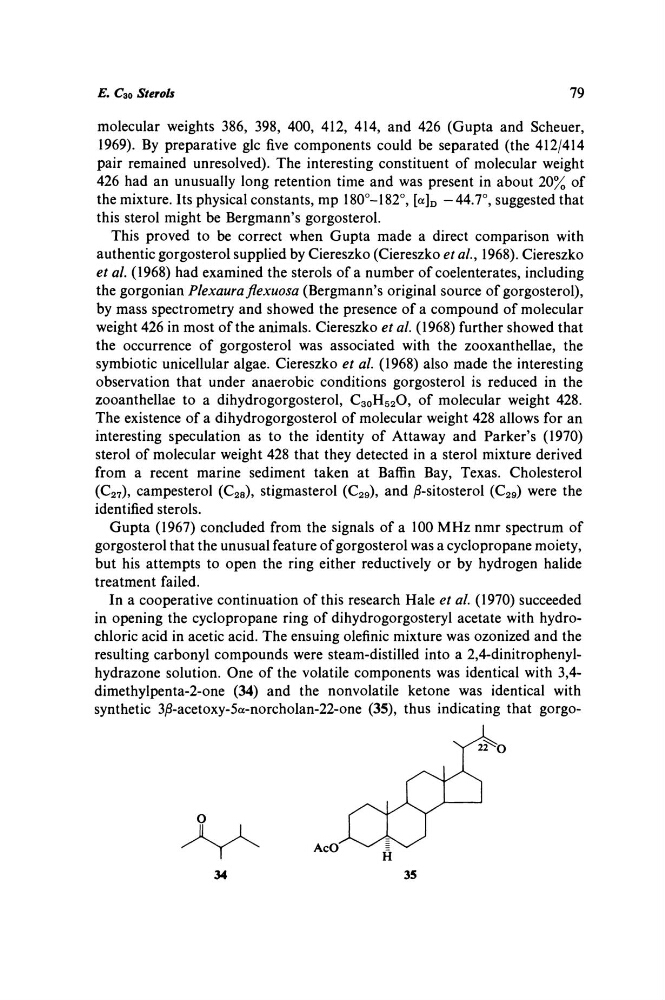
resulting carbonyl compounds were steam-distilled into a 2,4-dinitrophenylhydrazone solution. One of the volatile components was identical with 3,4dimethylpenta-2-one (34) and the nonvolatile ketone was identical with
synthetic 3ß-acetoxy-5a-norcholan-22-one (35), thus indicating that gorgo34
35
79
molecular weights 386, 398, 400, 412, 414, and 426 (Gupta and Scheuer,
1969). By preparative glc five components could be separated (the 412/414
pair remained unresolved). The interesting constituent of molecular weight
426 had an unusually long retention time and was present in about 20% of
the mixture. Its physical constants, mp 180°-182°, [a] D -44.7°, suggested that
this sterol might be Bergmann's gorgosterol.
This proved to be correct when Gupta made a direct comparison with
authentic gorgosterol supplied by Ciereszko (Ciereszko et al., 1968). Ciereszko
et al. (1968) had examined the sterols of a number of coelenterates, including
the gorgonian Plexaura flexuosa (Bergmann's original source of gorgosterol),
by mass spectrometry and showed the presence of a compound of molecular
weight 426 in most of the animals. Ciereszko et al. (1968) further showed that
the occurrence of gorgosterol was associated with the zooxanthellae, the
symbiotic unicellular algae. Ciereszko et al. (1968) also made the interesting
observation that under anaerobic conditions gorgosterol is reduced in the
zooanthellae to a dihydrogorgosterol, C30H52O, of molecular weight 428.
The existence of a dihydrogorgosterol of molecular weight 428 allows for an
interesting speculation as to the identity of Attaway and Parker's (1970)
sterol of molecular weight 428 that they detected in a sterol mixture derived
from a recent marine sediment taken at Baffin Bay, Texas. Cholesterol
(C 27 ), campesterol (C 28 ), stigmasterol (C 29 ), and ^-sitosterol (C 29 ) were the
identified sterols.
Gupta (1967) concluded from the signals of a 100 MHz nmr spectrum of
gorgosterol that the unusual feature of gorgosterol was a cyclopropane moiety,
but his attempts to open the ring either reductively or by hydrogen halide
treatment failed.
In a cooperative continuation of this research Hale et al. (1970) succeeded
in opening the cyclopropane ring of dihydrogorgosteryl acetate with hydrochloric acid in acetic acid. The ensuing olefinic mixture was ozonized and the
resulting carbonyl compounds were steam-distilled into a 2,4-dinitrophenylhydrazone solution. One of the volatile components was identical with 3,4dimethylpenta-2-one (34) and the nonvolatile ketone was identical with
synthetic 3ß-acetoxy-5a-norcholan-22-one (35), thus indicating that gorgo34
35