

76
2. Sterols
in the introduction to this chapter. Although fucosterol was first isolated by
Heilbron et al. (1934) over thirty-five years ago from the brown alga Fucus
vesiculosus, it was a homogeneous entity and its structure was determined
unambiguously by degradation and partial synthesis. Nes and co-workers
(1966) confirmed its distinguishing structural feature, the 24-ethylidene group,
by an nmr study. Ikekawa and co-workers (1968) in their recent quantitative
examination of the sterols of nine species of brown algae found that fucosterol
is the major sterol in all nine species. Its percentage varied from a low of 75.5
in Costaria costata to a high of 97 in Pelvetia wrightii and Dictyopteris divaricata.
8. SARGASTEROL (20-ISOFUCOSTEROL)
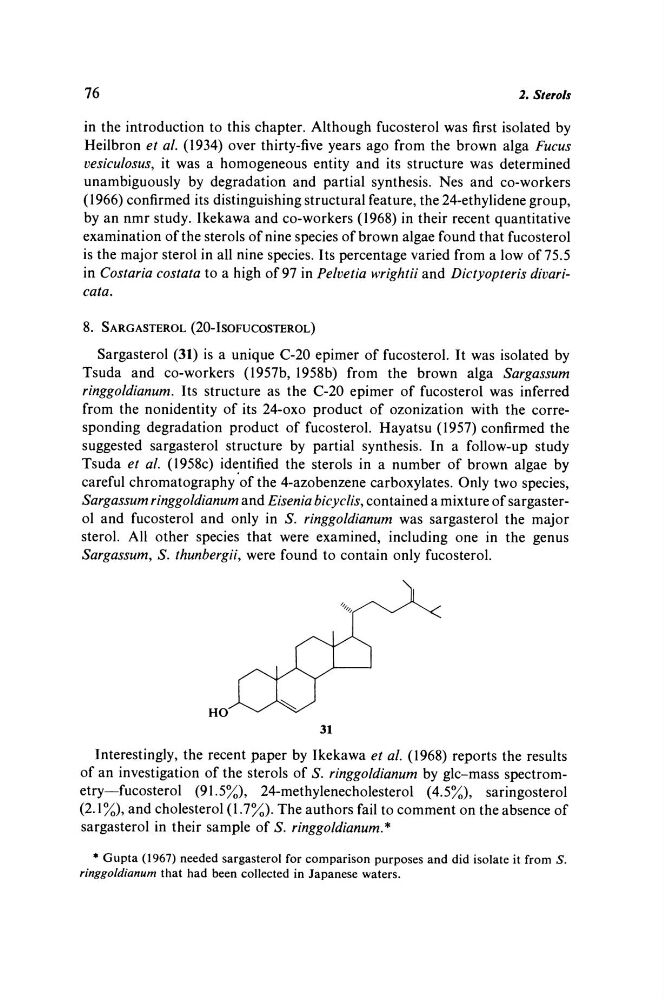
Sargasterol (31) is a unique C-20 epimer of fucosterol. It was isolated by
Tsuda and co-workers (1957b, 1958b) from the brown alga Sargassum
ringgoldianum. Its structure as the C-20 epimer of fucosterol was inferred
from the nonidentity of its 24-oxo product of ozonization with the corresponding degradation product of fucosterol. Hayatsu (1957) confirmed the
suggested sargasterol structure by partial synthesis. In a follow-up study
Tsuda et al. (1958c) identified the sterols in a number of brown algae by
careful chromatography of the 4-azobenzene carboxylates. Only two species,
Sargassum ringgoldianum and Eisenia bicyclis, contained a mixture of sargasterol and fucosterol and only in S. ringgoldianum was sargasterol the major
sterol. All other species that were examined, including one in the genus
Sargassum, S. thunbergii, were found to contain only fucosterol.
31
Interestingly, the recent paper by Ikekawa et al. (1968) reports the results
of an investigation of the sterols of S. ringgoldianum by glc-mass spectrometry—fucosterol (91.5%), 24-methylenecholesterol (4.5%), saringosterol
(2.1%), and cholesterol (1.7%). The authors fail to comment on the absence of
sargasterol in their sample of S. ringgoldianum*
* Gupta (1967) needed sargasterol for comparison purposes and did isolate it from S.
ringgoldianum that had been collected in Japanese waters.
2. Sterols
in the introduction to this chapter. Although fucosterol was first isolated by
Heilbron et al. (1934) over thirty-five years ago from the brown alga Fucus
vesiculosus, it was a homogeneous entity and its structure was determined
unambiguously by degradation and partial synthesis. Nes and co-workers
(1966) confirmed its distinguishing structural feature, the 24-ethylidene group,
by an nmr study. Ikekawa and co-workers (1968) in their recent quantitative
examination of the sterols of nine species of brown algae found that fucosterol
is the major sterol in all nine species. Its percentage varied from a low of 75.5
in Costaria costata to a high of 97 in Pelvetia wrightii and Dictyopteris divaricata.
8. SARGASTEROL (20-ISOFUCOSTEROL)
Sargasterol (31) is a unique C-20 epimer of fucosterol. It was isolated by
Tsuda and co-workers (1957b, 1958b) from the brown alga Sargassum
ringgoldianum. Its structure as the C-20 epimer of fucosterol was inferred
from the nonidentity of its 24-oxo product of ozonization with the corresponding degradation product of fucosterol. Hayatsu (1957) confirmed the
suggested sargasterol structure by partial synthesis. In a follow-up study
Tsuda et al. (1958c) identified the sterols in a number of brown algae by
careful chromatography of the 4-azobenzene carboxylates. Only two species,
Sargassum ringgoldianum and Eisenia bicyclis, contained a mixture of sargasterol and fucosterol and only in S. ringgoldianum was sargasterol the major
sterol. All other species that were examined, including one in the genus
Sargassum, S. thunbergii, were found to contain only fucosterol.
31
Interestingly, the recent paper by Ikekawa et al. (1968) reports the results
of an investigation of the sterols of S. ringgoldianum by glc-mass spectrometry—fucosterol (91.5%), 24-methylenecholesterol (4.5%), saringosterol
(2.1%), and cholesterol (1.7%). The authors fail to comment on the absence of
sargasterol in their sample of S. ringgoldianum*
* Gupta (1967) needed sargasterol for comparison purposes and did isolate it from S.
ringgoldianum that had been collected in Japanese waters.