

C. C 28 Sterols
69
18
fer tus (Gupta and Scheuer, 1969). It has been partially synthesized by Tarzia
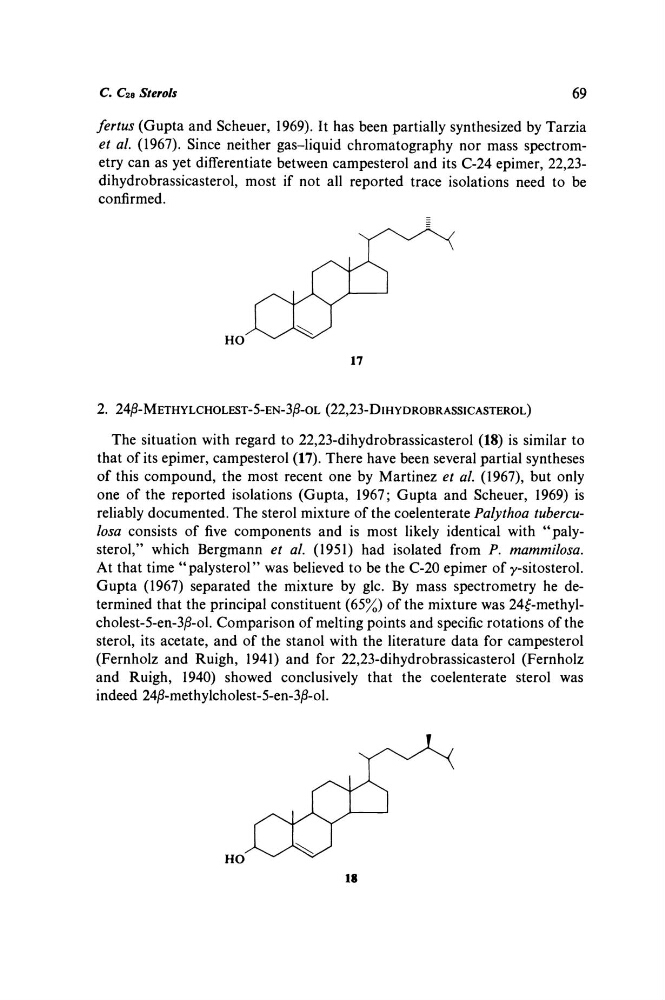
et al. (1967). Since neither gas-liquid chromatography nor mass spectrometry can as yet differentiate between campesterol and its C-24 epimer, 22,23dihydrobrassicasterol, most if not all reported trace isolations need to be
confirmed.
17
2. 24/^METHYLCHOLEST-5-EN-3£-OL (22,23-DIHYDROBRASSICASTEROL)
The situation with regard to 22,23-dihydrobrassicasterol (18) is similar to
that of its epimer, campesterol (17). There have been several partial syntheses
of this compound, the most recent one by Martinez et al. (1967), but only
one of the reported isolations (Gupta, 1967; Gupta and Scheuer, 1969) is
reliably documented. The sterol mixture of the coelenterate Palythoa tuberculosa consists of five components and is most likely identical with "palysterol," which Bergmann et al. (1951) had isolated from P. mammilosa.
At that time "palysterol" was believed to be the C-20 epimer of y-sitosterol.
Gupta (1967) separated the mixture by glc. By mass spectrometry he determined that the principal constituent (65%) of the mixture was 24£-methylcholest-5-en-3ß-ol. Comparison of melting points and specific rotations of the
sterol, its acetate, and of the stanol with the literature data for campesterol
(Fernholz and Ruigh, 1941) and for 22,23-dihydrobrassicasterol (Fernholz
and Ruigh, 1940) showed conclusively that the coelenterate sterol was
indeed 24ß-methylcholest-5-en-3ß-ol.
69
18
fer tus (Gupta and Scheuer, 1969). It has been partially synthesized by Tarzia
et al. (1967). Since neither gas-liquid chromatography nor mass spectrometry can as yet differentiate between campesterol and its C-24 epimer, 22,23dihydrobrassicasterol, most if not all reported trace isolations need to be
confirmed.
17
2. 24/^METHYLCHOLEST-5-EN-3£-OL (22,23-DIHYDROBRASSICASTEROL)
The situation with regard to 22,23-dihydrobrassicasterol (18) is similar to
that of its epimer, campesterol (17). There have been several partial syntheses
of this compound, the most recent one by Martinez et al. (1967), but only
one of the reported isolations (Gupta, 1967; Gupta and Scheuer, 1969) is
reliably documented. The sterol mixture of the coelenterate Palythoa tuberculosa consists of five components and is most likely identical with "palysterol," which Bergmann et al. (1951) had isolated from P. mammilosa.
At that time "palysterol" was believed to be the C-20 epimer of y-sitosterol.
Gupta (1967) separated the mixture by glc. By mass spectrometry he determined that the principal constituent (65%) of the mixture was 24£-methylcholest-5-en-3ß-ol. Comparison of melting points and specific rotations of the
sterol, its acetate, and of the stanol with the literature data for campesterol
(Fernholz and Ruigh, 1941) and for 22,23-dihydrobrassicasterol (Fernholz
and Ruigh, 1940) showed conclusively that the coelenterate sterol was
indeed 24ß-methylcholest-5-en-3ß-ol.