

C. C 28 Sterols
67
constituents of the bile of vertebrates. In most animals these compounds are
largely C-24 carboxylic acid derivatives of degraded C 27 sterols. The derivatives generally are sodium salts of glycine (11) or taurine (12), where the
amino function has formed an amide linkage with the C-24 carboxyl group.
In the bile of amphibians and elasmobranch fishes (sharks and rays) the
bile salts frequently are not derivatives of a C 24 acid, but either partly or
exclusively sodium sulfate esters of C 27 alcohols.
H 2 N— CH 2 —C0 2 H
H 2 N —CH 2 —CH 2 —S0 3 H
11
12
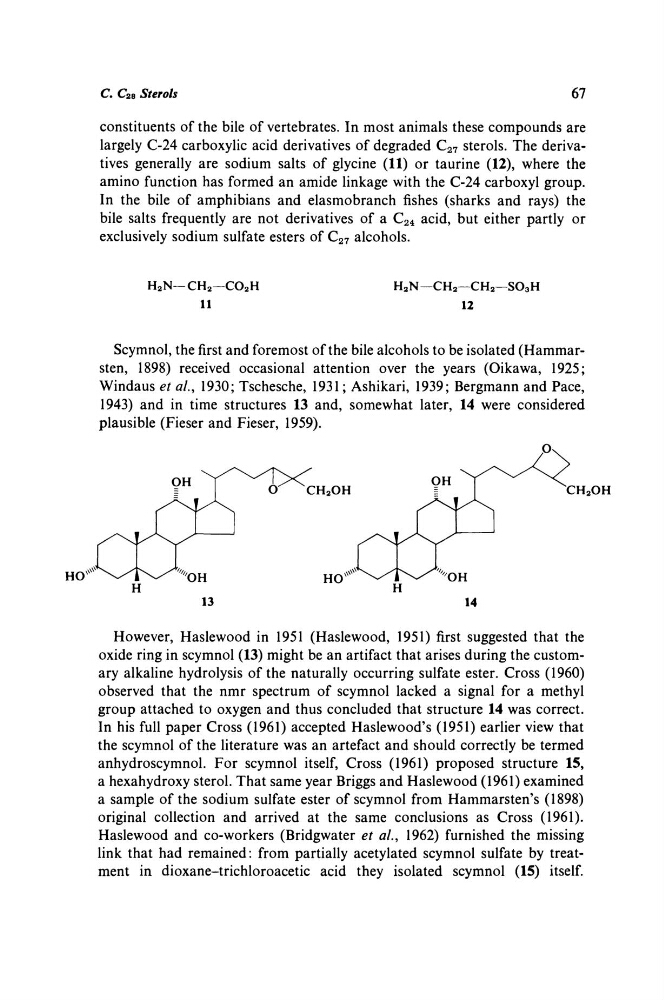
Scymnol, the first and foremost of the bile alcohols to be isolated (Hammarsten, 1898) received occasional attention over the years (Oikawa, 1925;
Windaus et al, 1930; Tschesche, 1931 ; Ashikari, 1939; Bergmann and Pace,
1943) and in time structures 13 and, somewhat later, 14 were considered
plausible (Fieser and Fieser, 1959).
/°\
OH Y^LX
OH ^] ^^^^C
I
I
Ο
CH 2 OH
I
I
CH 2 OH
Η
Η
13
14
However, Haslewood in 1951 (Haslewood, 1951) first suggested that the
oxide ring in scymnol (13) might be an artifact that arises during the customary alkaline hydrolysis of the naturally occurring sulfate ester. Cross (1960)
observed that the nmr spectrum of scymnol lacked a signal for a methyl
group attached to oxygen and thus concluded that structure 14 was correct.
In his full paper Cross (1961) accepted Haslewood's (1951) earlier view that
the scymnol of the literature was an artefact and should correctly be termed
anhydroscymnol. For scymnol itself, Cross (1961) proposed structure 15,
a hexahydroxy sterol. That same year Briggs and Haslewood (1961) examined
a sample of the sodium sulfate ester of scymnol from Hammarsten's (1898)
original collection and arrived at the same conclusions as Cross (1961).
Haslewood and co-workers (Bridgwater et al, 1962) furnished the missing
link that had remained: from partially acetylated scymnol sulfate by treatment in dioxane-trichloroacetic acid they isolated scymnol (15) itself.
67
constituents of the bile of vertebrates. In most animals these compounds are
largely C-24 carboxylic acid derivatives of degraded C 27 sterols. The derivatives generally are sodium salts of glycine (11) or taurine (12), where the
amino function has formed an amide linkage with the C-24 carboxyl group.
In the bile of amphibians and elasmobranch fishes (sharks and rays) the
bile salts frequently are not derivatives of a C 24 acid, but either partly or
exclusively sodium sulfate esters of C 27 alcohols.
H 2 N— CH 2 —C0 2 H
H 2 N —CH 2 —CH 2 —S0 3 H
11
12
Scymnol, the first and foremost of the bile alcohols to be isolated (Hammarsten, 1898) received occasional attention over the years (Oikawa, 1925;
Windaus et al, 1930; Tschesche, 1931 ; Ashikari, 1939; Bergmann and Pace,
1943) and in time structures 13 and, somewhat later, 14 were considered
plausible (Fieser and Fieser, 1959).
/°\
OH Y^LX
OH ^] ^^^^C
I
I
Ο
CH 2 OH
I
I
CH 2 OH
Η
Η
13
14
However, Haslewood in 1951 (Haslewood, 1951) first suggested that the
oxide ring in scymnol (13) might be an artifact that arises during the customary alkaline hydrolysis of the naturally occurring sulfate ester. Cross (1960)
observed that the nmr spectrum of scymnol lacked a signal for a methyl
group attached to oxygen and thus concluded that structure 14 was correct.
In his full paper Cross (1961) accepted Haslewood's (1951) earlier view that
the scymnol of the literature was an artefact and should correctly be termed
anhydroscymnol. For scymnol itself, Cross (1961) proposed structure 15,
a hexahydroxy sterol. That same year Briggs and Haslewood (1961) examined
a sample of the sodium sulfate ester of scymnol from Hammarsten's (1898)
original collection and arrived at the same conclusions as Cross (1961).
Haslewood and co-workers (Bridgwater et al, 1962) furnished the missing
link that had remained: from partially acetylated scymnol sulfate by treatment in dioxane-trichloroacetic acid they isolated scymnol (15) itself.