

D. Carotenoids
39
fusidic (94) acids, also products of microorganisms. All three compounds
have in common a dienic side chain that includes a carboxyl group at C-21 ;
oxygenation at C-16; lacking methyl groups at C-4 and C-13; and a rare
methyl group at C-8.
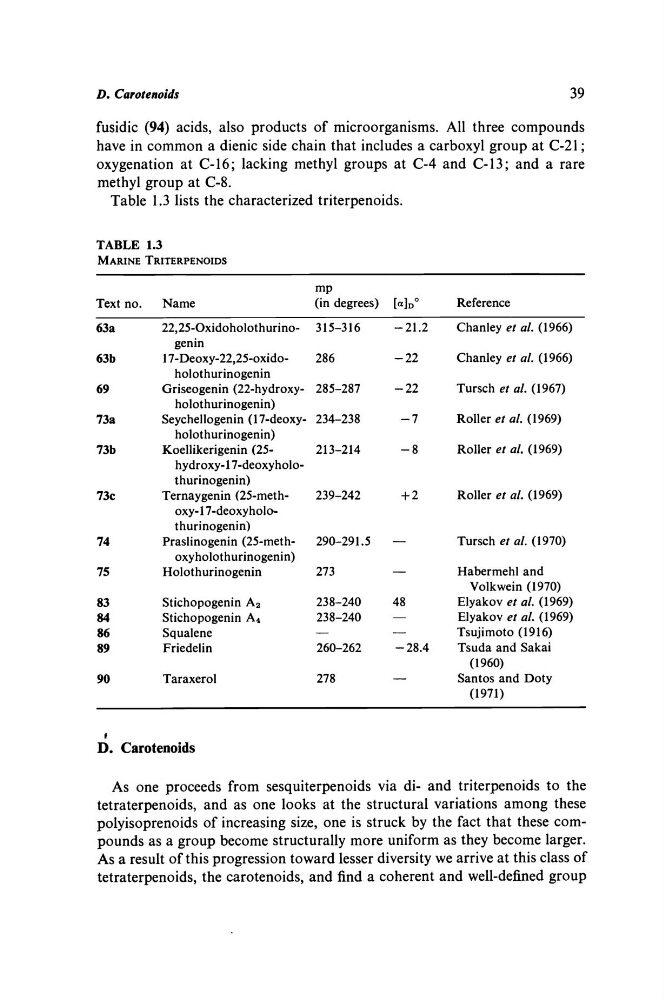
Table 1.3 lists the characterized triterpenoids.
TABLE 1.3
MARINE TRITERPENOIDS
mp
Text no.
Name
(in degrees)
Reference
63a
22,25-Oxidoholothurino- 315-316
-21.2
Chanley et al (1966)
genin
63b
17-Deoxy-22,25-oxido286
-22
Chanley et al (1966)
holothurinogenin
69
Griseogenin (22-hydroxy- 285-287
-22
Tursch et al (1967)
holothurinogenin)
73a
Seychellogenin (17-deoxy- 234-238
-7
Roller et al (1969)
holothurinogenin)
73b
Koellikerigenin (25213-214
-8
Roller et al (1969)
hydroxy-17-deoxyholothurinogenin)
73c
Ternaygenin (25-meth239-242
+ 2
Roller et al (1969)
oxy-17-deoxyholothurinogenin)
74
Praslinogenin (25-meth290-291.5
—
Tursch et al (1970)
oxyholothurinogenin)
75
Holothurinogenin
273
—
Habermehl and
Volkwein (1970)
83
Stichopogenin A 2
238-240
48
Elyakov et al (1969)
84
Stichopogenin A 4
238-240
—
Elyakov et al (1969)
86
Squalene
—
—
Tsujimoto (1916)
89
Friedelin
260-262
-28.4
Tsuda and Sakai
(1960)
90
Taraxerol
278
—
Santos and Doty
(1971)
D. Carotenoids
As one proceeds from sesquiterpenoids via di- and triterpenoids to the
tetraterpenoids, and as one looks at the structural variations among these
polyisoprenoids of increasing size, one is struck by the fact that these compounds as a group become structurally more uniform as they become larger.
As a result of this progression toward lesser diversity we arrive at this class of
tetraterpenoids, the carotenoids, and find a coherent and well-defined group
39
fusidic (94) acids, also products of microorganisms. All three compounds
have in common a dienic side chain that includes a carboxyl group at C-21 ;
oxygenation at C-16; lacking methyl groups at C-4 and C-13; and a rare
methyl group at C-8.
Table 1.3 lists the characterized triterpenoids.
TABLE 1.3
MARINE TRITERPENOIDS
mp
Text no.
Name
(in degrees)
Reference
63a
22,25-Oxidoholothurino- 315-316
-21.2
Chanley et al (1966)
genin
63b
17-Deoxy-22,25-oxido286
-22
Chanley et al (1966)
holothurinogenin
69
Griseogenin (22-hydroxy- 285-287
-22
Tursch et al (1967)
holothurinogenin)
73a
Seychellogenin (17-deoxy- 234-238
-7
Roller et al (1969)
holothurinogenin)
73b
Koellikerigenin (25213-214
-8
Roller et al (1969)
hydroxy-17-deoxyholothurinogenin)
73c
Ternaygenin (25-meth239-242
+ 2
Roller et al (1969)
oxy-17-deoxyholothurinogenin)
74
Praslinogenin (25-meth290-291.5
—
Tursch et al (1970)
oxyholothurinogenin)
75
Holothurinogenin
273
—
Habermehl and
Volkwein (1970)
83
Stichopogenin A 2
238-240
48
Elyakov et al (1969)
84
Stichopogenin A 4
238-240
—
Elyakov et al (1969)
86
Squalene
—
—
Tsujimoto (1916)
89
Friedelin
260-262
-28.4
Tsuda and Sakai
(1960)
90
Taraxerol
278
—
Santos and Doty
(1971)
D. Carotenoids
As one proceeds from sesquiterpenoids via di- and triterpenoids to the
tetraterpenoids, and as one looks at the structural variations among these
polyisoprenoids of increasing size, one is struck by the fact that these compounds as a group become structurally more uniform as they become larger.
As a result of this progression toward lesser diversity we arrive at this class of
tetraterpenoids, the carotenoids, and find a coherent and well-defined group