

C. Triterpenoids
25
CH 2 OH
CH 3
κ^τν ar°y
HO^Ç
γ
O H
Ηθ\|Ι γ OH
HQΝ] γ OH
OH
OH
OH
60
61
62
a: R = H
b: R = Me
follows : aglycone-xylose-glucose-3-methoxyglucose-quinovose (Chanley et
al, 1960). The authors deduced on the basis of circumstantial evidence that
the sulfuric acid moiety was attached to the aglycone rather than to a sugar.
Subsequently this point turned out to be incorrect. Chanley and Rossi
(1969b) mention in passing that the xylose molecule is the locus of attachment
for the sulfuric acid.
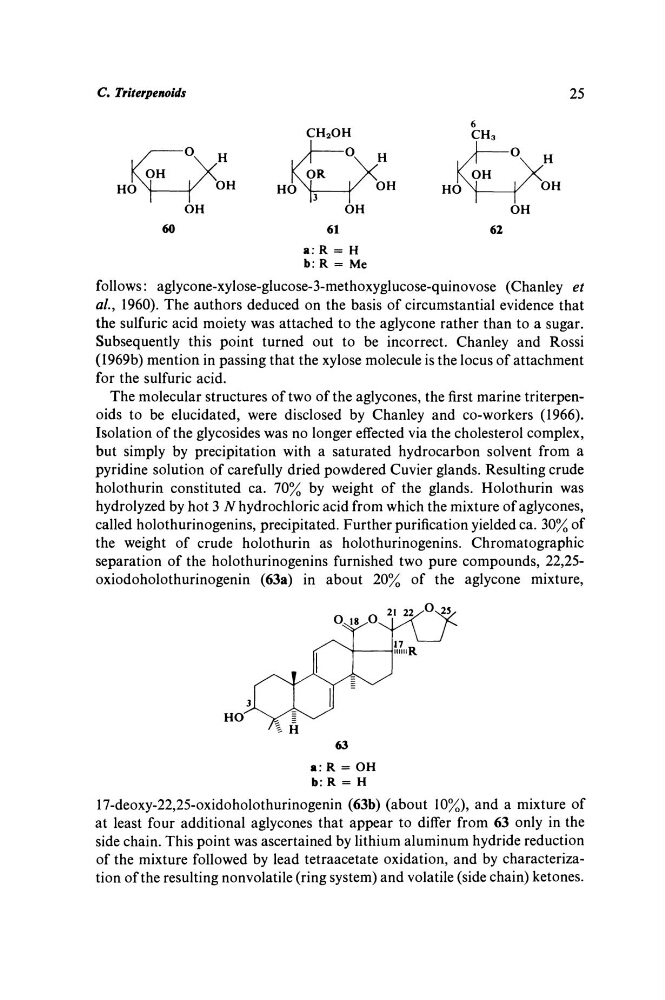
The molecular structures of two of the aglycones, the first marine triterpenoids to be elucidated, were disclosed by Chanley and co-workers (1966).
Isolation of the glycosides was no longer effected via the cholesterol complex,
but simply by precipitation with a saturated hydrocarbon solvent from a
pyridine solution of carefully dried powdered Cuvier glands. Resulting crude
holothurin constituted ca. 70% by weight of the glands. Holothurin was
hydrolyzed by hot 3 Ν hydrochloric acid from which the mixture of aglycones,
called holothurinogenins, precipitated. Further purification yielded ca. 30% of
the weight of crude holothurin as holothurinogenins. Chromatographic
separation of the holothurinogenins furnished two pure compounds, 22,25oxiodoholothurinogenin (63a) in about 20% of the aglycone mixture,
-
^ 21 22/0X25,
I ^ |R
'% Η
63
a: R = OH
b: R = Η
17-deoxy-22,25-oxidoholothurinogenin (63b) (about 10%), and a mixture of
at least four additional aglycones that appear to differ from 63 only in the
side chain. This point was ascertained by lithium aluminum hydride reduction
of the mixture followed by lead tetraacetate oxidation, and by characterization of the resulting nonvolatile (ring system) and volatile (side chain) ketones.
25
CH 2 OH
CH 3
κ^τν ar°y
HO^Ç
γ
O H
Ηθ\|Ι γ OH
HQΝ] γ OH
OH
OH
OH
60
61
62
a: R = H
b: R = Me
follows : aglycone-xylose-glucose-3-methoxyglucose-quinovose (Chanley et
al, 1960). The authors deduced on the basis of circumstantial evidence that
the sulfuric acid moiety was attached to the aglycone rather than to a sugar.
Subsequently this point turned out to be incorrect. Chanley and Rossi
(1969b) mention in passing that the xylose molecule is the locus of attachment
for the sulfuric acid.
The molecular structures of two of the aglycones, the first marine triterpenoids to be elucidated, were disclosed by Chanley and co-workers (1966).
Isolation of the glycosides was no longer effected via the cholesterol complex,
but simply by precipitation with a saturated hydrocarbon solvent from a
pyridine solution of carefully dried powdered Cuvier glands. Resulting crude
holothurin constituted ca. 70% by weight of the glands. Holothurin was
hydrolyzed by hot 3 Ν hydrochloric acid from which the mixture of aglycones,
called holothurinogenins, precipitated. Further purification yielded ca. 30% of
the weight of crude holothurin as holothurinogenins. Chromatographic
separation of the holothurinogenins furnished two pure compounds, 22,25oxiodoholothurinogenin (63a) in about 20% of the aglycone mixture,
-
^ 21 22/0X25,
I ^ |R
'% Η
63
a: R = OH
b: R = Η
17-deoxy-22,25-oxidoholothurinogenin (63b) (about 10%), and a mixture of
at least four additional aglycones that appear to differ from 63 only in the
side chain. This point was ascertained by lithium aluminum hydride reduction
of the mixture followed by lead tetraacetate oxidation, and by characterization of the resulting nonvolatile (ring system) and volatile (side chain) ketones.