

A. Sesquiterpenoids
15
in either Aplysia or Laurencia or in any other marine source. It is, however, a
heartwood constituent of various coniferous species in the plant family
Cupressaceae (Enzell and Erdtman, 1958); its structural assignments have
been confirmed by synthesis (Parker et aL, 1962).
JQJ£2χ j®XX
39
40
In their chemical conversion of laurene (29) into cuparene (38) Irie and
co-workers (1967) used the natural ketone 30 as their key intermediate.
Interestingly, they were unable to achieve the transformation back to
laurene (29), but instead isolated a mixture of epilaurene (39) and isolaurene
(40).
r^\ ^-—^^"i ni i m i n M un»—
KJJ^ J I
a: R = Η
^^(OR I
CHBr
b: R = Ac
41
A variant of structure 39 is the sesquiterpenoid laurenisol (41a), which
Irie and co-workers (1969a) isolated from Laurencia nipponica. Laurenisol
(41a), [a] D +85.9°, is unstable at room temperature, but forms a stable
acetate (41b) mp 102.5°-103°, [«] D +85.Γ. When laurenisol (41a) was placed
in a vacuum desiccator overnight, it was transformed into an oily mixture,
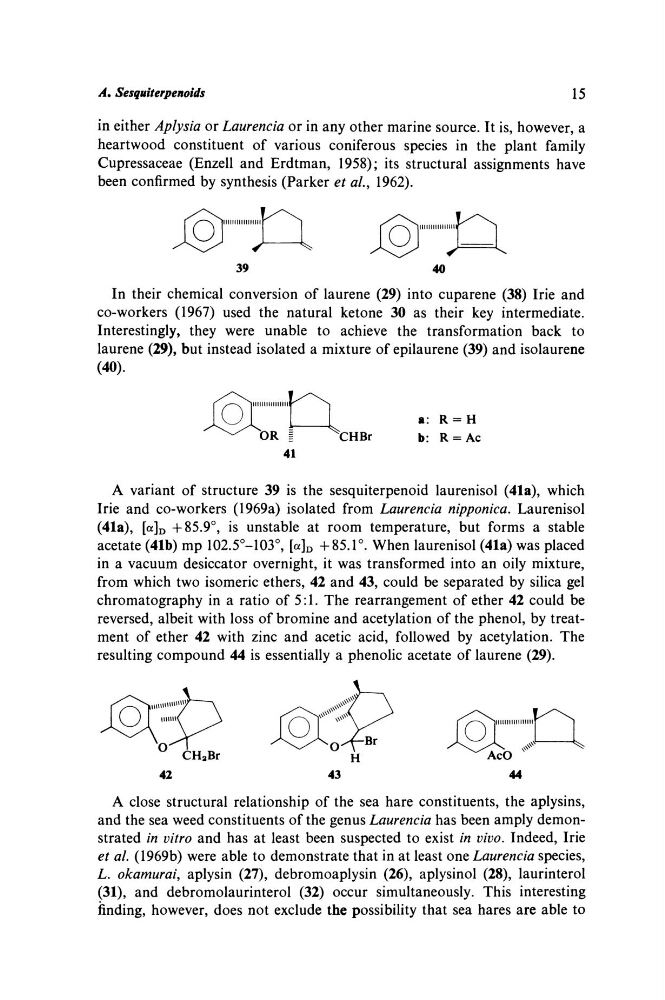
from which two isomeric ethers, 42 and 43, could be separated by silica gel
chromatography in a ratio of 5:1. The rearrangement of ether 42 could be
reversed, albeit with loss of bromine and acetylation of the phenol, by treatment of ether 42 with zinc and acetic acid, followed by acetylation. The
resulting compound 44 is essentially a phenolic acetate of laurene (29).
CH 3 Br
H
^AcO *
42
43
44
A close structural relationship of the sea hare constituents, the aplysins,
and the sea weed constituents of the genus Laurencia has been amply demonstrated in vitro and has at least been suspected to exist in vivo. Indeed, Irie
et al. (1969b) were able to demonstrate that in at least one Laurencia species,
L. okamurai, aplysin (27), debromoaplysin (26), aplysinol (28), laurinterol
(31), and debromolaurinterol (32) occur simultaneously. This interesting
rinding, however, does not exclude the possibility that sea hares are able to
15
in either Aplysia or Laurencia or in any other marine source. It is, however, a
heartwood constituent of various coniferous species in the plant family
Cupressaceae (Enzell and Erdtman, 1958); its structural assignments have
been confirmed by synthesis (Parker et aL, 1962).
JQJ£2χ j®XX
39
40
In their chemical conversion of laurene (29) into cuparene (38) Irie and
co-workers (1967) used the natural ketone 30 as their key intermediate.
Interestingly, they were unable to achieve the transformation back to
laurene (29), but instead isolated a mixture of epilaurene (39) and isolaurene
(40).
r^\ ^-—^^"i ni i m i n M un»—
KJJ^ J I
a: R = Η
^^(OR I
CHBr
b: R = Ac
41
A variant of structure 39 is the sesquiterpenoid laurenisol (41a), which
Irie and co-workers (1969a) isolated from Laurencia nipponica. Laurenisol
(41a), [a] D +85.9°, is unstable at room temperature, but forms a stable
acetate (41b) mp 102.5°-103°, [«] D +85.Γ. When laurenisol (41a) was placed
in a vacuum desiccator overnight, it was transformed into an oily mixture,
from which two isomeric ethers, 42 and 43, could be separated by silica gel
chromatography in a ratio of 5:1. The rearrangement of ether 42 could be
reversed, albeit with loss of bromine and acetylation of the phenol, by treatment of ether 42 with zinc and acetic acid, followed by acetylation. The
resulting compound 44 is essentially a phenolic acetate of laurene (29).
CH 3 Br
H
^AcO *
42
43
44
A close structural relationship of the sea hare constituents, the aplysins,
and the sea weed constituents of the genus Laurencia has been amply demonstrated in vitro and has at least been suspected to exist in vivo. Indeed, Irie
et al. (1969b) were able to demonstrate that in at least one Laurencia species,
L. okamurai, aplysin (27), debromoaplysin (26), aplysinol (28), laurinterol
(31), and debromolaurinterol (32) occur simultaneously. This interesting
rinding, however, does not exclude the possibility that sea hares are able to