

4
1, Isoprenoids
constituted an authentic occurrence of a typical plant constituent in a marine
animal, a carnivore at that ! Being aware of the unusual nature of this finding
Ciereszko et al. (1960) suggested that the terpenoids might be synthesized
not by the gorgonians but by the unicellular algae, the zooxanthellae, which
are symbiotically associated with the animals. Subsequently Ciereszko (1962)
examined the zooxanthellae associated with the gorgonian Pseudoplexaura
crassa* and found that the algae alone contained at least 3% cadinene (based
on dry weight) and 8% of a substance that was designated crassin acetate.
Crassin acetate, a diterpene lactone, had also been isolated and partially
characterized during the earlier survey (Ciereszko et al, 1960).
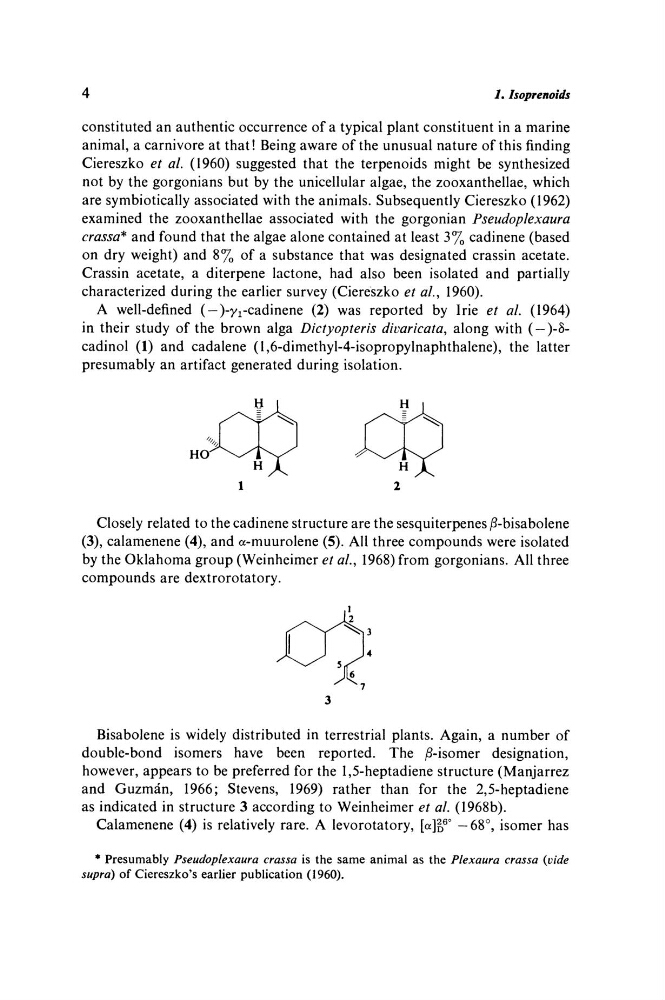
A well-defined ( —)-y 1 -cadinene (2) was reported by Irie et al. (1964)
in their study of the brown alga Dicty opter is divaricata, along with ( — )-δcadinol (1) and cadalene (l,6-dimethyl-4-isopropylnaphthalene), the latter
presumably an artifact generated during isolation.
H
A
H
A.
1
2
Closely related to the cadinene structure are the sesquiterpenes ß-bisabolene
(3), calamenene (4), and a-muurolene (5). All three compounds were isolated
by the Oklahoma group (Weinheimer et ai, 1968) from gorgonians. All three
compounds are dextrorotatory.
.1
7
3
Bisabolene is widely distributed in terrestrial plants. Again, a number of
double-bond isomers have been reported. The ß-isomer designation,
however, appears to be preferred for the 1,5-heptadiene structure (Manjarrez
and Guzman, 1966; Stevens, 1969) rather than for the 2,5-heptadiene
as indicated in structure 3 according to Weinheimer et al. (1968b).
Calamenene (4) is relatively rare. A levorotatory, [αβ
60 — 68°, isomer has
* Presumably Pseudoplexaura crassa is the same animal as the Plexaura crassa {vide
supra) of Ciereszko's earlier publication (1960).
1, Isoprenoids
constituted an authentic occurrence of a typical plant constituent in a marine
animal, a carnivore at that ! Being aware of the unusual nature of this finding
Ciereszko et al. (1960) suggested that the terpenoids might be synthesized
not by the gorgonians but by the unicellular algae, the zooxanthellae, which
are symbiotically associated with the animals. Subsequently Ciereszko (1962)
examined the zooxanthellae associated with the gorgonian Pseudoplexaura
crassa* and found that the algae alone contained at least 3% cadinene (based
on dry weight) and 8% of a substance that was designated crassin acetate.
Crassin acetate, a diterpene lactone, had also been isolated and partially
characterized during the earlier survey (Ciereszko et al, 1960).
A well-defined ( —)-y 1 -cadinene (2) was reported by Irie et al. (1964)
in their study of the brown alga Dicty opter is divaricata, along with ( — )-δcadinol (1) and cadalene (l,6-dimethyl-4-isopropylnaphthalene), the latter
presumably an artifact generated during isolation.
H
A
H
A.
1
2
Closely related to the cadinene structure are the sesquiterpenes ß-bisabolene
(3), calamenene (4), and a-muurolene (5). All three compounds were isolated
by the Oklahoma group (Weinheimer et ai, 1968) from gorgonians. All three
compounds are dextrorotatory.
.1
7
3
Bisabolene is widely distributed in terrestrial plants. Again, a number of
double-bond isomers have been reported. The ß-isomer designation,
however, appears to be preferred for the 1,5-heptadiene structure (Manjarrez
and Guzman, 1966; Stevens, 1969) rather than for the 2,5-heptadiene
as indicated in structure 3 according to Weinheimer et al. (1968b).
Calamenene (4) is relatively rare. A levorotatory, [αβ
60 — 68°, isomer has
* Presumably Pseudoplexaura crassa is the same animal as the Plexaura crassa {vide
supra) of Ciereszko's earlier publication (1960).