

156
4. Nitrogenous Compounds
C0 2 ME
C
χίΛΓ
ΟΛ„
CO z Me
I
H
*
N
N
Η
Me0 2 C
N
NAc Γ
^
- N
N A
c
C
+
C=NAc
•
I
I
I
J
IO.Me
» MTV™
o
o
122
123
124
126
SCHEME 4.6
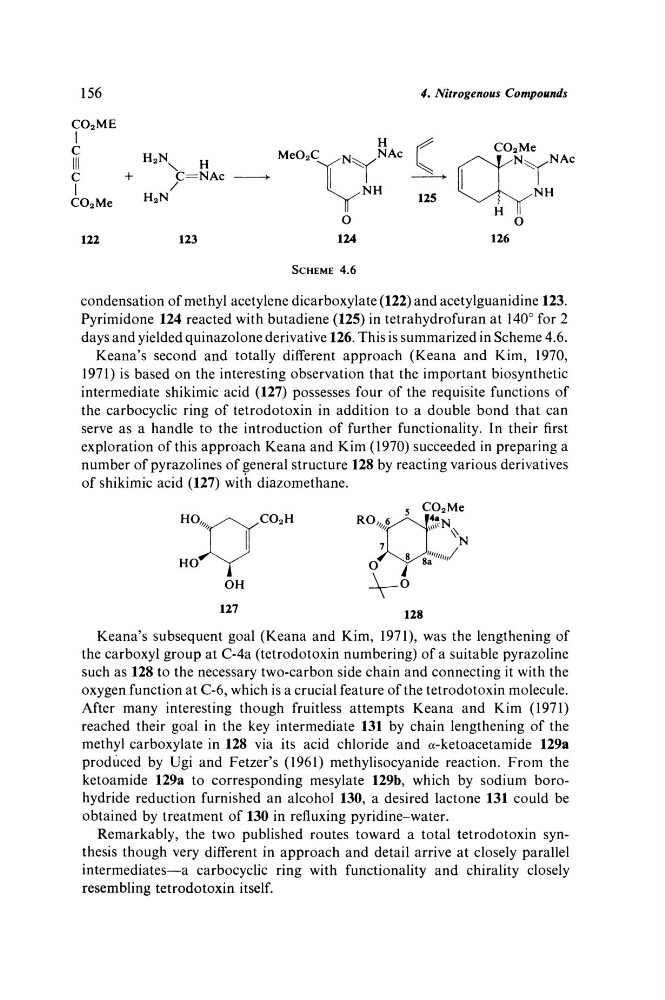
condensation of methyl acetylene dicarboxylate (122) and acetylguanidine 123.
Pyrimidone 124 reacted with butadiene (125) in tetrahydrofuran at 140° for 2
days and yielded quinazolone derivative 126. This is summarized in Scheme 4.6.
Keana's second and totally different approach (Keana and Kim, 1970,
1971) is based on the interesting observation that the important biosynthetic
intermediate shikimic acid (127) possesses four of the requisite functions of
the carbocyclic ring of tetrodotoxin in addition to a double bond that can
serve as a handle to the introduction of further functionality. In their first
exploration of this approach Keana and Kim (1970) succeeded in preparing a
number of pyrazolines of general structure 128 by reacting various derivatives
of shikimic acid (127) with diazomethane.
, C0 2 Me
OH "V~°
1 2 7
128
Keana's subsequent goal (Keana and Kim, 1971), was the lengthening of
the carboxyl group at C-4a (tetrodotoxin numbering) of a suitable pyrazoline
such as 128 to the necessary two-carbon side chain and connecting it with the
oxygen function at C-6, which is a crucial feature of the tetrodotoxin molecule.
After many interesting though fruitless attempts Keana and Kim (1971)
reached their goal in the key intermediate 131 by chain lengthening of the
methyl carboxylate in 128 via its acid chloride and α-ketoacetamide 129a
produced by Ugi and Fetzer's (1961) methylisocyanide reaction. From the
ketoamide 129a to corresponding mesylate 129b, which by sodium borohydride reduction furnished an alcohol 130, a desired lactone 131 could be
obtained by treatment of 130 in refluxing pyridine-water.
Remarkably, the two published routes toward a total tetrodotoxin synthesis though very different in approach and detail arrive at closely parallel
intermediates—a carbocyclic ring with functionality and chirality closely
resembling tetrodotoxin itself.
4. Nitrogenous Compounds
C0 2 ME
C
χίΛΓ
ΟΛ„
CO z Me
I
H
*
N
N
Η
Me0 2 C
N
NAc Γ
^
- N
N A
c
C
+
C=NAc
•
I
I
I
J
IO.Me
» MTV™
o
o
122
123
124
126
SCHEME 4.6
condensation of methyl acetylene dicarboxylate (122) and acetylguanidine 123.
Pyrimidone 124 reacted with butadiene (125) in tetrahydrofuran at 140° for 2
days and yielded quinazolone derivative 126. This is summarized in Scheme 4.6.
Keana's second and totally different approach (Keana and Kim, 1970,
1971) is based on the interesting observation that the important biosynthetic
intermediate shikimic acid (127) possesses four of the requisite functions of
the carbocyclic ring of tetrodotoxin in addition to a double bond that can
serve as a handle to the introduction of further functionality. In their first
exploration of this approach Keana and Kim (1970) succeeded in preparing a
number of pyrazolines of general structure 128 by reacting various derivatives
of shikimic acid (127) with diazomethane.
, C0 2 Me
OH "V~°
1 2 7
128
Keana's subsequent goal (Keana and Kim, 1971), was the lengthening of
the carboxyl group at C-4a (tetrodotoxin numbering) of a suitable pyrazoline
such as 128 to the necessary two-carbon side chain and connecting it with the
oxygen function at C-6, which is a crucial feature of the tetrodotoxin molecule.
After many interesting though fruitless attempts Keana and Kim (1971)
reached their goal in the key intermediate 131 by chain lengthening of the
methyl carboxylate in 128 via its acid chloride and α-ketoacetamide 129a
produced by Ugi and Fetzer's (1961) methylisocyanide reaction. From the
ketoamide 129a to corresponding mesylate 129b, which by sodium borohydride reduction furnished an alcohol 130, a desired lactone 131 could be
obtained by treatment of 130 in refluxing pyridine-water.
Remarkably, the two published routes toward a total tetrodotoxin synthesis though very different in approach and detail arrive at closely parallel
intermediates—a carbocyclic ring with functionality and chirality closely
resembling tetrodotoxin itself.