

D, Complex Polycyclic Compounds
153
three carbons of the carbocyclic ring, C-5, C-7, and C-8, would bear single
hydrogen atoms as well as acyloxy groups. In fact, the nmr spectrum of the
heptaacetylanhydro derivative exhibited only one such resonance. Consequently, two of the three involved hydroxy groups apparently combined to
form a new system. If, as is shown in Scheme 4.4, one of the hydroxyl groups
combines with the lactone function to form a hemilactal grouping, only one
hydroxyl group remains to be acetylated. Double resonance experiments on
the heptaacetylanhydro derivative showed that the hydroxyl group at C-8
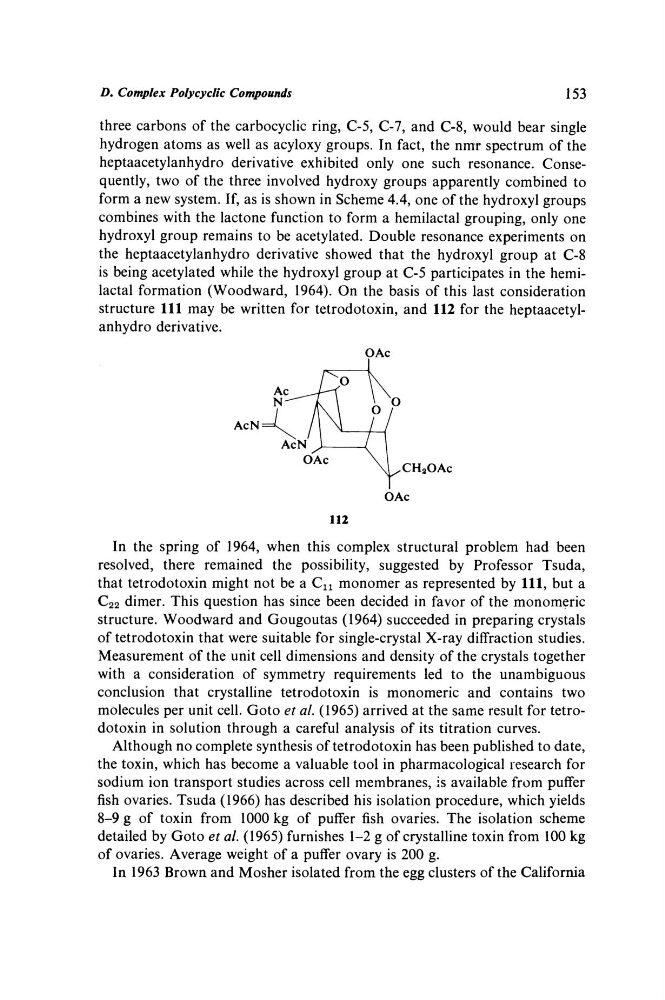
is being acetylated while the hydroxyl group at C-5 participates in the hemilactal formation (Woodward, 1964). On the basis of this last consideration
structure 111 may be written for tetrodotoxin, and 112 for the heptaacetylanhydro derivative.
OAc
°
A C
\ L c H 2 O A c
OAc
112
In the spring of 1964, when this complex structural problem had been
resolved, there remained the possibility, suggested by Professor Tsuda,
that tetrodotoxin might not be a C n monomer as represented by 111, but a
C 22 dimer. This question has since been decided in favor of the monomeric
structure. Woodward and Gougoutas (1964) succeeded in preparing crystals
of tetrodotoxin that were suitable for single-crystal X-ray diffraction studies.
Measurement of the unit cell dimensions and density of the crystals together
with a consideration of symmetry requirements led to the unambiguous
conclusion that crystalline tetrodotoxin is monomeric and contains two
molecules per unit cell. Goto et al (1965) arrived at the same result for tetrodotoxin in solution through a careful analysis of its titration curves.
Although no complete synthesis of tetrodotoxin has been published to date,
the toxin, which has become a valuable tool in pharmacological research for
sodium ion transport studies across cell membranes, is available from puffer
fish ovaries. Tsuda (1966) has described his isolation procedure, which yields
8-9 g of toxin from 1000 kg of puffer fish ovaries. The isolation scheme
detailed by Goto et al (1965) furnishes 1-2 g of crystalline toxin from 100 kg
of ovaries. Average weight of a puffer ovary is 200 g.
In 1963 Brown and Mosher isolated from the egg clusters of the California
153
three carbons of the carbocyclic ring, C-5, C-7, and C-8, would bear single
hydrogen atoms as well as acyloxy groups. In fact, the nmr spectrum of the
heptaacetylanhydro derivative exhibited only one such resonance. Consequently, two of the three involved hydroxy groups apparently combined to
form a new system. If, as is shown in Scheme 4.4, one of the hydroxyl groups
combines with the lactone function to form a hemilactal grouping, only one
hydroxyl group remains to be acetylated. Double resonance experiments on
the heptaacetylanhydro derivative showed that the hydroxyl group at C-8
is being acetylated while the hydroxyl group at C-5 participates in the hemilactal formation (Woodward, 1964). On the basis of this last consideration
structure 111 may be written for tetrodotoxin, and 112 for the heptaacetylanhydro derivative.
OAc
°
A C
\ L c H 2 O A c
OAc
112
In the spring of 1964, when this complex structural problem had been
resolved, there remained the possibility, suggested by Professor Tsuda,
that tetrodotoxin might not be a C n monomer as represented by 111, but a
C 22 dimer. This question has since been decided in favor of the monomeric
structure. Woodward and Gougoutas (1964) succeeded in preparing crystals
of tetrodotoxin that were suitable for single-crystal X-ray diffraction studies.
Measurement of the unit cell dimensions and density of the crystals together
with a consideration of symmetry requirements led to the unambiguous
conclusion that crystalline tetrodotoxin is monomeric and contains two
molecules per unit cell. Goto et al (1965) arrived at the same result for tetrodotoxin in solution through a careful analysis of its titration curves.
Although no complete synthesis of tetrodotoxin has been published to date,
the toxin, which has become a valuable tool in pharmacological research for
sodium ion transport studies across cell membranes, is available from puffer
fish ovaries. Tsuda (1966) has described his isolation procedure, which yields
8-9 g of toxin from 1000 kg of puffer fish ovaries. The isolation scheme
detailed by Goto et al (1965) furnishes 1-2 g of crystalline toxin from 100 kg
of ovaries. Average weight of a puffer ovary is 200 g.
In 1963 Brown and Mosher isolated from the egg clusters of the California