

D. Complex Poly cyclic Compounds
151
109
R' depends on the mode of degradation. These key quinazoline compounds
confirmed the three nitrogen atoms as a guanidine moiety and indicated
strongly that six of the eleven carbon atoms of tetrodotoxin are part of the
carbocyclic ring.
CH 2 R'
RN
N
OR
108
The clearly demonstrated guanidine function gave rise to an interesting
structural puzzle. The observed weak basicity of tetrodotoxin (pK a 8.5)
is too low to be associated with a normally strongly basic guanidine system.
In accordance with the basic nature of the toxin, many attempts to prepare
crystalline salts of tetrodotoxin were made but all failed. However, an unusual
combination of 0.2 TV hydrogen chloride in methanol-acetone did yield a
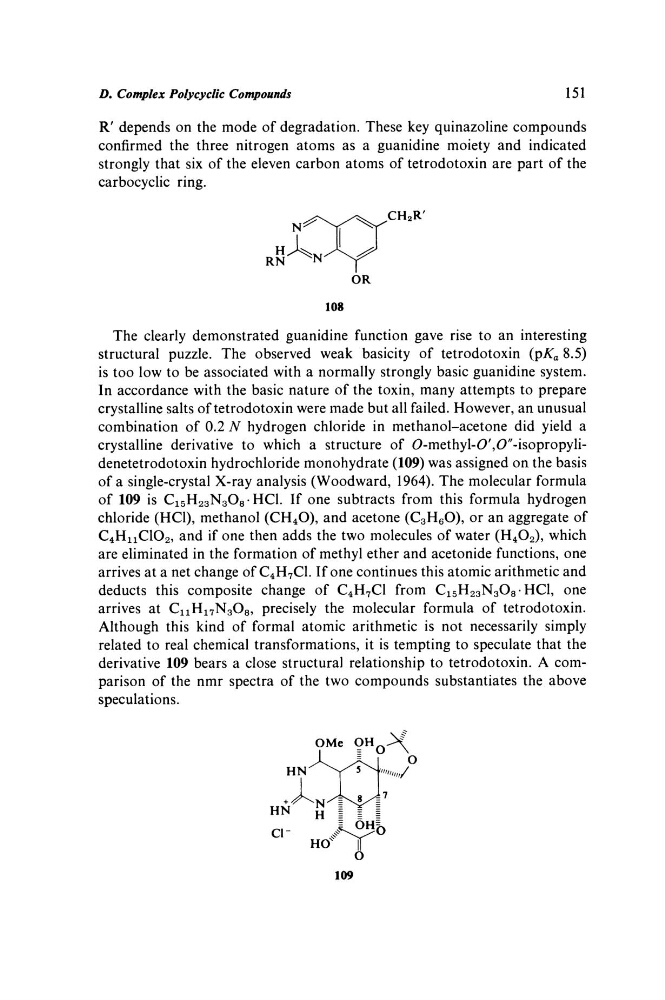
crystalline derivative to which a structure of 0-methyl-0',O"-isopropylidenetetrodotoxin hydrochloride monohydrate (109) was assigned on the basis
of a single-crystal X-ray analysis (Woodward, 1964). The molecular formula
of 109 is C 1 5 H 2 3 N 3 0 8 HC1. If one subtracts from this formula hydrogen
chloride (HCl), methanol (CH 4 0), and acetone (C 3 H e O), or an aggregate of
C4HHCIO2, and if one then adds the two molecules of water (H 4 0 2 ), which
are eliminated in the formation of methyl ether and acetonide functions, one
arrives at a net change of C 4 H 7 C1. If one continues this atomic arithmetic and
deducts this composite change of C 4 H 7 C1 from C 1 5 H 2 3 N 3 0 8 HC1, one
arrives at CnH 1 7 N 3 0 8 , precisely the molecular formula of tetrodotoxin.
Although this kind of formal atomic arithmetic is not necessarily simply
related to real chemical transformations, it is tempting to speculate that the
derivative 109 bears a close structural relationship to tetrodotoxin. A comparison of the nmr spectra of the two compounds substantiates the above
speculations.
OMe
OH Q J^
Ο
ΗΝ
5
^ ""///„/
ΗΝ
g
ΙΥΙ
CI/\^Ô
HO^
Τ
Ο
151
109
R' depends on the mode of degradation. These key quinazoline compounds
confirmed the three nitrogen atoms as a guanidine moiety and indicated
strongly that six of the eleven carbon atoms of tetrodotoxin are part of the
carbocyclic ring.
CH 2 R'
RN
N
OR
108
The clearly demonstrated guanidine function gave rise to an interesting
structural puzzle. The observed weak basicity of tetrodotoxin (pK a 8.5)
is too low to be associated with a normally strongly basic guanidine system.
In accordance with the basic nature of the toxin, many attempts to prepare
crystalline salts of tetrodotoxin were made but all failed. However, an unusual
combination of 0.2 TV hydrogen chloride in methanol-acetone did yield a
crystalline derivative to which a structure of 0-methyl-0',O"-isopropylidenetetrodotoxin hydrochloride monohydrate (109) was assigned on the basis
of a single-crystal X-ray analysis (Woodward, 1964). The molecular formula
of 109 is C 1 5 H 2 3 N 3 0 8 HC1. If one subtracts from this formula hydrogen
chloride (HCl), methanol (CH 4 0), and acetone (C 3 H e O), or an aggregate of
C4HHCIO2, and if one then adds the two molecules of water (H 4 0 2 ), which
are eliminated in the formation of methyl ether and acetonide functions, one
arrives at a net change of C 4 H 7 C1. If one continues this atomic arithmetic and
deducts this composite change of C 4 H 7 C1 from C 1 5 H 2 3 N 3 0 8 HC1, one
arrives at CnH 1 7 N 3 0 8 , precisely the molecular formula of tetrodotoxin.
Although this kind of formal atomic arithmetic is not necessarily simply
related to real chemical transformations, it is tempting to speculate that the
derivative 109 bears a close structural relationship to tetrodotoxin. A comparison of the nmr spectra of the two compounds substantiates the above
speculations.
OMe
OH Q J^
Ο
ΗΝ
5
^ ""///„/
ΗΝ
g
ΙΥΙ
CI/\^Ô
HO^
Τ
Ο