

Β, Compounds Containing Acyclic Nitrogen
133
54
55
2. CAULERPICIN
A substance containing neutral acyclic nitrogen in a long-chain saturated
hydrocarbon was first isolated by Doty and Santos (1966) from the green
alga Caulerpa racemosa and was named caulerpicin. The algal genus Caulerpa
is known in the Philippines for its peppery taste and some species are edible
and cultivated. On the basis of spectral data Santos and Doty (1968) proposed
structure 51 for caulerpicin. Mass spectral data indicate that caulerpicin
may be a mixture of homologs. Full confirmation of structure 51 has not
yet been reported.
CH 2 OH
I
CH 3 —(CH 2 ) 13 —CH—N—CO—(CH 2 ) n —CH 3
Η
51
η = 23, 24, 25
3. NEREISTOXIN
It had been known in Japan that some insects die when they come in
contact with a common fish bait, the marine annelid Lumbriconeris
heteropoda
(Hashimoto and Okaichi, 1960). The toxic principle could be isolated as a
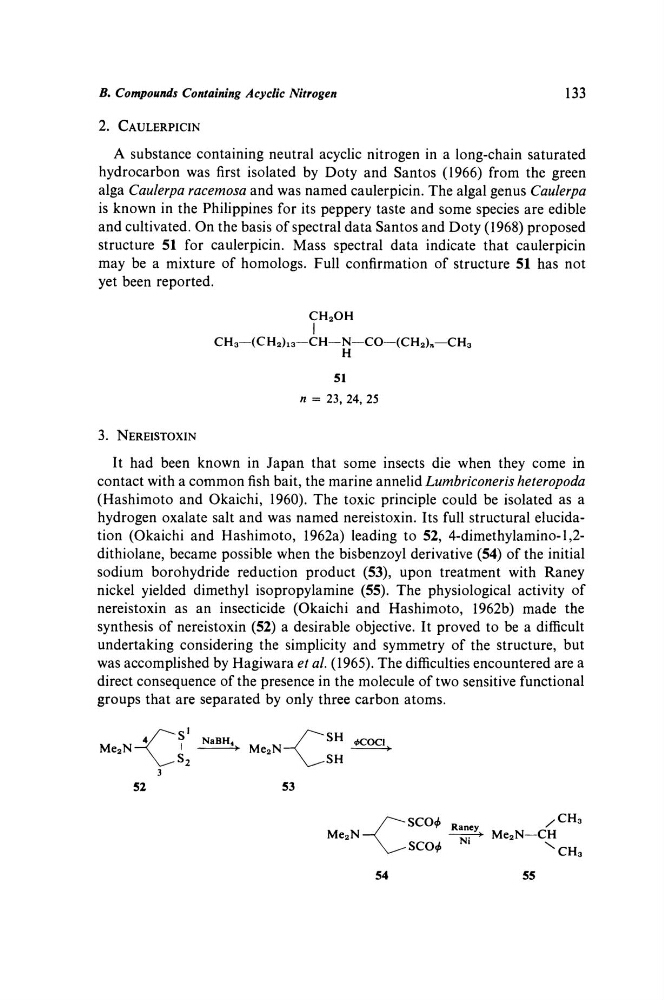
hydrogen oxalate salt and was named nereistoxin. Its full structural elucidation (Okaichi and Hashimoto, 1962a) leading to 52, 4-dimethylamino-l,2dithiolane, became possible when the bisbenzoyl derivative (54) of the initial
sodium borohydride reduction product (53), upon treatment with Raney
nickel yielded dimethyl isopropylamine (55). The physiological activity of
nereistoxin as an insecticide (Okaichi and Hashimoto, 1962b) made the
synthesis of nereistoxin (52) a desirable objective. It proved to be a difficult
undertaking considering the simplicity and symmetry of the structure, but
was accomplished by Hagiwara et al. (1965). The difficulties encountered are a
direct consequence of the presence in the molecule of two sensitive functional
groups that are separated by only three carbon atoms.
MC 2 NY"I' ^
Me 2 N^
SH
^
3
52
53
Me 2 N—(
Me 2 N—CH
Y/SCO*
N l
\ C H 3
133
54
55
2. CAULERPICIN
A substance containing neutral acyclic nitrogen in a long-chain saturated
hydrocarbon was first isolated by Doty and Santos (1966) from the green
alga Caulerpa racemosa and was named caulerpicin. The algal genus Caulerpa
is known in the Philippines for its peppery taste and some species are edible
and cultivated. On the basis of spectral data Santos and Doty (1968) proposed
structure 51 for caulerpicin. Mass spectral data indicate that caulerpicin
may be a mixture of homologs. Full confirmation of structure 51 has not
yet been reported.
CH 2 OH
I
CH 3 —(CH 2 ) 13 —CH—N—CO—(CH 2 ) n —CH 3
Η
51
η = 23, 24, 25
3. NEREISTOXIN
It had been known in Japan that some insects die when they come in
contact with a common fish bait, the marine annelid Lumbriconeris
heteropoda
(Hashimoto and Okaichi, 1960). The toxic principle could be isolated as a
hydrogen oxalate salt and was named nereistoxin. Its full structural elucidation (Okaichi and Hashimoto, 1962a) leading to 52, 4-dimethylamino-l,2dithiolane, became possible when the bisbenzoyl derivative (54) of the initial
sodium borohydride reduction product (53), upon treatment with Raney
nickel yielded dimethyl isopropylamine (55). The physiological activity of
nereistoxin as an insecticide (Okaichi and Hashimoto, 1962b) made the
synthesis of nereistoxin (52) a desirable objective. It proved to be a difficult
undertaking considering the simplicity and symmetry of the structure, but
was accomplished by Hagiwara et al. (1965). The difficulties encountered are a
direct consequence of the presence in the molecule of two sensitive functional
groups that are separated by only three carbon atoms.
MC 2 NY"I' ^
Me 2 N^
SH
^
3
52
53
Me 2 N—(
Me 2 N—CH
Y/SCO*
N l
\ C H 3