

62
G . S. P4TTkRSON. JR.
limit. As an heuristic cxarnple, Goldstein (1951) introduced a binary walk in
which a particle's velociiy has probability p of being the same as that at the
preceding stcp. The sequence of particle velocities thus forms a first order
Markov chain. In the limit dx, dt + 0, requiring dx/dt = V and p = 1 -
( & W )
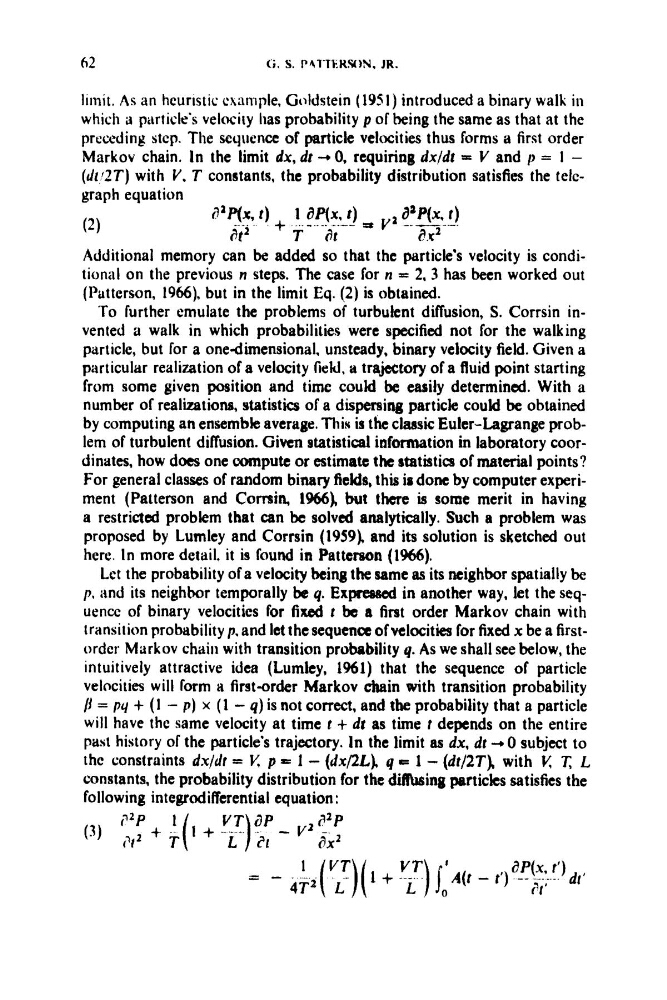
with V, T constants, the probability distribution satisfies the telegraph equation
Additional memory can be added so that the particle's velocity is conditional on the previous n steps. The case for n = 2. 3 has been worked out
(Patterson, 1966), but in the limit Eq. (2) is obtained.
To further emulate the problems of turbulent diffusion, S. Corrsin invented a walk in which probabilities were specified not for the walking
particle, but for a onedimensional, unsteady, binary velocity field. Given a
piirticular realization of a velocity fieekl, a trajectory of a fluid point starting
from some given position and time could be easily determined. With a
number of realizations, statistics of a dispersing particle could be obtained
by computing an ensemble average. This is the classic Eulcr-Lagrange problem of turbulent diffusion. Given statistical information in laboratory coordinates, how d m one m p u t e or estimate the statistics of material points?
For general classes of random binary fields, this irdom by computer experiment (Patterson and Cornin, 1W), but there is some merit in having
a restricted problem that can bc solved analytically. Such a problem was
proposed by Lumley and Cornin (1959), and its solution is sketched out
here. In more detail, it is found in Patterson (1966).
Let the probability of a velocity being the same as its neighbor spatially be
p. iind its neighbor temporally be (I. Expreaead in another way, let the sequence of binary velocities for fixed t ba a first order Markov chain with
transition probability p. and let thesequence ofvelocities for fixed x be a firstorder Markov chain with transition probability q. As we shall see below, the
intuitively attractive idea (Lumley, 1961) that the sequence of particle
velocities will form H first-order Markov drain with transition probability
b = py t (1 - p ) x (1 - 9 ) is not correct, and the probability that a particle
will have thc same velocity at time r + dt as time t depends on the entire
pa$( history of the particle's trajectory. In the limit as dx, dt + 0 subject to
the constraints dxldt = K p = 1 - (dx/2L), q = 1 - (dt/2T), with V, L
constants, the probability distribution for the difRrsing particks satisfies the
following intcgrodifferential equation :
dP(x t')
?f
= -
- t ' ) - - - I- dt'
G . S. P4TTkRSON. JR.
limit. As an heuristic cxarnple, Goldstein (1951) introduced a binary walk in
which a particle's velociiy has probability p of being the same as that at the
preceding stcp. The sequence of particle velocities thus forms a first order
Markov chain. In the limit dx, dt + 0, requiring dx/dt = V and p = 1 -
( & W )
with V, T constants, the probability distribution satisfies the telegraph equation
Additional memory can be added so that the particle's velocity is conditional on the previous n steps. The case for n = 2. 3 has been worked out
(Patterson, 1966), but in the limit Eq. (2) is obtained.
To further emulate the problems of turbulent diffusion, S. Corrsin invented a walk in which probabilities were specified not for the walking
particle, but for a onedimensional, unsteady, binary velocity field. Given a
piirticular realization of a velocity fieekl, a trajectory of a fluid point starting
from some given position and time could be easily determined. With a
number of realizations, statistics of a dispersing particle could be obtained
by computing an ensemble average. This is the classic Eulcr-Lagrange problem of turbulent diffusion. Given statistical information in laboratory coordinates, how d m one m p u t e or estimate the statistics of material points?
For general classes of random binary fields, this irdom by computer experiment (Patterson and Cornin, 1W), but there is some merit in having
a restricted problem that can bc solved analytically. Such a problem was
proposed by Lumley and Cornin (1959), and its solution is sketched out
here. In more detail, it is found in Patterson (1966).
Let the probability of a velocity being the same as its neighbor spatially be
p. iind its neighbor temporally be (I. Expreaead in another way, let the sequence of binary velocities for fixed t ba a first order Markov chain with
transition probability p. and let thesequence ofvelocities for fixed x be a firstorder Markov chain with transition probability q. As we shall see below, the
intuitively attractive idea (Lumley, 1961) that the sequence of particle
velocities will form H first-order Markov drain with transition probability
b = py t (1 - p ) x (1 - 9 ) is not correct, and the probability that a particle
will have thc same velocity at time r + dt as time t depends on the entire
pa$( history of the particle's trajectory. In the limit as dx, dt + 0 subject to
the constraints dxldt = K p = 1 - (dx/2L), q = 1 - (dt/2T), with V, L
constants, the probability distribution for the difRrsing particks satisfies the
following intcgrodifferential equation :
dP(x t')
?f
= -
- t ' ) - - - I- dt'