

4x
S-I . Z \ l . t Y ('ORRSIN
coordinate system, highlights E q (7 1 ) as an assumption on the principal axis
directions of the diffusivity tensor It assumes that they coincide with the
iiican How direction and the normal to the boundary (if, for example. we
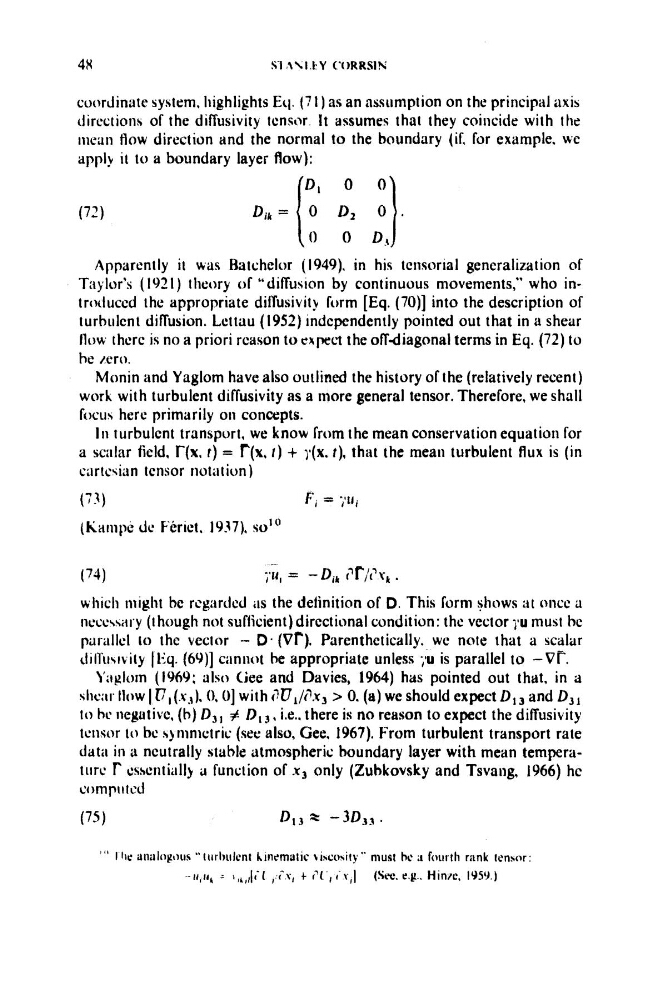
apply it to a boundary layer flow):
Apparently it was Ratchelor (1949). in his tcnsorial generalization of
Taylor's (1931) theory o f "diffusion by continuous movements," who introduced the appropriate diffusivity form [Eq. (70)] into the description of
turhulcnt diffusion. Lcttau (1952) indcpendently pointed out that in a shear
flow thcrc is no a priori reason to cxpct the ondiagonal terms in Eq. (72) to
he Lero.
Monin and Yaglom have also outlined the history of the (relatively recent)
work with turbulent diffusivity as a more general tensor. Therefore, we shall
focus here primarily on concepts.
I n turbulcnt transport. we know from the mean conservation equation for
a scdar field. T(x. t ) = r(x, I ) + y(x. t ) , that the mean turbulent flux is (in
cartcsian tensor notat ion)
( 7 3 )
Fi = ;'tii
(Katiipb de Fcriet. 1927). solo
-
(74)
;'u, = - D,, x p Y k
.
~ l i i c l i
might be rcgnrdcd ,is the delinition of D. This form shows at oiicc 1
nccowry (I hough not suflicient) directional condition: the vector ;'II must he
pi.~raIIoI lo the vector - D. (Vr"). Parenthetically. we note that a scalar
clilTit\ibity IEq. (69)J ciin1W be appropriate unless ;'u is parallel to - V r .
)'aplom (1969; also Gee and Davies, 1964) has pointed out that, in a
4iwr flow I n,( x.~). 0.01 with C?U,/c'x3 > 0. (a) we should expect D , and D,,
lo hc riegutivc, (h) D,, f D13, i.e.. there is no reason to expect the diffusivity
toncor to bc hqmnictric (see also, Gee, 1967). From turbulent transport rate
datil in it neutrally stable atmospheric boundary layer with mean temperattirc r csscntiallq ; 1 function of x3 only (Zubkovsky and Tsvang, 1966) hc
cc )m pri 1 cd
(75)
D l j * - 3 0 3 3 .
S-I . Z \ l . t Y ('ORRSIN
coordinate system, highlights E q (7 1 ) as an assumption on the principal axis
directions of the diffusivity tensor It assumes that they coincide with the
iiican How direction and the normal to the boundary (if, for example. we
apply it to a boundary layer flow):
Apparently it was Ratchelor (1949). in his tcnsorial generalization of
Taylor's (1931) theory o f "diffusion by continuous movements," who introduced the appropriate diffusivity form [Eq. (70)] into the description of
turhulcnt diffusion. Lcttau (1952) indcpendently pointed out that in a shear
flow thcrc is no a priori reason to cxpct the ondiagonal terms in Eq. (72) to
he Lero.
Monin and Yaglom have also outlined the history of the (relatively recent)
work with turbulent diffusivity as a more general tensor. Therefore, we shall
focus here primarily on concepts.
I n turbulcnt transport. we know from the mean conservation equation for
a scdar field. T(x. t ) = r(x, I ) + y(x. t ) , that the mean turbulent flux is (in
cartcsian tensor notat ion)
( 7 3 )
Fi = ;'tii
(Katiipb de Fcriet. 1927). solo
-
(74)
;'u, = - D,, x p Y k
.
~ l i i c l i
might be rcgnrdcd ,is the delinition of D. This form shows at oiicc 1
nccowry (I hough not suflicient) directional condition: the vector ;'II must he
pi.~raIIoI lo the vector - D. (Vr"). Parenthetically. we note that a scalar
clilTit\ibity IEq. (69)J ciin1W be appropriate unless ;'u is parallel to - V r .
)'aplom (1969; also Gee and Davies, 1964) has pointed out that, in a
4iwr flow I n,( x.~). 0.01 with C?U,/c'x3 > 0. (a) we should expect D , and D,,
lo hc riegutivc, (h) D,, f D13, i.e.. there is no reason to expect the diffusivity
toncor to bc hqmnictric (see also, Gee, 1967). From turbulent transport rate
datil in it neutrally stable atmospheric boundary layer with mean temperattirc r csscntiallq ; 1 function of x3 only (Zubkovsky and Tsvang, 1966) hc
cc )m pri 1 cd
(75)
D l j * - 3 0 3 3 .