

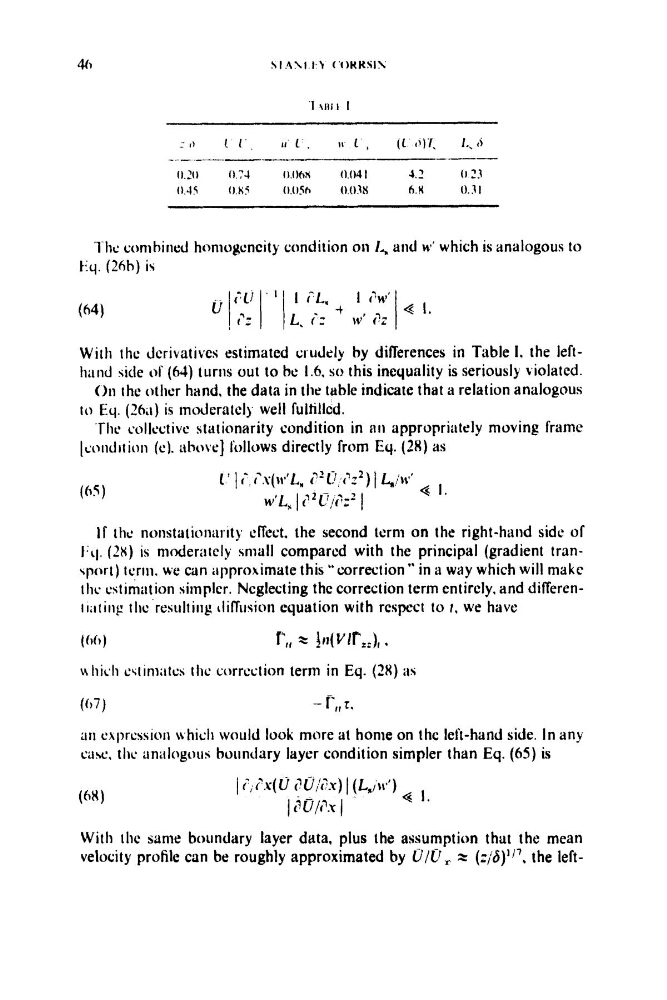
l'hc combined honiogcncity condition on L, and H" which is analogous to
)iq. (2hh) is
W i ~ h thc Jcrivatives estimated cIudely by differences in Table I, the lefthiltid side of (64) turns out to he 1.6. so this inequality is seriously violated.
On the otlier hand. the data in the table indicate that a relation analogous
to Eq. (26ii) is tnoderatcly well fulfilled.
'Pht collective stationarity condition in t i n appropriately moving frame
[midit ion (c). nixwe] follows directly from Eq. (ZX) as
(h.5)
I f the nonstationurity clTect. the second tcrni on the right-hand side of
Fq. (2%) is moderately small comparcd with the principal (gradient transport) Icrin. we can approximate this "correction *' in a way which will make
thc estimilt ion simpler. Ncglecting thc correction term entircly, and differenIi;tiiiig tlw 'resulting tlifliision equation with rcspect to r. we have
( hh )
u Iiich cs1ini;itcs ttic corrcction term in Ey. (28) iis
f,, * 4)1( W*:), .
(07)
- r,, 5.
an chprcssion which would look more at honie on the left-hand side. In any
caw, tlic analogous hoondrtry layer condition simpler than Eq. (65) is
With tlic same boundary layer data, plus the assumption that the mean
velocity profile can be roughly approximated by U I U , t (z/d)'''. the left-
)iq. (2hh) is
W i ~ h thc Jcrivatives estimated cIudely by differences in Table I, the lefthiltid side of (64) turns out to he 1.6. so this inequality is seriously violated.
On the otlier hand. the data in the table indicate that a relation analogous
to Eq. (26ii) is tnoderatcly well fulfilled.
'Pht collective stationarity condition in t i n appropriately moving frame
[midit ion (c). nixwe] follows directly from Eq. (ZX) as
(h.5)
I f the nonstationurity clTect. the second tcrni on the right-hand side of
Fq. (2%) is moderately small comparcd with the principal (gradient transport) Icrin. we can approximate this "correction *' in a way which will make
thc estimilt ion simpler. Ncglecting thc correction term entircly, and differenIi;tiiiig tlw 'resulting tlifliision equation with rcspect to r. we have
( hh )
u Iiich cs1ini;itcs ttic corrcction term in Ey. (28) iis
f,, * 4)1( W*:), .
(07)
- r,, 5.
an chprcssion which would look more at honie on the left-hand side. In any
caw, tlic analogous hoondrtry layer condition simpler than Eq. (65) is
With tlic same boundary layer data, plus the assumption that the mean
velocity profile can be roughly approximated by U I U , t (z/d)'''. the left-