

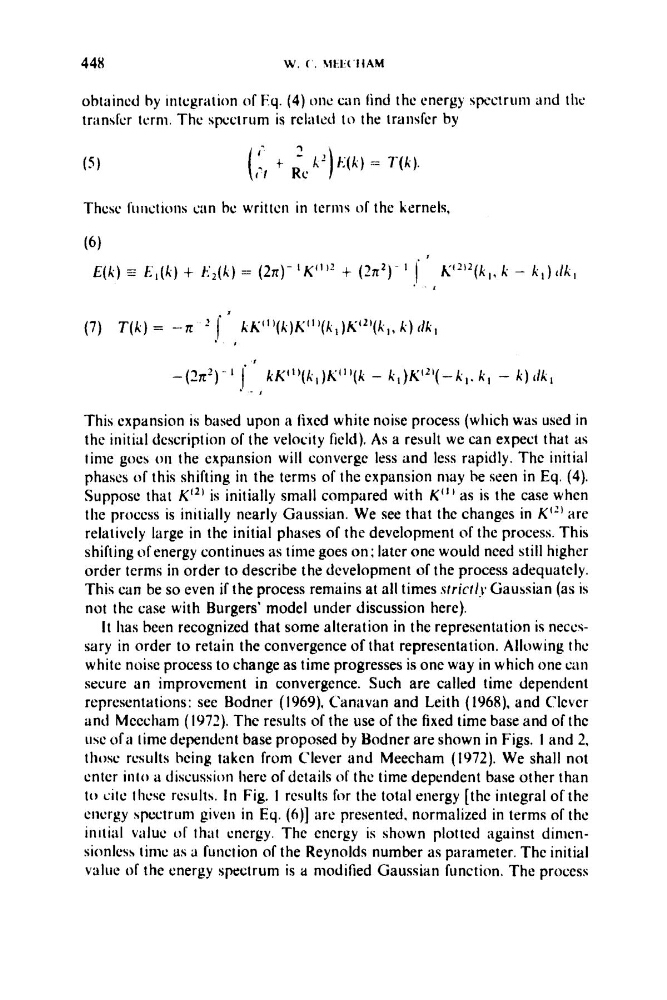
obtained by intcgr;ition of Fq. (4) onc can lind the energy \pcctruni and the
trcin\fcr tcrni. The spectrum is rcliitcd t o the transfcr by
Thew liiiictinns can be writtcn in tcrniq of the kernels,
This cxpansion is based upon a lixcd white noise process (which was used in
the initial description of the velocity field). As a result we can expect that as
time goeh on the cxpansion will convergc less and less rapidly. The initial
phases of this shifting in the terms of the cxpansion niay he seen in Eq. (4).
Suppose thal Kf2' is initially small compared with K"' as is the case when
the process is initially ncarly Gaussian. We see that the changes in K'" are
relatively large in the initial phases of the development of the process. This
shifting ofenergy continues as time goes on; later one would need still higher
order terms in order to describe the dcvelopment of the process adequatcly.
This can be so even if the process remains at all times strictly Ciaubsian (as is
not the case with Burgers' model under discussion here).
I t has been recognized that some alteration in the representation is neccpsary in order to retain the convergence of that representation. Allowing the
white noise process to change as time progresses is one way in which one c~in
secure an improvement in convergence. Such are called time dependcnt
representations: sec Hodner (1969). Canavan and Leith (1968), and Clcver
and Mccctiam (1972). The results of the use of the fixed time base and of the
use o f a limc dependent base proposed by Bodner are shown in Figs. I and 2,
those rcsults being taken from Clever and Meecham (1972). We shall not
cntcr into a discussion here ofdctails of thc time dependent base other than
l o cite Ihcsc results. In Fig. 1 results for the total energy [thc integral ofthe
cncrgy spectrirni given in Eq. (6)] ilrc presented, normalized in terms of thc
inltiiil VillUc of Ihiit cncrgy. The cncrgy is shown plotted against diniensionless time as a runction of the Reynolds number as parameter. Thc initial
value of the energy spectrum is a modified Gaussian function. The process
trcin\fcr tcrni. The spectrum is rcliitcd t o the transfcr by
Thew liiiictinns can be writtcn in tcrniq of the kernels,
This cxpansion is based upon a lixcd white noise process (which was used in
the initial description of the velocity field). As a result we can expect that as
time goeh on the cxpansion will convergc less and less rapidly. The initial
phases of this shifting in the terms of the cxpansion niay he seen in Eq. (4).
Suppose thal Kf2' is initially small compared with K"' as is the case when
the process is initially ncarly Gaussian. We see that the changes in K'" are
relatively large in the initial phases of the development of the process. This
shifting ofenergy continues as time goes on; later one would need still higher
order terms in order to describe the dcvelopment of the process adequatcly.
This can be so even if the process remains at all times strictly Ciaubsian (as is
not the case with Burgers' model under discussion here).
I t has been recognized that some alteration in the representation is neccpsary in order to retain the convergence of that representation. Allowing the
white noise process to change as time progresses is one way in which one c~in
secure an improvement in convergence. Such are called time dependcnt
representations: sec Hodner (1969). Canavan and Leith (1968), and Clcver
and Mccctiam (1972). The results of the use of the fixed time base and of the
use o f a limc dependent base proposed by Bodner are shown in Figs. I and 2,
those rcsults being taken from Clever and Meecham (1972). We shall not
cntcr into a discussion here ofdctails of thc time dependent base other than
l o cite Ihcsc results. In Fig. 1 results for the total energy [thc integral ofthe
cncrgy spectrirni given in Eq. (6)] ilrc presented, normalized in terms of thc
inltiiil VillUc of Ihiit cncrgy. The cncrgy is shown plotted against diniensionless time as a runction of the Reynolds number as parameter. Thc initial
value of the energy spectrum is a modified Gaussian function. The process