

<'hupni;in ;iiid C'owling (1970) and the tirticle of Grad (1958). for example.
will provide inorc rittioniil starting points for some kinds of generalized
analyses. Long ago. Chapman (1928) and others pointed out that the
approach to be used here can lead to errors in higher order kinetic theory of
gases. Since our goals are primarily heuristic, we simply accept the hazards.
2. MATHEMATICAL RESTRICTIONS LEADING TO THE
Suppose we are interested in the spatial transport rate of a scalar field
whew niean "coiicentration" is P(z, t ) . z is a spatial coordinate (we restrict
to onc dimension for simplicity) and I is time. Restricting also to a conserved
propcrty, \ve can write a n expression for the mean "flux" rate F(z, t ) o f f
from all space at coordiniite positions < z to all space positions > z. viz.
GRADIENT TRANSPORT APPROXIMATIOX
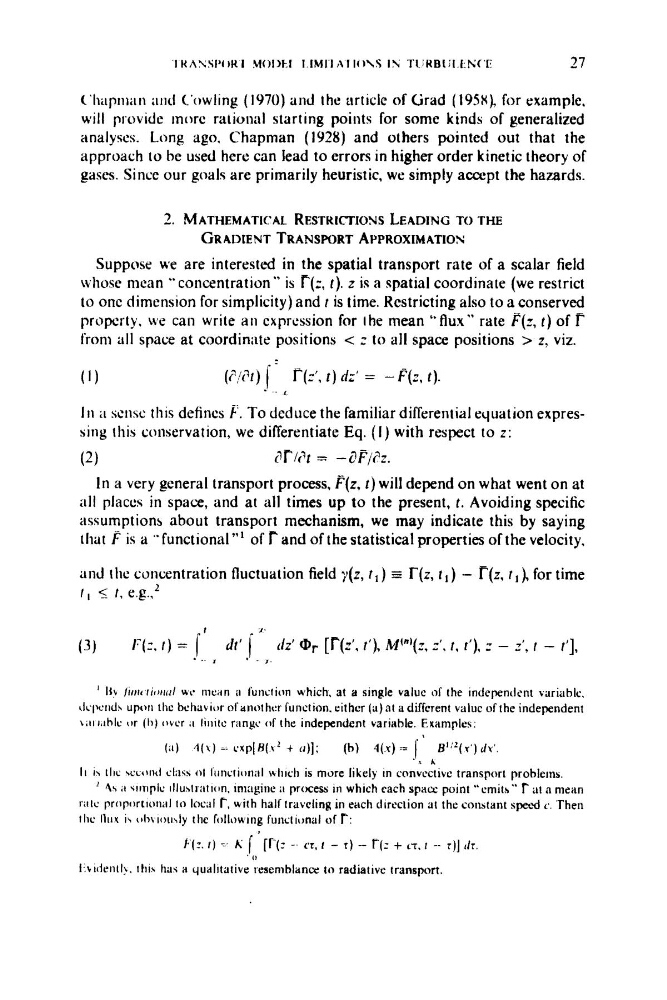
I n ;I sensc this defines P. To deduce the familiar differential equation expressing this conservation, we differentiate Eq. ( I ) with respect to z:
(2)
JFl?t = -dF/l?Z.
In a very general transport process, F(z. t ) will depend on what went on at
all places in space, and at all times up to the present, t. Avoiding specific
assumptions about transport mechanism, we may indicate this by saying
that F is a "functional"' of F and of the statistical properties of the velocity,
and tile cuncentration fluctuation field y(z, t l ) = I+, t l ) - P(z, t l ), for time
/ I 5 I , e.g.,Z
" 1
J ,
(3)
/qz, I ) = 1 dl' 1 tlz' a+ [r(z', I ' ) , M'"'(z, 2'. I , f ' ) , z - z', I - 4,
* . I
*
I
' I$\. /iuwiitwo/ wc iiiciin ;I function which. at a single value of the independent variable.
d~yciids upoii thc hcliovitv olanothcr function. either (a) nt a different valuc of the independent
\iii i,ihlc o r (I,) ovcr ;I liiiiic riingz ( i f the independent varirhle. Examples:
(;I) I(\) =j cxplH(.\' t N ) ] ;
(h) 4 ( . ~ )
= 1 @ " ( T ' ) du'.
' 7
h
11 i\ tlic xuml cliiss 01 l i t i l c t i ~ ~ t i i i l
~ l i i ~ l i
is more likely in convcctive transport probleinr.
A\ A cirnplc illuhir:iiion, iniagine ii process in which each space point "emits" r i i t n niean
r:ik prt~piirtioii;il lo Ioc:iI r, with hall traveling in each direction at thc conatant speed C. Then
tlic Iluu i\ ~ I ~ i o i i d y
the rollt)wing rutlctitJnal of P:
will provide inorc rittioniil starting points for some kinds of generalized
analyses. Long ago. Chapman (1928) and others pointed out that the
approach to be used here can lead to errors in higher order kinetic theory of
gases. Since our goals are primarily heuristic, we simply accept the hazards.
2. MATHEMATICAL RESTRICTIONS LEADING TO THE
Suppose we are interested in the spatial transport rate of a scalar field
whew niean "coiicentration" is P(z, t ) . z is a spatial coordinate (we restrict
to onc dimension for simplicity) and I is time. Restricting also to a conserved
propcrty, \ve can write a n expression for the mean "flux" rate F(z, t ) o f f
from all space at coordiniite positions < z to all space positions > z. viz.
GRADIENT TRANSPORT APPROXIMATIOX
I n ;I sensc this defines P. To deduce the familiar differential equation expressing this conservation, we differentiate Eq. ( I ) with respect to z:
(2)
JFl?t = -dF/l?Z.
In a very general transport process, F(z. t ) will depend on what went on at
all places in space, and at all times up to the present, t. Avoiding specific
assumptions about transport mechanism, we may indicate this by saying
that F is a "functional"' of F and of the statistical properties of the velocity,
and tile cuncentration fluctuation field y(z, t l ) = I+, t l ) - P(z, t l ), for time
/ I 5 I , e.g.,Z
" 1
J ,
(3)
/qz, I ) = 1 dl' 1 tlz' a+ [r(z', I ' ) , M'"'(z, 2'. I , f ' ) , z - z', I - 4,
* . I
*
I
' I$\. /iuwiitwo/ wc iiiciin ;I function which. at a single value of the independent variable.
d~yciids upoii thc hcliovitv olanothcr function. either (a) nt a different valuc of the independent
\iii i,ihlc o r (I,) ovcr ;I liiiiic riingz ( i f the independent varirhle. Examples:
(;I) I(\) =j cxplH(.\' t N ) ] ;
(h) 4 ( . ~ )
= 1 @ " ( T ' ) du'.
' 7
h
11 i\ tlic xuml cliiss 01 l i t i l c t i ~ ~ t i i i l
~ l i i ~ l i
is more likely in convcctive transport probleinr.
A\ A cirnplc illuhir:iiion, iniagine ii process in which each space point "emits" r i i t n niean
r:ik prt~piirtioii;il lo Ioc:iI r, with hall traveling in each direction at thc conatant speed C. Then
tlic Iluu i\ ~ I ~ i o i i d y
the rollt)wing rutlctitJnal of P: