

E m Y DIFPIJSION COEFFICIENTS
417
In order to study the effect of nonstationarity, k, and ii have been computed
for different times of the day from the results of the time-dependent
boundary-layer model (clear day); vertical averages have been taken
between the ground and 170 m. Then the concentration 3,,, obtained by
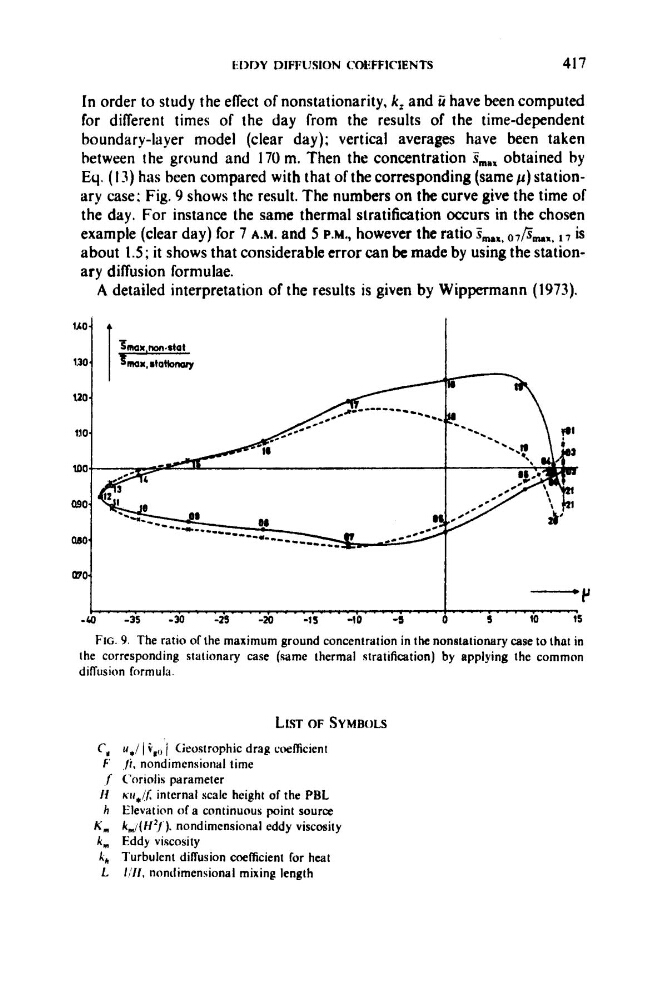
Eq. ( I 3) has been compared with that of the corresponding (same p ) stationary case: Fig. 9 shows thc result. The numbers on the curve give the time of
the day. For instance the same thermal stratification occurs in the chosen
example (clear day) for 7 A.M. and 5 P.M., however the ratio Xm,x, 07fimx, 17 is
about 1.5; it shows that considerable error can be made by using the stationary diffusion formulae.
A detailed interpretation of the results is given by Wippermann (1973).
"4.. . . . , , - . - . . - . . . . . - . . . - . . . . . . - . . . ~. . . . . , .-tJ
-u)
-35
-30
-25
-20
4 5
4 0
-5
0
5
10
15
Fic. 9. The ratio of the maximum ground concentration in the nonstationary case to that in
the corresponding stationary case (same thermal stratification) by applying the common
diffusion formulrl.
LIST OF SYMBOLS
u*/ 1 C, , , 1 Cieostrophic drag coefficient
li. nondimensiorial time
Coriolis parameter
KIIJL internal scale height of the PBL
Elevation o f a continuous p i n t source
k,/(H2/ ). nondimensional eddy viscosity
Eddy viscosity
Turbulent difiuusion coefficient for heat
/:II, nondimensional mixing length
417
In order to study the effect of nonstationarity, k, and ii have been computed
for different times of the day from the results of the time-dependent
boundary-layer model (clear day); vertical averages have been taken
between the ground and 170 m. Then the concentration 3,,, obtained by
Eq. ( I 3) has been compared with that of the corresponding (same p ) stationary case: Fig. 9 shows thc result. The numbers on the curve give the time of
the day. For instance the same thermal stratification occurs in the chosen
example (clear day) for 7 A.M. and 5 P.M., however the ratio Xm,x, 07fimx, 17 is
about 1.5; it shows that considerable error can be made by using the stationary diffusion formulae.
A detailed interpretation of the results is given by Wippermann (1973).
"4.. . . . , , - . - . . - . . . . . - . . . - . . . . . . - . . . ~. . . . . , .-tJ
-u)
-35
-30
-25
-20
4 5
4 0
-5
0
5
10
15
Fic. 9. The ratio of the maximum ground concentration in the nonstationary case to that in
the corresponding stationary case (same thermal stratification) by applying the common
diffusion formulrl.
LIST OF SYMBOLS
u*/ 1 C, , , 1 Cieostrophic drag coefficient
li. nondimensiorial time
Coriolis parameter
KIIJL internal scale height of the PBL
Elevation o f a continuous p i n t source
k,/(H2/ ). nondimensional eddy viscosity
Eddy viscosity
Turbulent difiuusion coefficient for heat
/:II, nondimensional mixing length