

EDDY DIFFUSION COEFFICIENTS IN
THE PLANETARY BOUNDARY LAYER
F. K. WIPPERMANN
Insrifuf $ir Mrrroroloyir diir Tei,hnischu Hwhschule Durmsrudr
Darmsradr. German,
I . INTRODUCTION
In the past few years a model of the atmospheric boundary layer has been
developed, closing the system of equations by a mixing-length hypothesis.
Numerical integrations with that model show inter alia the variation with
height of the eddy diffusion coefficients as dependent on thermal
stratification. baroclinicity, and the diurnal time variation.
2. A SHORT DESCRIPTION OF THE BOUNDARY LAYER MODEL
The planetary boundary layer (PBL) of the atmosphere is defined as a
steady state and horizontally homogeneous boundary layer; it is described
by the set of eyuations (1 )-(4):
d 2 Y
X
d Z 2 K,
- +1,=0
- & = O
d2X
+
Y
d Z 2 K ,
(3)
K , = (L/KXX’ + Y 2 ] 1 / 2
(4)
L= L ( Z , L,) or L = L ( X , Y ; L,)
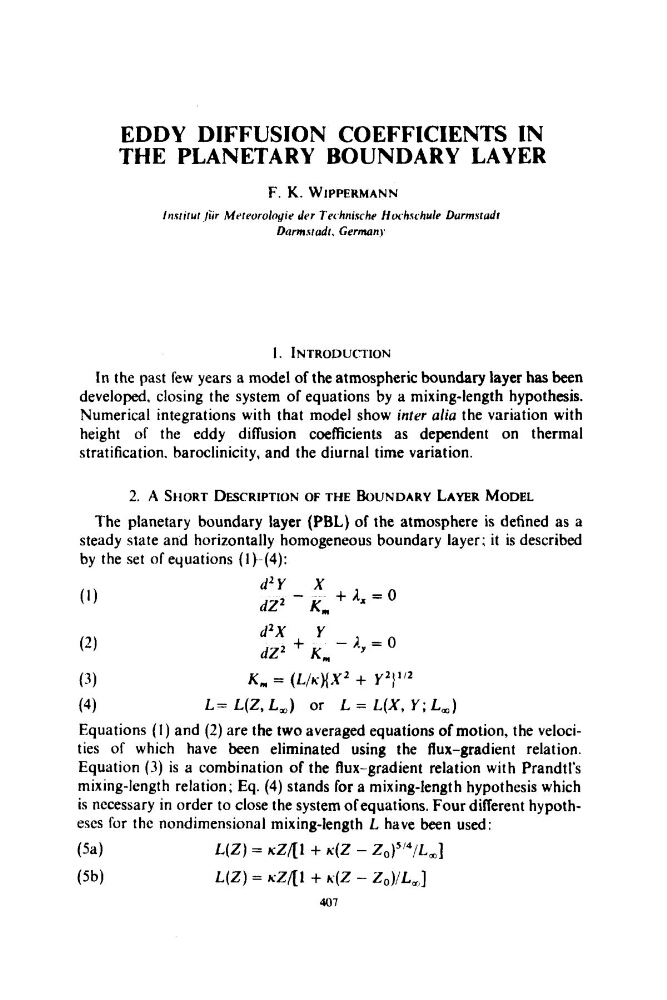
Equations ( I ) and (2) are the two averaged equations of motion, the velocities of which have been eliminated using the flux-gradient relation.
Equation (3) is a combination of the flux-gradient relation with Prandtl’s
mixing-length relation; Eq. (4) stands for a mixing-length hypothesis which
is necessary in order to close the system of equations. Four different hypotheses for the nondimensional mixing-length L have been used:
(5a)
(5b)
L ( 2 ) = KZ41 + K(Z - Z 0 ) 5 / 4 / L , ]
L(2) = KZA1 + K(Z - Z O ) / L , ]
407
THE PLANETARY BOUNDARY LAYER
F. K. WIPPERMANN
Insrifuf $ir Mrrroroloyir diir Tei,hnischu Hwhschule Durmsrudr
Darmsradr. German,
I . INTRODUCTION
In the past few years a model of the atmospheric boundary layer has been
developed, closing the system of equations by a mixing-length hypothesis.
Numerical integrations with that model show inter alia the variation with
height of the eddy diffusion coefficients as dependent on thermal
stratification. baroclinicity, and the diurnal time variation.
2. A SHORT DESCRIPTION OF THE BOUNDARY LAYER MODEL
The planetary boundary layer (PBL) of the atmosphere is defined as a
steady state and horizontally homogeneous boundary layer; it is described
by the set of eyuations (1 )-(4):
d 2 Y
X
d Z 2 K,
- +1,=0
- & = O
d2X
+
Y
d Z 2 K ,
(3)
K , = (L/KXX’ + Y 2 ] 1 / 2
(4)
L= L ( Z , L,) or L = L ( X , Y ; L,)
Equations ( I ) and (2) are the two averaged equations of motion, the velocities of which have been eliminated using the flux-gradient relation.
Equation (3) is a combination of the flux-gradient relation with Prandtl’s
mixing-length relation; Eq. (4) stands for a mixing-length hypothesis which
is necessary in order to close the system of equations. Four different hypotheses for the nondimensional mixing-length L have been used:
(5a)
(5b)
L ( 2 ) = KZ41 + K(Z - Z 0 ) 5 / 4 / L , ]
L(2) = KZA1 + K(Z - Z O ) / L , ]
407