

DIFFLISION AND DEPOSITION OF FLOATING POLLUTANTS
379
these washed up as on the observed occasion (a hypothesis entirely without
justification). Further evidence is clearly needed on this point, but we may
conclude for the time being that the deposition velocity of alewives on a
beach is often zero, but it reaches values of 0.1 to 1.0 cm sec-' on those
occasions when waves are diminishing in amplitude.
1V. A SIMPLE DIFFUSION MODEL
We are now in a position to elucidate the role played by Langmuir circulations in the dispersal of dead alewives. Suppose that a batch of alewives
experience thermal shock at a distance h from shore, of sufficient intensity to
kill or at least disorient them entirely, so that they will float as passive
objects thereafter. We assume that there is a shore-parallel current of constant velocity (in space and time) U. A straight shore will be taken to be the x
axis, the y axis pointing into the lake.
According to earlier remarks, we may take the concentration ~ ( x .
y, t ) of
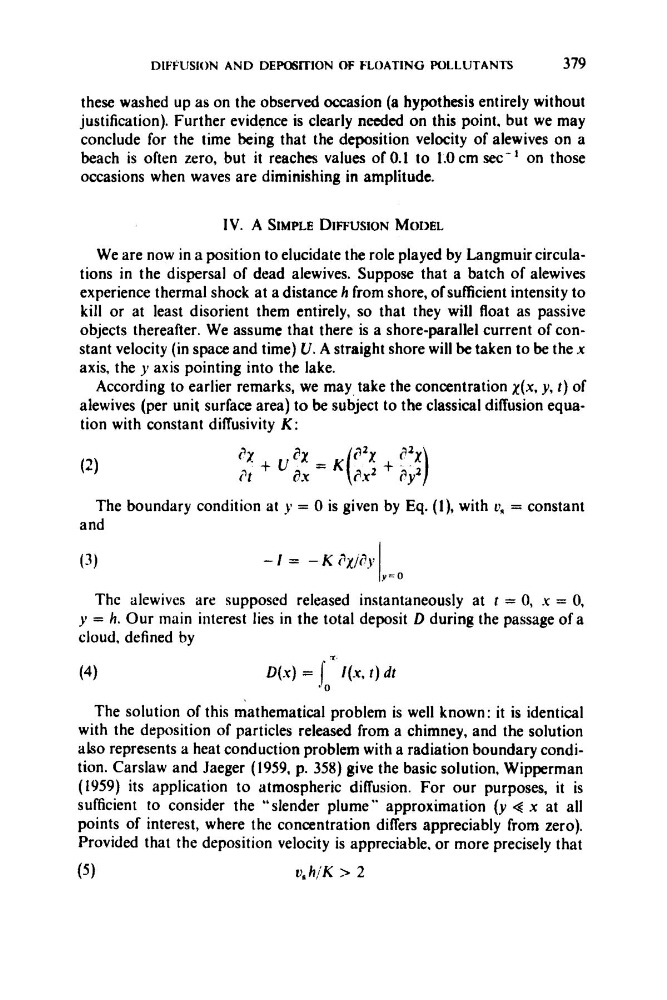
alewives (per unit surface area) to be subject to the classical diffusion equation with constant diffusivity K:
The boundary condition at y = 0 is given by Eq. (l), with L: = constant
and
The alewives are supposed released instantaneously at r = 0, x = 0,
y = h. Our main interest lies in the total deposit D during the passage of a
cloud. defined by
(4)
The solution of this mathematical problem is well known: it is identical
with the deposition of particles released from a chimney, and the solution
also represents a heat conduction problem with a radiation boundary condition. Carslaw and Jaeger (1959, p. 358) give the basic solution, Wipperman
(1959) its application to atmospheric diffusion. For our purposes, it is
sufficient to consider the "slender plume" approximation (y 4 x at all
points of interest, where the concentration differs appreciably from zero).
Provided that the deposition velocity is appreciable, or more precisely that
( 5 )
vsh/K > 2
379
these washed up as on the observed occasion (a hypothesis entirely without
justification). Further evidence is clearly needed on this point, but we may
conclude for the time being that the deposition velocity of alewives on a
beach is often zero, but it reaches values of 0.1 to 1.0 cm sec-' on those
occasions when waves are diminishing in amplitude.
1V. A SIMPLE DIFFUSION MODEL
We are now in a position to elucidate the role played by Langmuir circulations in the dispersal of dead alewives. Suppose that a batch of alewives
experience thermal shock at a distance h from shore, of sufficient intensity to
kill or at least disorient them entirely, so that they will float as passive
objects thereafter. We assume that there is a shore-parallel current of constant velocity (in space and time) U. A straight shore will be taken to be the x
axis, the y axis pointing into the lake.
According to earlier remarks, we may take the concentration ~ ( x .
y, t ) of
alewives (per unit surface area) to be subject to the classical diffusion equation with constant diffusivity K:
The boundary condition at y = 0 is given by Eq. (l), with L: = constant
and
The alewives are supposed released instantaneously at r = 0, x = 0,
y = h. Our main interest lies in the total deposit D during the passage of a
cloud. defined by
(4)
The solution of this mathematical problem is well known: it is identical
with the deposition of particles released from a chimney, and the solution
also represents a heat conduction problem with a radiation boundary condition. Carslaw and Jaeger (1959, p. 358) give the basic solution, Wipperman
(1959) its application to atmospheric diffusion. For our purposes, it is
sufficient to consider the "slender plume" approximation (y 4 x at all
points of interest, where the concentration differs appreciably from zero).
Provided that the deposition velocity is appreciable, or more precisely that
( 5 )
vsh/K > 2