

TURBULENCE IN AN INTERNAL BOUNDARY LAYER
283
0.5
0.4
0.3
Cohrrrnco
0.2
0.1
-
-
-
-
-
0
0
0
CI
0
0
0
0
0.
0
P
0 0
0 6
O
O
I
I
- 1
Id
1 0 .
1 0
0 1
Id*
k’
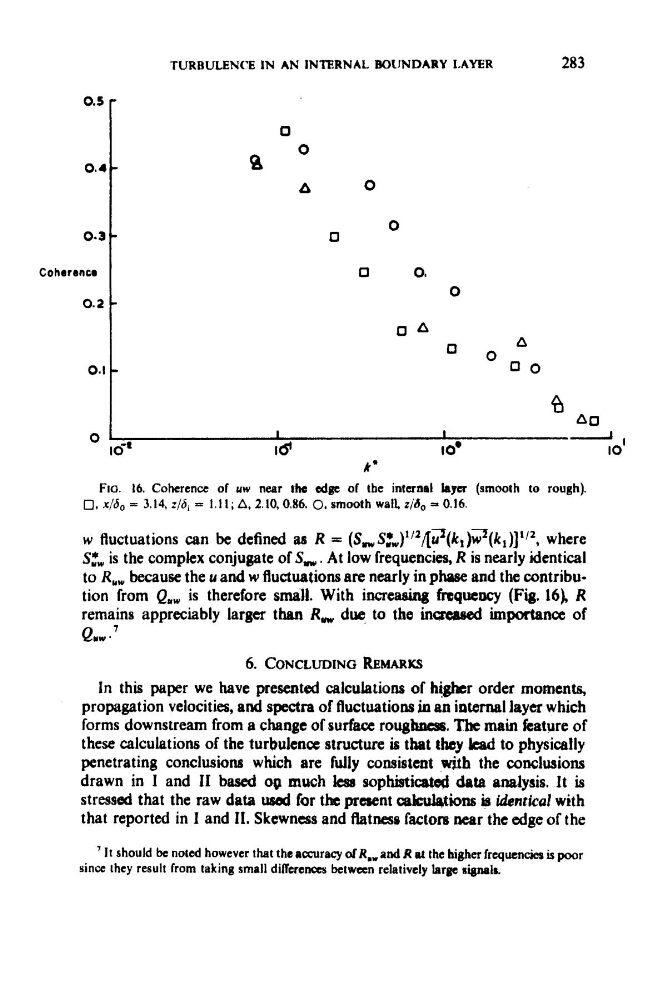
FIG. 16. Coherence of uw near ths edge of the internal hycr (smooth to rough).
0 , X& = 3.14, z/6, = 1.1 I ; A, 2.10,0.86. 0, smooth wall, z/6, = 0.16
w fluctuations can be defined as R = ( S , S ~ w ) 1 ’ 2 / 1 3 ( k l ) ~ ( k , ) ] 1 / 2 ,
where
S& is the complex conjugate of S, , , , , . At low frequencies, R is nearly identical
to R,, because the u and w fluctuations are nearly in phase and the contribution from Q,,, is therefore smarll. With increaabg fnqutncy (Fig. 16) R
remains appreciably larger than R , due to the i n d importance of
6. CONCLUDINO REMARKS
In this paper we have presented calculations of higher order moments,
propagation velocities, and spectre of fluctuations h~ an internal layer which
forms downstream from a change of surfacc roughness. The main feature of
these calculations of the turbulence structure is that they Acad to physically
penetrating conclusions which are fdly consistent with the conclusions
drawn in 1 and 11 based og much less sophisticated data analysis. It is
stressed that the raw data used for the present OaiculqtiOns is identical with
that reported in I and 11. Skewness and Ratneso factors near the edge of the
1
Q w .
’ It should be noted however that the accuracy dR,,and R at the higher frequencies is poor
since they result from taking small differam betwecn relatively larp aignala
283
0.5
0.4
0.3
Cohrrrnco
0.2
0.1
-
-
-
-
-
0
0
0
CI
0
0
0
0
0.
0
P
0 0
0 6
O
O
I
I
- 1
Id
1 0 .
1 0
0 1
Id*
k’
FIG. 16. Coherence of uw near ths edge of the internal hycr (smooth to rough).
0 , X& = 3.14, z/6, = 1.1 I ; A, 2.10,0.86. 0, smooth wall, z/6, = 0.16
w fluctuations can be defined as R = ( S , S ~ w ) 1 ’ 2 / 1 3 ( k l ) ~ ( k , ) ] 1 / 2 ,
where
S& is the complex conjugate of S, , , , , . At low frequencies, R is nearly identical
to R,, because the u and w fluctuations are nearly in phase and the contribution from Q,,, is therefore smarll. With increaabg fnqutncy (Fig. 16) R
remains appreciably larger than R , due to the i n d importance of
6. CONCLUDINO REMARKS
In this paper we have presented calculations of higher order moments,
propagation velocities, and spectre of fluctuations h~ an internal layer which
forms downstream from a change of surfacc roughness. The main feature of
these calculations of the turbulence structure is that they Acad to physically
penetrating conclusions which are fdly consistent with the conclusions
drawn in 1 and 11 based og much less sophisticated data analysis. It is
stressed that the raw data used for the present OaiculqtiOns is identical with
that reported in I and 11. Skewness and Ratneso factors near the edge of the
1
Q w .
’ It should be noted however that the accuracy dR,,and R at the higher frequencies is poor
since they result from taking small differam betwecn relatively larp aignala