

TURBULENCE IN AN INTERNAL WUNDARY LAYER
271
considered here.' The distributions of p(u) and p(w) are not appreciably
different for the two values of z/6, and do not deviate very much when
compared with, say, ~ ( u w )
from the Gaussian distributions shown in Figs. 5a
and 5b. The probability density p(u) at z/6, = 1.10 is clearly negatively
skewed and is slightly higher than p(u) at z/6, = 0.22 for near zero values of
u/u', so leading to larger flatness factors. For the intermediate -
values of
I uw - iw 1 shown in Fig. 5% the probability p(uw - uw) is appreciably
smaller near the edge of the internal layer than at z/&, = 0.22. At the high
values of 1 uw - iw I the trend is reversed thus leadin# to the relatively high
value of F,, found at z/6, = 1.10.
To predict adequately high order moments of y w, or 11w in the inner
region of a self-preserving boundary layer it is neoessary to include small
departures from Gawsianity in the aysumed probability densities of u or w
' (see Frenkiel and Klebanoff, 1973; Antonia and Atkinson, 1973). When
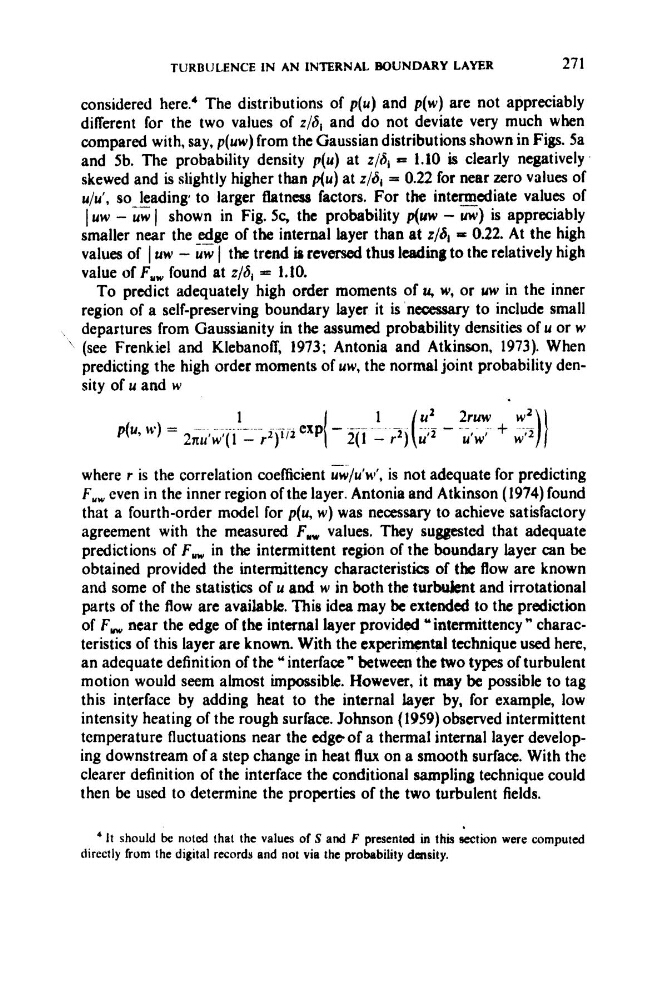
predicting the high order moments of uw, the normal joint probability density of u and w
1
1
where r is the correlation coefficient h / u ' w ' , is not adequate for predicting
F,, even in the inner region of the layer. Antonia and Atkinson (1974) found
that a fourth-order model for p(u, w ) was necessary to achieve satisfactory
agreement with the measured F,, values. They suggested that adequate
predictions of F , in the intermittent region of the boundary layer can be
obtained provided the intermittency characteristics of the flow are known
and some of the statistics of u and w in both the turbulent and irrotational
parts of the flow are available. This idea may be extended to the prediction
of F, near the edge of the internal layer provided intermittency " characteristics of this layer are known. With the experimental technique used here,
an adequate definition of the interface" between the two types of turbulent
motion would seem almost impossible. However, it may be possible to tag
this interface by adding heat to the internal layer by, for example, low
intensity heating of the rough surface. Johnson (1959) observed intermittent
temperature fluctuations near the edgcof a thermal internal layer developing downstream of a step change in heat flux on a smooth surface. With the
clearer definition of the interface the conditional sampling technique could
then be used to determine the properties of the two turbulent fields.
It should be noted that the values of S and F presented in this section were computed
directly from the digital records and not via the probability dasity.
271
considered here.' The distributions of p(u) and p(w) are not appreciably
different for the two values of z/6, and do not deviate very much when
compared with, say, ~ ( u w )
from the Gaussian distributions shown in Figs. 5a
and 5b. The probability density p(u) at z/6, = 1.10 is clearly negatively
skewed and is slightly higher than p(u) at z/6, = 0.22 for near zero values of
u/u', so leading to larger flatness factors. For the intermediate -
values of
I uw - iw 1 shown in Fig. 5% the probability p(uw - uw) is appreciably
smaller near the edge of the internal layer than at z/&, = 0.22. At the high
values of 1 uw - iw I the trend is reversed thus leadin# to the relatively high
value of F,, found at z/6, = 1.10.
To predict adequately high order moments of y w, or 11w in the inner
region of a self-preserving boundary layer it is neoessary to include small
departures from Gawsianity in the aysumed probability densities of u or w
' (see Frenkiel and Klebanoff, 1973; Antonia and Atkinson, 1973). When
predicting the high order moments of uw, the normal joint probability density of u and w
1
1
where r is the correlation coefficient h / u ' w ' , is not adequate for predicting
F,, even in the inner region of the layer. Antonia and Atkinson (1974) found
that a fourth-order model for p(u, w ) was necessary to achieve satisfactory
agreement with the measured F,, values. They suggested that adequate
predictions of F , in the intermittent region of the boundary layer can be
obtained provided the intermittency characteristics of the flow are known
and some of the statistics of u and w in both the turbulent and irrotational
parts of the flow are available. This idea may be extended to the prediction
of F, near the edge of the internal layer provided intermittency " characteristics of this layer are known. With the experimental technique used here,
an adequate definition of the interface" between the two types of turbulent
motion would seem almost impossible. However, it may be possible to tag
this interface by adding heat to the internal layer by, for example, low
intensity heating of the rough surface. Johnson (1959) observed intermittent
temperature fluctuations near the edgcof a thermal internal layer developing downstream of a step change in heat flux on a smooth surface. With the
clearer definition of the interface the conditional sampling technique could
then be used to determine the properties of the two turbulent fields.
It should be noted that the values of S and F presented in this section were computed
directly from the digital records and not via the probability dasity.