

STATISTICAL ANALYSIS OF WALL TURBULENCE PHENOMENA
255
investigations of free boundaries, for which the technique was developed, it
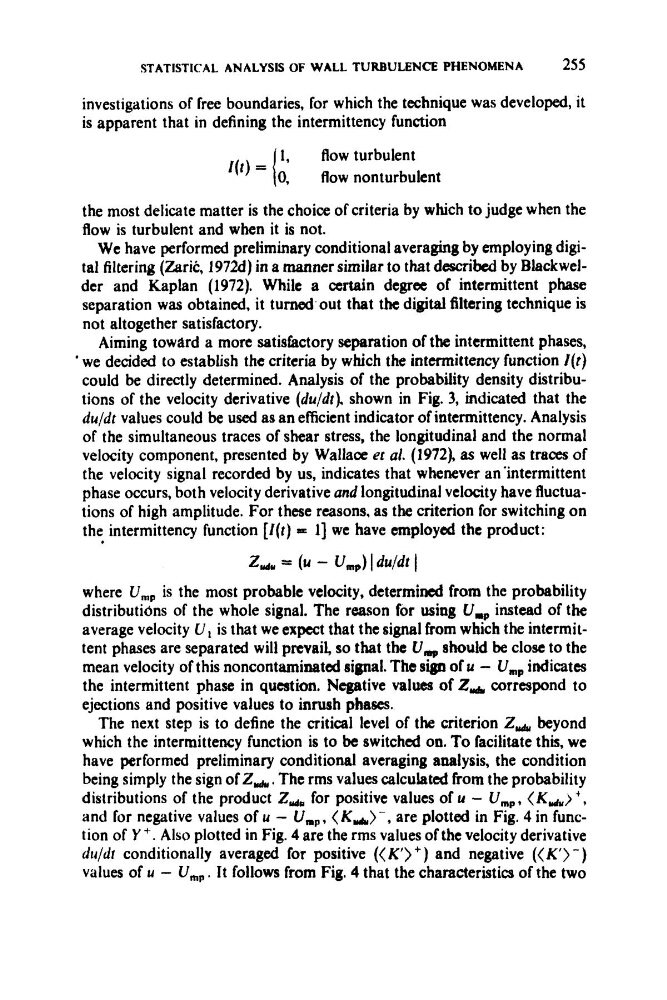
is apparent that in defining the intermittency function
flow turbulent
'(') = 1
;
: flow nonturbulent
the most delicate matter is the choice of criteria by which to judge when the
flow is turbulent and when it is not.
We have performed preliminary conditional averaging by employing digital filtering (zclric, 1972d) in a manner similar to that described by Blackwelder and Kaplan (1972). While a certain degree of intermittent phase
separation was obtained, it turned out that the digital filtering technique is
not altogether satisfactory.
Aiming toward a more satisfactory separation of the intermittent phases,
' we decided to establish the criteria by which the intermittency function I(?)
could be directly determined. Analysis of the probability density distributions of the velocity derivative (duldr), shown in Fig. 3, indicated that the
du/dr values could be used as an efficient indicator of interrnittency. Analysis
of the simultaneous traces of shear stress, the longitudinal and the normal
velocity component, presented by Wallace er al. (1972) as well as traces of
the velocity signal recorded by us, indicates that whenever an'intermittent
phase occurs, both velocity derivative and longitudinal velocity have fluctuations of high amplitude. For these reasons, as the criterion for switching on
the intermittency function [ l ( t ) = 11 we have employed the product:
z,, = (u - U,) I du/dt 1
where U,, is the most probabk velocity, determined from the probability
distributidns of the whole signal. The reason for using U , instead of the
average velocity U , is that we expect that the signal from which the intermittent phases are separated will prevail, so that the U- should be close to the
mean velocity of this noncontminatcd signal. The slga of u - Urn, indicates
the intermittent phase in question. Negative values of Z,,,,,, correspond to
ejections and positive values to inrush phases.
The next step is to define the critical level of the criterion Zudu beyond
which the intermittency function is to bc switched on. To facilitate this, we
have performed preliminary conditional averaging analysis, the condition
being simply the sign of Zdu. The rms values calculated from the probability
distributions of the product ZdD for positive values of u - U,, , ( K d u ) ',
and for negative values of u - Urn,,, (K,,,,,)-, are plotted in Fig. 4 in funct ion of Y' . Also plotted in Fig. 4 are the rms values of the velocity derivative
du/dr conditionally averaged for positive ((K')') and negative ( ( K ' ) - )
values of u - U,, . It follows from Fig. 4 that the characteristics of the two
255
investigations of free boundaries, for which the technique was developed, it
is apparent that in defining the intermittency function
flow turbulent
'(') = 1
;
: flow nonturbulent
the most delicate matter is the choice of criteria by which to judge when the
flow is turbulent and when it is not.
We have performed preliminary conditional averaging by employing digital filtering (zclric, 1972d) in a manner similar to that described by Blackwelder and Kaplan (1972). While a certain degree of intermittent phase
separation was obtained, it turned out that the digital filtering technique is
not altogether satisfactory.
Aiming toward a more satisfactory separation of the intermittent phases,
' we decided to establish the criteria by which the intermittency function I(?)
could be directly determined. Analysis of the probability density distributions of the velocity derivative (duldr), shown in Fig. 3, indicated that the
du/dr values could be used as an efficient indicator of interrnittency. Analysis
of the simultaneous traces of shear stress, the longitudinal and the normal
velocity component, presented by Wallace er al. (1972) as well as traces of
the velocity signal recorded by us, indicates that whenever an'intermittent
phase occurs, both velocity derivative and longitudinal velocity have fluctuations of high amplitude. For these reasons, as the criterion for switching on
the intermittency function [ l ( t ) = 11 we have employed the product:
z,, = (u - U,) I du/dt 1
where U,, is the most probabk velocity, determined from the probability
distributidns of the whole signal. The reason for using U , instead of the
average velocity U , is that we expect that the signal from which the intermittent phases are separated will prevail, so that the U- should be close to the
mean velocity of this noncontminatcd signal. The slga of u - Urn, indicates
the intermittent phase in question. Negative values of Z,,,,,, correspond to
ejections and positive values to inrush phases.
The next step is to define the critical level of the criterion Zudu beyond
which the intermittency function is to bc switched on. To facilitate this, we
have performed preliminary conditional averaging analysis, the condition
being simply the sign of Zdu. The rms values calculated from the probability
distributions of the product ZdD for positive values of u - U,, , ( K d u ) ',
and for negative values of u - Urn,,, (K,,,,,)-, are plotted in Fig. 4 in funct ion of Y' . Also plotted in Fig. 4 are the rms values of the velocity derivative
du/dr conditionally averaged for positive ((K')') and negative ( ( K ' ) - )
values of u - U,, . It follows from Fig. 4 that the characteristics of the two