

21%
1'. 1. S1II.L.IVAN
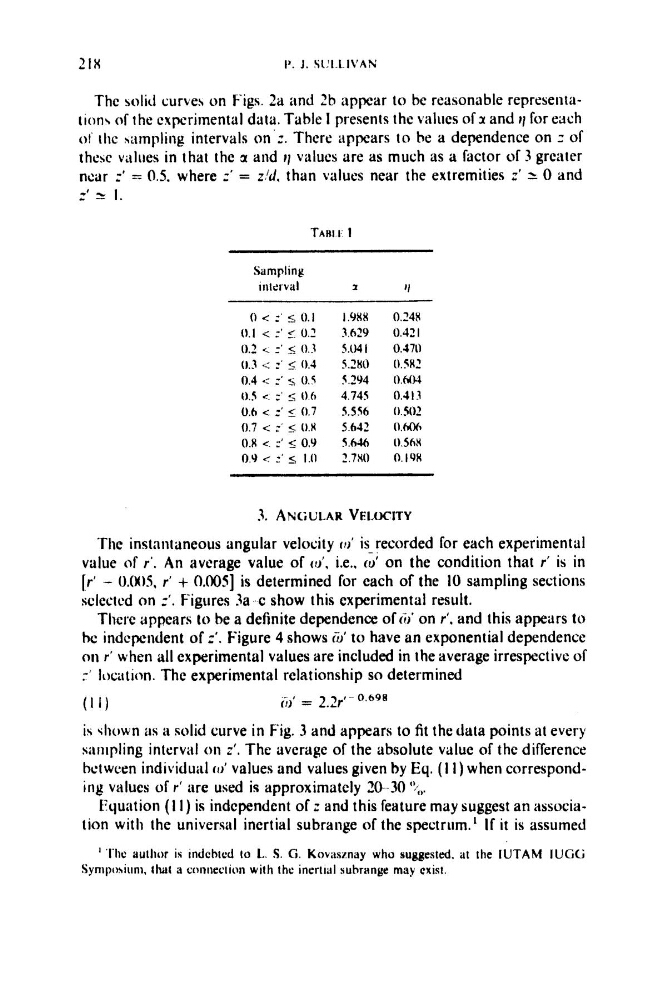
The solid curves on Figs. Za and ?ti appear to be reasonable representation\ of the cvperiinental data. Table 1 presents the valiies of2 and 11 for each
ot itrc hiimpling intervals on : . Thcre appears to be a dependence on z of
thew values in that the z and values are as much as a factor of 3 greater
ncar z' = 0.5. where : ' = z'd, than values near the extremities z' 0 and
f -z I.
TAHII I
Sampling
intrival
0 < :
'
5 0.1
0.1 < :
' c 0.2
0.2 < :
' r-: 0 . 3
0.3 < z' 5 0.4
0.4 < z' s 0.5
0.5 c. :
'
5 0.6
0.6 < : ' 5 0.7
0.7 < :
' < 0.X
0 . N c. : ' < 0.9
0.9 c I" 5 1.(1
31
I .9xx
3.629
5.04 I
5.210
5.294
4.745
5.556
5.641
5.646
2.7XO
3. ANGULAR VEl.OCITY
The instantaneous angular velocity (1)' is recorded for each experimental
value of r'. An avcrage value of d, i.e., to; on the condition that r' is in
[r' - O.OUS, r' + O.OOS] is determined for each of the 10 sampling sections
sclectcd on :' . Figures 3a-.c show this experimental result.
There appears to be a definite dependence of 6)' on r', and this appears to
hc indcpcndent of z'. Figure 4 shows 0' to have an exponential dependence
on r' when all experimental values are included in the average irrespective of
.-' location. The experimental relationship so determined
( 1 1 )
is shown ;IS a solid curve in Fig. 3 and appears to fit the data points at every
siiilipling interval on 2'. The average of the absolute value of the difference
bctwcen individual w' values and values given by Eq. ( I 1 ) when corresponding values of r' are used is approximately ?@-30 ' !;,.
Equation ( I I ) is independent of z and this feature may suggest an association with the universal inertial subrange of the spectrum.' If it is assumed
' '1110 autlior is indchtcd to L. S. Cl. Kovasznay who suggested, at the IUTAM IUGG
; ; , , = 2.?,.1-- 0.69R
Synipoxiiini, that a coiineciioii with thc inertial suhranye may exist.
1'. 1. S1II.L.IVAN
The solid curves on Figs. Za and ?ti appear to be reasonable representation\ of the cvperiinental data. Table 1 presents the valiies of2 and 11 for each
ot itrc hiimpling intervals on : . Thcre appears to be a dependence on z of
thew values in that the z and values are as much as a factor of 3 greater
ncar z' = 0.5. where : ' = z'd, than values near the extremities z' 0 and
f -z I.
TAHII I
Sampling
intrival
0 < :
'
5 0.1
0.1 < :
' c 0.2
0.2 < :
' r-: 0 . 3
0.3 < z' 5 0.4
0.4 < z' s 0.5
0.5 c. :
'
5 0.6
0.6 < : ' 5 0.7
0.7 < :
' < 0.X
0 . N c. : ' < 0.9
0.9 c I" 5 1.(1
31
I .9xx
3.629
5.04 I
5.210
5.294
4.745
5.556
5.641
5.646
2.7XO
3. ANGULAR VEl.OCITY
The instantaneous angular velocity (1)' is recorded for each experimental
value of r'. An avcrage value of d, i.e., to; on the condition that r' is in
[r' - O.OUS, r' + O.OOS] is determined for each of the 10 sampling sections
sclectcd on :' . Figures 3a-.c show this experimental result.
There appears to be a definite dependence of 6)' on r', and this appears to
hc indcpcndent of z'. Figure 4 shows 0' to have an exponential dependence
on r' when all experimental values are included in the average irrespective of
.-' location. The experimental relationship so determined
( 1 1 )
is shown ;IS a solid curve in Fig. 3 and appears to fit the data points at every
siiilipling interval on 2'. The average of the absolute value of the difference
bctwcen individual w' values and values given by Eq. ( I 1 ) when corresponding values of r' are used is approximately ?@-30 ' !;,.
Equation ( I I ) is independent of z and this feature may suggest an association with the universal inertial subrange of the spectrum.' If it is assumed
' '1110 autlior is indchtcd to L. S. Cl. Kovasznay who suggested, at the IUTAM IUGG
; ; , , = 2.?,.1-- 0.69R
Synipoxiiini, that a coiineciioii with thc inertial suhranye may exist.