

210
J . C’. W\”<;AARl)
El’ A[..
l o
t
c
t i
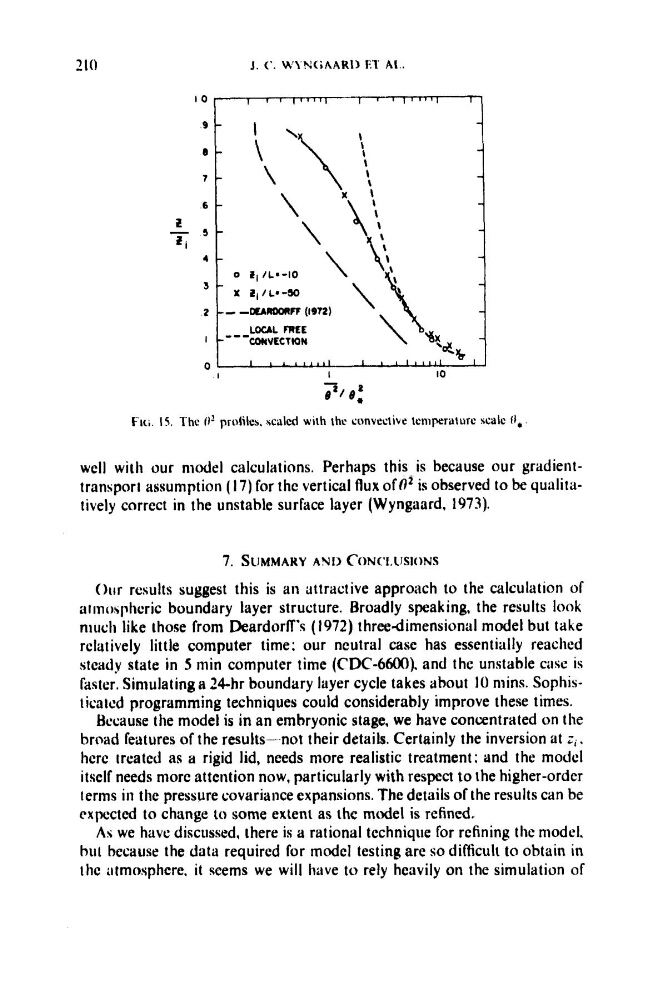
FIG. I S . The 0’ protilcs, scald with the convective tcmprilturc acale I),
well with our niodel calculations. Perhaps this is because our gradienttransport assumption ( 1 7) for thc vertical flux of02 is observed to be qualitatively corrcct in the unstable surface layer (Wyngaard, 1973).
7. SLIMMAKY AND CONCI.LISIONS
O u r results suggest this is an attractive approitch to the calculation of
atmospheric boundary layer structure. Broadly speaking, the results look
niucli like those from Deardorff’s ( 1972) threedimensional model but take
relatively little computer time; our ncutral case has essentially reached
stcady stale in 5 niin computer time (CDC-6600). and the unstable ciise is
faster. Simulating a 24-hr boundary layer cycle takes about 10 mins. Sophist icalcd programming techniques could considerably improve these times.
Because the model is in an embryonic stage, we have concentrated on the
broed features of the results- not their details. Certainly the inversion at z,,
licrc treatcd as a rigid lid, needs more realistic treatment: and the model
itself needs morc attention now, particularly with respect to the higher-order
terms in the pressure covariance expansions. The details of the results can be
expected to change to some extent as the model is refined.
As we have discussed, there is a rational technique for refining the model.
htil because the data required for model testing are so difficult to obtain in
ihe iitmosphere, it seems we will have t o rely hcavily on the simulation of
J . C’. W\”<;AARl)
El’ A[..
l o
t
c
t i
FIG. I S . The 0’ protilcs, scald with the convective tcmprilturc acale I),
well with our niodel calculations. Perhaps this is because our gradienttransport assumption ( 1 7) for thc vertical flux of02 is observed to be qualitatively corrcct in the unstable surface layer (Wyngaard, 1973).
7. SLIMMAKY AND CONCI.LISIONS
O u r results suggest this is an attractive approitch to the calculation of
atmospheric boundary layer structure. Broadly speaking, the results look
niucli like those from Deardorff’s ( 1972) threedimensional model but take
relatively little computer time; our ncutral case has essentially reached
stcady stale in 5 niin computer time (CDC-6600). and the unstable ciise is
faster. Simulating a 24-hr boundary layer cycle takes about 10 mins. Sophist icalcd programming techniques could considerably improve these times.
Because the model is in an embryonic stage, we have concentrated on the
broed features of the results- not their details. Certainly the inversion at z,,
licrc treatcd as a rigid lid, needs more realistic treatment: and the model
itself needs morc attention now, particularly with respect to the higher-order
terms in the pressure covariance expansions. The details of the results can be
expected to change to some extent as the model is refined.
As we have discussed, there is a rational technique for refining the model.
htil because the data required for model testing are so difficult to obtain in
ihe iitmosphere, it seems we will have t o rely hcavily on the simulation of