

( z = 31) in tor our standard conditions). Note that the L'-profile is logarithmic until it first reaches Ll, . Thc integral constraint
shows LI must overshoot L', .
Most previous models of the boundary layer have used eddydifhivity
models (see Estoque. 1973, for a review) in which stresses in the LI and V
equations, for example, are replaced by
(27)
= - K , i?L'/cz, ~ * \ y
= - K , ? C:/cz
.01
.02
I03
.04
2
K f / u,
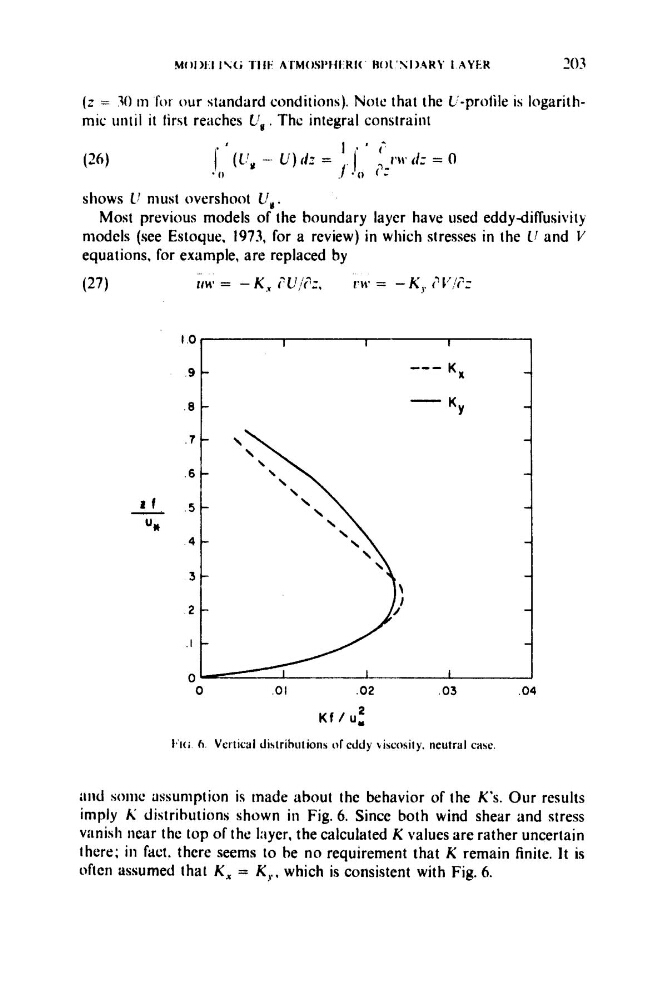
l k h Vertical distrihutionr of eddy circosity. neutral case.
;iritl sonic assumption is made about the behavior of the K's. Our results
imply K distributions shown in Fig. 6. Since both wind shear and stress
vanish near thc top of the layer, the calculated K values are rather uncertain
there; in fact, there seems to be no requirement that K remain finite. It is
oftcri assumed that K, = K , , which is consistent with Fig. 6.
shows LI must overshoot L', .
Most previous models of the boundary layer have used eddydifhivity
models (see Estoque. 1973, for a review) in which stresses in the LI and V
equations, for example, are replaced by
(27)
= - K , i?L'/cz, ~ * \ y
= - K , ? C:/cz
.01
.02
I03
.04
2
K f / u,
l k h Vertical distrihutionr of eddy circosity. neutral case.
;iritl sonic assumption is made about the behavior of the K's. Our results
imply K distributions shown in Fig. 6. Since both wind shear and stress
vanish near thc top of the layer, the calculated K values are rather uncertain
there; in fact, there seems to be no requirement that K remain finite. It is
oftcri assumed that K, = K , , which is consistent with Fig. 6.